
Hair Breakage Causes: Why Your Hair Is Snapping (and How to Stop It)
The best fix for hair breakage is not a product - it is a routine change. Heat is the one cause all five top pages agree on, and split ends cannot be reattached: the only fix is a trim. No top-five page is a full guide - one is a brand shop, one is three paragraphs long, and the oldest is from 2019.
By the end of this guide, you will know whether your hair is breaking or shedding, which cause fits your hair type, the prevention routine in order, which products to use and avoid, and when to see a doctor.
As an Amazon Associate I earn from qualifying purchases.
In a hurry? See the current price on Amazon.

Photo: a botanical Christmas candle — one of the simplest cozy gifts that always works.
As an Amazon Associate I earn from qualifying purchases. This guide contains affiliate links — it costs you nothing extra and keeps our content free.
Hair breakage looks simple - hair snaps, you buy a product. The search results say otherwise. The most-asked questions are how do I stop my hair from breaking, what vitamin deficiencies cause it, can hair grow back after breakage, and what is my body lacking - and not one of the top five pages answers all four, because none of them is a full guide. This guide answers all four questions first, then gives the routine that actually stops the snapping.
Most hair pages either list causes or sell you one brand's products. This one answers a single question - why is my hair breaking - with the evidence that matters: the breakage-vs-shedding test, causes by hair type, heat and chemical damage in depth, a prevention routine in order, a neutral list of products to use and avoid, scalp health, and the doctor checklist. Every claim below is marked with where it comes from: the live top five pages we read in full. We did not test these products, and this guide does not pretend otherwise. Check the live price on the product page before you order - prices move constantly, so we do not print them here.
Hair breakage means your hair is snapping along the lengths and ends, not falling out from the root — and the fix is usually a routine change, not a new product. The top five pages on Google all list causes, but none of them is a full guide: one is a brand shop, one is three paragraphs long, and the oldest is from 2019 with no FAQ. This guide fills those gaps — the breakage-vs-shedding test, causes by hair type, a prevention routine in order, a neutral use-and-avoid list, and when to see a doctor.
Key takeaways
- Breakage snaps mid-shaft; shedding leaves the root. A shed hair has a little white bulb — a broken one does not.
- Heat is the one cause all five top pages agree on. Lower the temperature before you buy anything new.
- Split ends cannot be reattached. The only fix is a trim — everything else is prevention.
- Fine hair, curly hair, bleached hair and aging hair break for different reasons. One routine does not fit all four.
- See a doctor if breakage comes with shedding, bald patches, or fatigue — thyroid and iron problems are real causes, not hair-care failures.
Quick verdict
If your hair is breaking, start with three changes and give them four weeks: stop brushing wet hair with a fine-tooth brush, turn the heat down, and sleep on silk or satin. Those three cover the causes that appear in almost every top-five page — heat damage, rough wet handling, and overnight friction. If the breakage is still getting worse after a month, or if you are also shedding a lot of hair from the root, that is the point to see a doctor, not to buy a stronger product. Breakage from habits is fixable. Breakage from a medical cause is not a hair-care problem, and no shampoo will solve it.
What this guide does differently: every top-five page we read lists causes, but none of them gives you a way to tell breakage from shedding, a cause list by hair type, a routine in the right order, or a neutral list of ingredients to use and avoid. Two of the five are brand shops in disguise — Wella and Nexxus recommend only their own lines. One, a salon blog, is three paragraphs long. The oldest, Medical News Today, is from 2019 and has no FAQ. This guide uses their agreed facts, names where each fact comes from, and adds the ten things none of them covers.
How we picked these
We read the top five pages for "hair breakage causes" on Google US in full — Healthline (updated May 13, 2026), Wella Professionals (July 14, 2026), Nexxus, a salon blog called Make Me Fab, and Medical News Today (April 25, 2019). We counted which causes each page names, checked which claims appear in more than one source, and listed the ten gaps none of them covers. A cause counts as agreed when at least three of the five name it. A product or tool counts as a pick only when it answers a cause the pages agree on — heat, wet handling, friction, or dryness — and when it is not tied to one brand's marketing claims. We did not test these products, and this guide does not pretend otherwise. Brand claims quoted here, such as Wella's "99% less breakage" or Nexxus's "up to 97% less hair loss from breakage," are the brands' own figures, not measurements we made. Check the live price on the product page before you order — prices move constantly, so we do not print them here.
At a glance: the best hair breakage causes
The five pages agree on seven causes more than any others. Heat damage is the only one all five name. Chemical over-processing, diet, brushing, towel drying, tight hairstyles and skipped trims each appear in four of the five. Stress, dryness, thyroid problems and eating disorders appear in three. That agreement is the spine of this guide — everything below starts from it, and the gaps section adds what the pages left out.
| Cause | Pages naming it | What it does | First fix |
|---|---|---|---|
| Heat damage | 5 of 5 | Weakens the shaft, dries the cuticle, snaps ends | Lower the temperature, always use a protectant |
| Chemical over-processing | 4 of 5 | Color, bleach, perm and relaxer strip structure | Space services 8–10 weeks apart |
| Diet and nutrition | 4 of 5 | Low iron, zinc, biotin, protein or vitamin D weakens new growth | Eat for protein and iron first, supplement only on a doctor's advice |
| Brushing and combing | 4 of 5 | Wet hair stretches and snaps under a fine brush | Wide-tooth comb, start at the ends |
| Towel drying | 4 of 5 | Rough rubbing frays the cuticle | Press and squeeze, or use a microfiber towel |
| Tight hairstyles | 4 of 5 | Constant tension snaps hair at the tie and the hairline | Looser styles, silk ties, vary the part |
| Skipped trims | 4 of 5 | Split ends travel up the shaft and snap higher | Trim every 6–12 weeks, sooner for bleached hair |
Breakage vs shedding vs hair loss
This is the single most useful section in the guide, and it is the one no top-five page does properly. Breakage, shedding and hair loss are three different things, and they need three different responses. Breakage is hair snapping along the shaft — the strand breaks in the middle or at the end, and the root stays in your scalp. Shedding is hair leaving from the root at the end of its normal growth cycle. Hair loss is shedding or thinning beyond the normal range, or hair that does not grow back.
The test is simple, and Nexxus gives the clearest version of it in the top five: look at the hair you find. A shed hair has a little white bulb at one end — that is the root. A broken hair has no bulb. It is shorter than the rest of your hair, and the end looks frayed or split. If most of what you find on your pillow and in the shower has no bulb and is shorter than your hair length, you have breakage. If most of it has a bulb and is full length, you have shedding. Wella puts normal shedding at 50 to 100 hairs a day — if you are losing far more than that, or you can see your scalp where you could not before, that is hair loss, and the next step is a doctor, not a product.
| Sign | Breakage | Shedding | Hair loss |
|---|---|---|---|
| What the hair looks like | Short pieces, frayed or split ends, no root bulb | Full-length strands with a small white bulb | Full-length strands, many more than usual, or visible thinning |
| Where you find it | On clothes, in the brush, on the pillow | In the shower drain, on the pillow, in the brush | Everywhere, plus a widening part or bald patches |
| Main cause | Heat, chemicals, rough handling, friction | Normal cycle, stress, seasonal change, hormones | Medical causes, hormones, medication, traction |
| First response | Change the routine — heat, tools, sleep | Wait and watch for a few weeks | See a doctor, and stop tight styles now |
One warning from Medical News Today deserves repeating: tight hairstyles can cause traction alopecia — hair loss from constant pulling. It starts as breakage and thinning at the hairline and can become permanent if the pulling goes on for years. If your edges are thinning and you wear tight ponytails, braids or extensions every day, loosening the style is not cosmetic advice. It is the treatment.
Causes by hair type
No top-five page gives causes by hair type as a system. The fragments are scattered: Nexxus covers thin and fine hair, Make Me Fab covers curly and aging hair in two sentences, and Medical News Today says breakage "affects all types of hair from straight to curly" and stops there. That is not enough, because the same habit breaks different hair in different places.
Fine hair. Nexxus says thin hair is the most prone to breakage — about ten times more than thick hair — and that fine hair has a smaller core, a thinner cuticle and about 50% less protein than thick hair. The practical meaning is that fine hair snaps under loads thick hair shrugs off: the same tight ponytail, the same flat iron pass, the same rough towel. Fine hair needs the lightest touch — loose styles, low heat, and no heavy oils that drag the strand down and pull at the root.
Curly and coily hair. Make Me Fab gives the one good line in the top five: scalp oil cannot travel the full length of a curly shaft, so the ends stay drier than the roots, and tighter curls and coils are more susceptible. The breakage point is usually the ends and the crown, where the curl bends hardest. The fix is moisture first and detangling only when the hair is damp and conditioned, with fingers or a wide-tooth comb, never a brush on dry curls.
Bleached and color-treated hair. No top-five page has a bleached-hair section at all — bleach appears only as one line inside chemical processing. That is a real gap, because bleached hair is the most fragile hair in the room: the cuticle is lifted, the protein is depleted, and heat that healthy hair tolerates will snap bleached hair. If your hair is bleached, the rules change — heat protectant is not optional, trims come sooner, and bleach plus a flat iron on the same day is the single most damaging combination in this guide.
Aging and gray hair. Make Me Fab notes that aging and gray hair is coarser, resists moisture and has lost elasticity. Less elasticity means the strand stretches less before it snaps, so the same brushing that was fine at thirty breaks hair at sixty. The fix is gentler handling and more moisture, not stronger products.
Thick hair. Thick hair breaks less often, but when it does it is usually from heat and weight — long, thick hair holds more water, takes longer to dry, and gets more heat exposure per wash. The fix is drying in sections and never going to bed with wet, thick hair twisted up.

Heat and chemical damage
Heat is the one cause all five pages agree on, and it is also the one they cover least deeply. None of them gives tool temperatures or a heat routine. The damage works like this: a flat iron or curling iron at full heat boils the water inside the hair shaft, which cracks the cuticle from the inside. A blow-dryer at close range does the same thing more slowly. The result is the same — dry, rough, snapping ends that no conditioner can glue back together.
What actually helps: turn the tool down before you buy anything. Fine and bleached hair needs the lowest setting your tool offers. Always use a heat protectant — every page that mentions heat mentions a protectant, and it is the cheapest prevention in this guide. Keep the tool moving and never pass the same section twice. Let hair air-dry most of the way before the blow-dryer touches it, and never flat-iron damp hair. UV counts too — Wella is the only page that names sun damage, and it is right: long sun exposure dries the cuticle the same way heat does, so a hat or a UV spray on long summer days is real prevention, not vanity.
Chemical damage works differently: color, bleach, perm and relaxer change the hair's structure, and each service leaves the strand weaker than before. Healthline is the only page that gives a spacing number — 8 to 10 weeks between chemical sessions — and that number is worth keeping. Stacking bleach on bleach, or a relaxer on freshly colored hair, is how hair starts snapping at the roots. Chlorine and hard water belong here too: only Medical News Today and Healthline mention swim care in passing, and neither treats it as a cause. Chlorine dries the cuticle and hard water leaves mineral buildup that makes hair stiff and brittle. A swim cap and a rinse with fresh water after swimming are the whole fix.
The prevention routine
No top-five page gives a routine. They give scattered tips — a tip about towels here, a tip about pillowcases there. A routine is what makes the tips stick, because breakage is a sequence: what you do in the shower decides what happens on the pillow. Here is the order, wash day first.
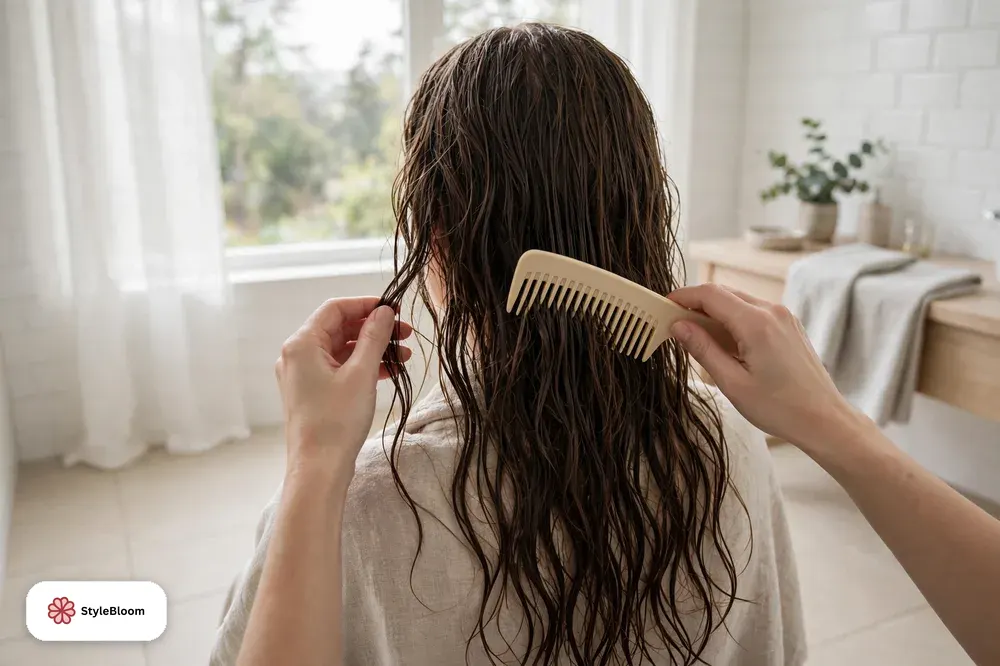
Wash day. Wash with lukewarm water, not hot. Shampoo the scalp, not the lengths — the lengths get clean from the rinse running down. Condition every wash, and leave the conditioner in for two to three minutes. Detangle while the conditioner is in, with a wide-tooth comb, starting at the ends and working up. Rinse with cool water. Never wring your hair. Press it with a microfiber towel or an old cotton T-shirt and let it air-dry most of the way.
Daily. Brush dry hair only, gently, with a brush that does not snag — Healthline recommends a natural-bristle brush, and several pages recommend a wide-tooth comb. Vary your part and your ponytail position so the same strands are not pulled every day. Keep styles loose. If you use heat, use a protectant every single time, no exceptions, and keep the tool moving.
Weekly. One deep-conditioning mask a week if your hair is dry, bleached or curly. Check your ends in good light — if they look white at the tips or feel rough, they are splitting, and a trim is due. Clean your brush and your pillowcase; product buildup on both transfers back to your hair.
Overnight. This is the cheapest prevention in the guide and the one Wella and Nexxus both name: sleep on silk or satin, or wear a satin bonnet. Cotton pillowcases grip the hair and rub it all night; silk lets it slide. A loose braid or a low, loose bun beats a tight ponytail. Never sleep with wet hair tied up — wet hair stretches, and a tight tie on wet hair is a snap waiting to happen.
Trims. The pages disagree on timing — Wella says every 6 to 8 weeks, Nexxus says at least every 12 weeks — and both are right for different hair. The rule is the ends, not the calendar: bleached and fine hair needs the shorter interval, healthy thick hair can go longer. The point the pages agree on is that split ends travel up the shaft. A small trim now prevents a big cut later.
If breakage is only part of your hair story, the next guides to read are the ones that cover the rest of it: our organic hair oil guide for which oil fits which hair type, our best hair growth shampoo guide if shedding worries you more than snapping, our curly hair wash routine for wash-day order that protects curls, our best satin bonnet for sleeping for the overnight half of this routine, and our best hair serum for frizzy hair for the moisture step that keeps ends from drying out.
Products to use and avoid
No top-five page gives a neutral ingredient list. The only product guidance is brand-led — Wella's Ultimate Repair line, Nexxus's Unbreakable Care line — or generic, like "use a conditioner" and "use a heat protectant." That leaves the reader with no way to judge a product that is not one of those two brands. Here is the neutral version.
Use. A heat protectant before any hot tool — this is the single most agreed product in the top five. A conditioner every wash, and a leave-in conditioner or a hair mask if your hair is dry, bleached or curly. A gentle, sulfate-free shampoo if your scalp is dry or your hair is color-treated. A wide-tooth comb and a microfiber towel, which are tools, not products, and which do more for breakage than most bottles. A silk or satin pillowcase, which Wella and Nexxus both name.
Avoid. Harsh, alkaline shampoos — Medical News Today is the only page that mentions pH, and it recommends a neutral-pH shampoo. Drying alcohols in styling products, which strip moisture from already-dry ends. Heavy oils on fine hair, which drag the strand and pull at the root. Protein overload: protein treatments help damaged hair, but too much protein makes hair stiff and brittle, and stiff hair snaps. If your hair feels straw-like after a protein treatment, stop the protein and add moisture. And skip the miracle claims — no shampoo, oil or serum can reattach a split end. Wella says it plainly: split and snapped ends cannot be repaired, only cut.
What about vitamins? Healthline, Medical News Today and Nexxus all list diet and nutrition as a cause — iron, zinc, biotin, protein and vitamin D. The honest version is that a deficiency can weaken new growth, but a supplement will not fix breakage caused by heat or handling, and it will not work overnight. Eat for protein and iron first. Take a supplement only if a doctor has found a deficiency, because the dose and the cause both matter, and guessing at both wastes money.
Scalp health
Scalp health is almost entirely missing from the top five. Only Make Me Fab mentions it, in one sentence about fungi and folliculitis. No page covers dandruff, seborrheic dermatitis, scalp dryness, or a scalp-care routine. That matters, because hair grows from the scalp, and an unhealthy scalp grows weak hair.
The signs are easy to miss: itching that does not stop, flakes that do not go away with a normal shampoo, redness, soreness, or pimples along the hairline. Dandruff and seborrheic dermatitis dry the scalp and the hair at the root. A dry, tight scalp needs moisture and gentleness, not more scrubbing. A medicated shampoo helps dandruff; a doctor helps anything that does not improve in two to three weeks. Do not scratch an itchy scalp with your nails or a fine comb — that breaks the hair at the root and opens the skin. And keep hot water off the scalp: hot water strips the scalp's oils the same way it strips the hair's.
When to see a doctor
Three of the five pages name thyroid problems and eating disorders as causes, and all three say the same thing: see a doctor. None of them gives a checklist for when, or what to ask. Here is the checklist.
Go soon if: you are shedding far more than 100 hairs a day for more than a few weeks; you can see bald patches or a widening part; your hairline is receding and you wear tight styles; the breakage started suddenly after a new medication, an illness, or a big weight change; or the breakage comes with fatigue, weight gain, feeling cold all the time, or a low mood — those last four are the thyroid symptoms Healthline lists, and they need a blood test, not a shampoo.
What to ask for. A dermatologist is the right first stop for hair and scalp problems; a trichologist is a hair specialist, and the salon blog's trichologist referral is the one useful thing in that thin page. Ask about blood work for iron, ferritin, vitamin D, vitamin B12 and thyroid function. Bring a list of medications — several common ones list hair shedding as a side effect. Mention pregnancy, postpartum or menopause, because hormonal shifts change shedding for months. And if eating is part of the picture, say so: disordered eating is a medical cause, and the right help is a healthcare professional, not a hair product.
What a doctor will not do. A doctor will not fix broken ends. No medicine reattaches a split end. What a doctor can do is find the cause behind the breakage — iron deficiency, thyroid, hormones, medication, a scalp condition — and treat that, so the new hair grows in stronger. The routine in this guide handles the breakage; the doctor handles the cause.

The five tools that help most
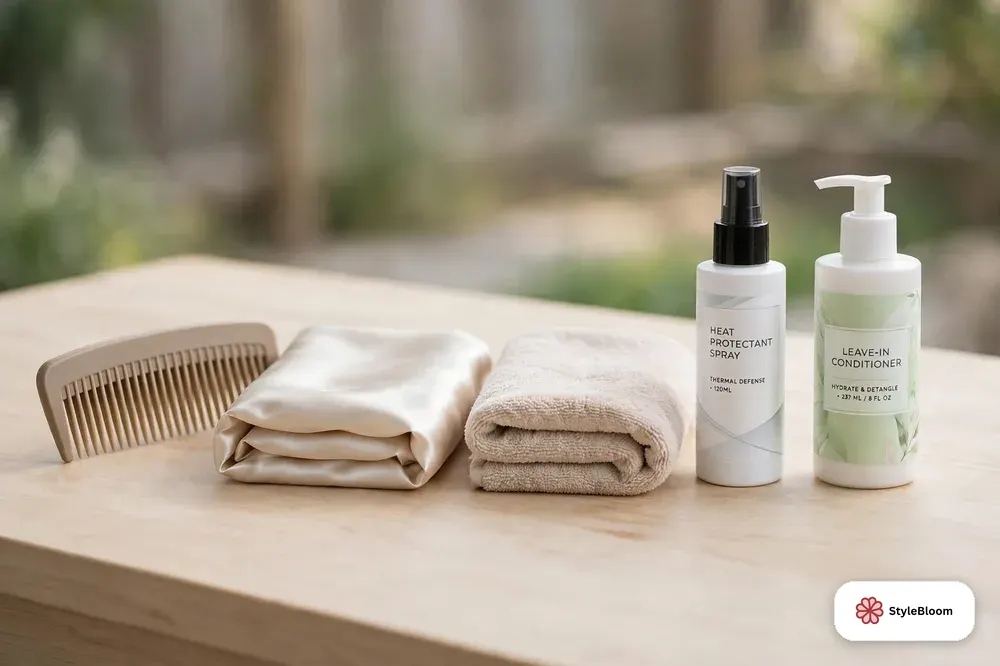
These five picks are tools, not miracle products. Each one answers a cause the top five pages agree on, and none of them depends on one brand's marketing. The links below go to Amazon search results so you can compare options and prices yourself.
1. Silk Pillowcase — best overall. Best for: anyone who wakes up with tangled, snapped hair. Cotton grips and rubs all night; silk lets the hair slide. It is the cheapest overnight fix in this guide, and the one Wella and Nexxus both name. See silk pillowcases on Amazon.
2. Microfiber Hair Towel — best for wet hair. Best for: anyone who rubs their hair dry with a bath towel. A microfiber towel absorbs water without the rough friction that frays the cuticle. Press and squeeze, do not rub. See microfiber hair towels on Amazon.
3. Wide-Tooth Comb — best for detangling. Best for: curly, long or easily tangled hair. A wide-tooth comb detangles without snapping, and it works best on damp, conditioned hair, starting at the ends. Four of the five top pages recommend it or warn against the wrong brush. See wide-tooth combs on Amazon.
4. Heat Protectant Spray — best for heat styling. Best for: anyone who blow-dries, straightens or curls. Every page that mentions heat mentions a protectant, and it is the one product the pages agree on. Use it every time, on every section, before the tool touches the hair. See heat protectant sprays on Amazon.
5. Leave-In Conditioner — best for moisture. Best for: dry, bleached or curly hair. A leave-in conditioner adds the moisture that heat and chemicals strip away, and it makes detangling easier, which means less snapping. See leave-in conditioners on Amazon.
Five more tools that fit the same logic: a satin bonnet for overnight protection (satin bonnets on Amazon), silk scrunchies that do not crease or snap the hair (silk scrunchies on Amazon), a claw clip for loose updos (claw clips on Amazon), a sulfate-free shampoo for dry or color-treated hair (sulfate-free shampoos on Amazon), and a deep-conditioning hair mask for weekly repair (hair masks on Amazon).
Who should skip this
Skip this guide's product advice if your breakage started suddenly with heavy shedding, bald patches, or the medical symptoms in the doctor section — that is a medical question, and the routine here will not answer it. Skip the heat and chemical sections if you never use heat and never color your hair; your cause is more likely handling, friction or nutrition, so start with the routine and the hair-type section instead. And skip any product that promises to repair split ends. Split ends cannot be repaired. The honest spend is a trim and a silk pillowcase, not a serum with a miracle claim.
Red flags
Red flag 1: a product that claims to repair split ends. No product can reattach a split end. The claim is false, and the money is better spent on a trim.
Red flag 2: a guide that recommends only one brand. Two of the top five pages do this. A brand shop is not advice. If every recommendation on a page is the same brand, the page is an advertisement.
Red flag 3: breakage plus shedding plus symptoms. Breakage alone is usually a routine problem. Breakage with heavy shedding, bald patches, fatigue, weight change or a low mood is a medical problem. Do not shop your way past it.
Red flag 4: the same tight style every day. If your edges are thinning and you wear the same tight ponytail or braids daily, the style is the cause. Traction alopecia starts as breakage and can become permanent.
How-to-buy checklist
Before you buy anything for breakage, run this checklist. First, do the bulb test: if most of what you find has no root bulb, you have breakage and the routine is the fix. Second, check your heat: if you use a hot tool, a protectant and a lower setting come before any new product. Third, check your sleep: a silk pillowcase or a satin bonnet costs less than most serums and works every night. Fourth, check your ends: if they are split, book a trim — no product replaces it. Fifth, check your scalp: itching, flakes or soreness that last more than two weeks need a doctor, not a shampoo. Sixth, check the label: neutral pH, no drying alcohols, and no promise to repair split ends. If a product fails that last check, skip it.
What to try first: Do the bulb test tonight, then change three things this week - a wide-tooth comb on damp hair, a lower heat setting with a protectant, and silk or satin at night. Good looks like: fewer short pieces on your pillow in four weeks, and ends that feel smooth instead of rough. If it fails: the cause is probably medical or chemical, not handling - re-read the doctor section. Learn next: Organic Hair Oil - which oil fits which hair type, and how to use it without weighing fine hair down.
Frequently asked questions
- How do I stop my hair from breaking?
- Lower the heat, always use a protectant, detangle damp conditioned hair with a wide-tooth comb, stop rubbing with a bath towel, loosen tight styles, and sleep on silk or satin. Give the routine four weeks before judging it — hair does not heal overnight, and the new growth is what shows the change.
- What vitamin deficiencies cause hair breakage?
- Iron, zinc, biotin, protein and vitamin D are the ones the top pages name. A deficiency can weaken new growth, but a supplement will not fix breakage caused by heat or handling. Eat for protein and iron first, and take a supplement only if a doctor has found a deficiency.
- Can hair grow back after breakage?
- Yes — breakage does not damage the follicle, so the hair grows back. What does not grow back is the broken length: the snapped ends are gone, and only a trim removes the split. New growth is healthy if the cause is fixed; if the cause continues, the new hair breaks the same way.
- What is my body lacking if my hair keeps breaking?
- It may be nothing at all — most breakage is caused by heat, chemicals and handling, not by a deficiency. If the breakage comes with shedding, fatigue, weight change or a low mood, ask a doctor about iron, ferritin, vitamin D, vitamin B12 and thyroid function. Do not guess at supplements.
- Is my hair breaking or shedding?
- Look for the root bulb. A shed hair has a little white bulb at the end; a broken hair has no bulb and is shorter than the rest of your hair, with a frayed or split end. Most hair with a bulb means shedding. Most hair without a bulb means breakage.
- Does heat styling cause hair breakage?
- Yes — heat is the one cause all five top pages agree on. A flat iron or curling iron at full heat cracks the cuticle, and a blow-dryer at close range does the same thing more slowly. Lower the temperature, use a protectant every time, keep the tool moving, and never flat-iron damp hair.
- How often should I trim my hair to stop breakage?
- Wella says every 6 to 8 weeks and Nexxus says at least every 12 weeks — both are right for different hair. Bleached and fine hair needs the shorter interval; healthy thick hair can go longer. The rule is the ends, not the calendar: if the tips look white or feel rough, they are splitting and a trim is due.
- Can damaged hair be repaired or does it need to be cut?
- Damaged hair can be improved with moisture and gentler handling, but split and snapped ends cannot be reattached — Wella says so plainly. The only fix for a split end is a trim. Everything else is prevention, and it protects the new growth, not the broken ends.
- How do I protect my hair while sleeping?
- Sleep on silk or satin, or wear a satin bonnet. Cotton grips and rubs the hair all night; silk lets it slide. Wear a loose braid or a low, loose bun, never a tight ponytail, and never sleep with wet hair tied up — wet hair stretches and snaps under a tie.
- Does over-washing cause hair breakage?
- It can, especially for dry and curly hair — Healthline is the only top page that names over-washing as a cause. Washing strips the hair's natural oils, so the ends dry out and snap. Wash as often as your scalp needs, condition every wash, and skip a wash day when you can.
- Is hair breakage a sign of a medical problem?
- Sometimes. Thyroid problems, iron deficiency, hormonal changes, medication and eating disorders are all named as causes by the top pages. See a doctor if the breakage comes with heavy shedding, bald patches, fatigue, weight gain or a low mood, or if it started suddenly after an illness or a new medication.
- What is the best product for hair breakage?
- There is no single best product, and any page that names one brand for everything is an advertisement. The tools the evidence supports are a heat protectant, a leave-in conditioner, a wide-tooth comb, a microfiber towel and a silk pillowcase. Start with the heat protectant and the pillowcase — they are the cheapest and they work every day.