The Satin Bonnet Night Routine That Actually Protects Your Hair
Cotton pillowcases drink your hair's moisture and rough up the cuticle while you sleep. Here is the complete night routine — bonnet, prep and pillowcase — behind the 'satin bonnet' search trend.
- Cotton pillowcases are the enemy — friction is what the 5-minute routine eliminates.
- The routine: moisturize ends, pineapple or twist, bonnet on with the band on the hairline.
- Bonnet vs. pillowcase vs. silk scarf compared honestly — each has a best use.
- Expect week-by-week changes, and avoid the three mistakes that undo the whole routine.
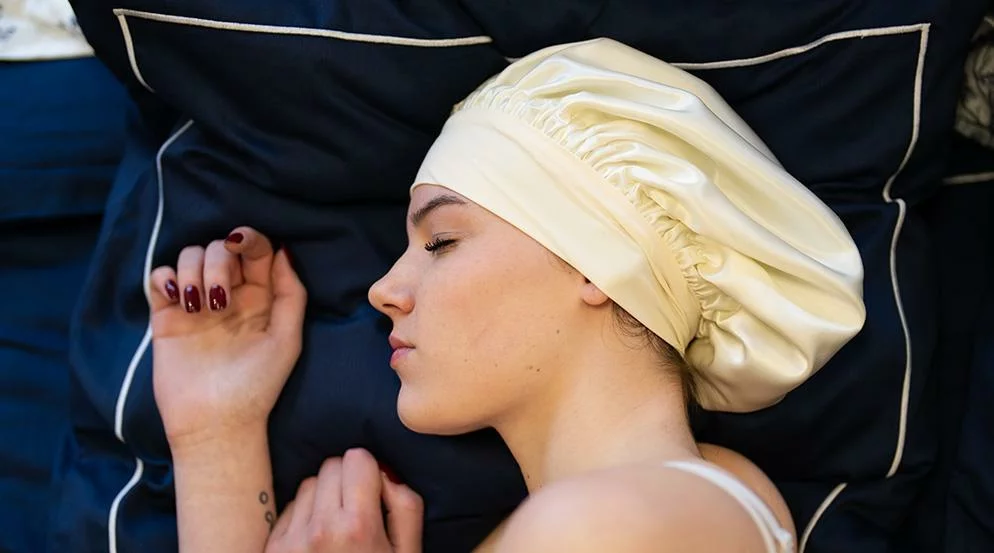
Woman sleeping peacefully wearing a champagne satin bonnet on dark navy bedding
Wear a satin bonnet over properly prepped hair. That is the whole answer — and this satin bonnet night routine is the simplest form of nighttime hair protection there is. For roughly eight hours every night, your hair grinds against a cotton pillowcase that drinks its moisture and roughs up the cuticle — quietly undoing whatever your wash-day routine built. A bonnet ends that hair friction completely, so you wake up with the hair you went to sleep with: less frizz, fewer tangles, curls that survived the night, and ends that stop snapping off on the brush.
Why cotton is the enemy of good hair days
Cotton fibres are short, rough, and thirsty. Under a microscope their edges look like tiny hooks; your hair's cuticle is a set of overlapping scales, like shingles on a roof. Eight hours of tossing and turning drags those hooks across the scales, lifting them — which is how moisture escapes, frizz forms, and strands tangle into the knots you fight every morning. Cotton is also absorbent by design: it wicks away your leave-in, your scalp's natural oils, and whatever your deep conditioner left behind, straight into the pillowcase. One night of this is nothing. A year of it — roughly 2,900 hours of grinding — is how healthy ends turn frayed, how curls go flat on one side, and how fine, straight hair develops the mid-shaft breakage that no serum can fix. Satin works because it does the opposite: a smooth, low-friction surface that hair glides across instead of catching on, so the cuticle stays flat and the moisture stays in the strand.
The satin bonnet night routine, step by step
Five minutes, in this order — this is how to sleep with a satin bonnet so it actually protects your hair:
- Detangle from ends to roots with a wide-tooth comb or your fingers. Starting at the scalp pushes shed hairs down into knots; starting at the ends clears them before they form.
- Work a pea-sized amount of leave-in conditioner through the ends — the oldest, driest part of your hair. If your hair is dry or high-porosity, add one drop of oil over the mid-lengths. Fine hair should skip heavy oil near the roots or wake up flat.
- Gather loosely: a high, loose 'pineapple' ponytail — the classic protective hairstyle for sleeping — for curls and coils, one soft low twist or loose braid for straight or wavy hair past the shoulders. Secure with a silk scrunchie, never a tight elastic — the goal is zero tension on the hairline.
- Flip your head forward, gather every strand inside the bonnet, and pull it on from front to back. The band should sit on your hairline, not your forehead. If you feel pressure on your edges, the bonnet is too tight — size up, don't suffer.
- Still losing it by morning? A satin pillowcase underneath is your safety net: on the nights the bonnet slips, your hair lands on glide instead of grind.
In the morning, take the bonnet off, shake your hair out at the roots, and go. Most women find they skip the restyle entirely — second-day hair stops being a project.
Satin bonnet vs satin pillowcase vs silk scarf: the honest comparison
A satin pillowcase asks nothing of you: nothing on your head, no adjustment, no learning curve. It is the best choice for short hair, pixie cuts, and side-sleepers who cannot stand anything on their head. Its limit is containment — long or curly hair still moves, strands still rub against each other, and volume still gets crushed on one side.
A silk scarf protects edges beautifully and doubles as a daytime accessory, but as a sleep system it is unreliable: even a double knot migrates by 3 a.m. on most sleepers, and re-tying it half-asleep defeats the purpose. Use it as a supplement, not the plan.
The satin bonnet wins for curly, coily, long, and thick hair because it is the only option that contains everything and removes surface friction at the same time. Searches for a satin bonnet for curly hair keep rising for exactly this reason — containment plus glide is the combination curly hair needs. The trade-off is comfort — some people simply hate headwear while sleeping, and that is a genuine preference, not a failure of the method. If that is you, the pillowcase is your answer, and it is a good one.
Choosing a bonnet that stays on all night
The number-one complaint in satin bonnet reviews is 'it came off by morning.' Almost always, that is a fit problem, not a bonnet problem. Look for three things. First, a wide elastic band — roughly an inch or more. Thin cords dig into the forehead and slide off; wide bands distribute pressure and grip. Second, a double layer, so the smooth side touches your hair whichever way it sits — a single shiny layer with a rough lining defeats the entire purpose. Third, size matched to your hair's volume: long, thick, or curly hair needs the large, while fine or short hair drowns in one and pops off by midnight. Tie-band styles let you dial in the tension; wide stretch bands are gentler on edges. The fit test is simple: it should feel secure with zero headache and leave no deep red line on your forehead.
Three mistakes that undo the whole routine
- Bonnet over wet or damp hair. Trapping moisture against your scalp for eight hours invites itch, odour, and in stubborn cases fungal irritation — and damp hair frizzes worse, not better, under a bonnet. The rule: hair should be at least 90% dry before the bonnet goes on. If wash day runs late, finish with a quick blow-dry or wait it out.
- The wrong size or a thin elastic cord. A bonnet on the bedroom floor at 3 a.m. protects nothing. Wide band, the right size for your volume, band on the hairline — that combination stays put. For nine more fixes, see our guide on how to keep satin bonnet on at night.
- Never washing it. A bonnet sits against your hair and skin longer than any product you own. Weekly wash, cold water, gentle detergent — see the tip above.
Real doubts, answered honestly
Does it work for straight hair? Yes — the mechanism is friction, not curl pattern. Straight hair still loses moisture to cotton, still develops split ends from nightly grinding, and still wakes up flat on one side. Bonnet wearers with straight hair typically report less breakage and noticeably less morning heat styling, which is itself a win, since heat is the other great enemy of hair.
Will it flatten fine or thin hair? Only if it is too small or too tight. A roomy bonnet with loosely gathered hair preserves volume; many fine-haired women actually get better second-day volume because there is no pillow friction pressing one side flat.
Satin or silk? Silk is a natural protein fibre, and a silk bonnet is marginally smoother than satin; it is also several times the price. Good-quality satin gives you nearly the same glide for a fraction of the cost, which is why it dominates every trend chart. One caution: some cheap 'satin' bonnets are rough polyester with a shiny coating. Rub it across your cheek — if it drags on skin, it will drag on your cuticle.
What to expect, week by week
If you are still asking 'do satin bonnets work,' the honest answer is that they remove nightly damage rather than adding anything new. Read the timeline below as the typical experience, not a promise — hair is individual. Week one: morning detangling takes half the time, because the tangles never formed. Week two: curls and blowouts hold an extra day, and the mid-week refresh gets shorter. Weeks three to four: visibly less breakage on the pillow and in the brush, and ends that look neater between trims. What a bonnet will not do: replace trims, repair damage that is already there, or make hair grow faster on its own. The satin bonnet routine works the same way: the benefit is in the damage that never happens, and it compounds quietly.
Frequently asked questions
- Satin or silk — which is better for hair?
- Both beat cotton by a wide margin. Silk is a natural fibre and marginally smoother, but good-quality satin delivers nearly the same low-friction glide for a fraction of the price — which is why satin dominates the trend. Whichever you choose, check the weave: rub it on your cheek, and skip it if it drags.
- Can I wear a bonnet with wet hair?
- No. Hair should be at least 90% dry before the bonnet goes on. Trapping damp hair for eight hours invites scalp itch and odour and makes frizz worse, not better. If wash day runs late, blow-dry or air-dry first.
- Does a bonnet help straight hair too?
- Yes. Nightly friction damages every hair type: straight hair sees less breakage, fewer split ends, and smoother mornings that need less heat styling. Skip the pineapple — a loose low twist is enough.
- Will a bonnet flatten my hair or slip off overnight?
- Flattening comes from a bonnet that is too small or too tight; slipping comes from thin cord elastics and the wrong size. A roomy bonnet with a wide band, sized to your hair’s volume, stays on without squashing it.