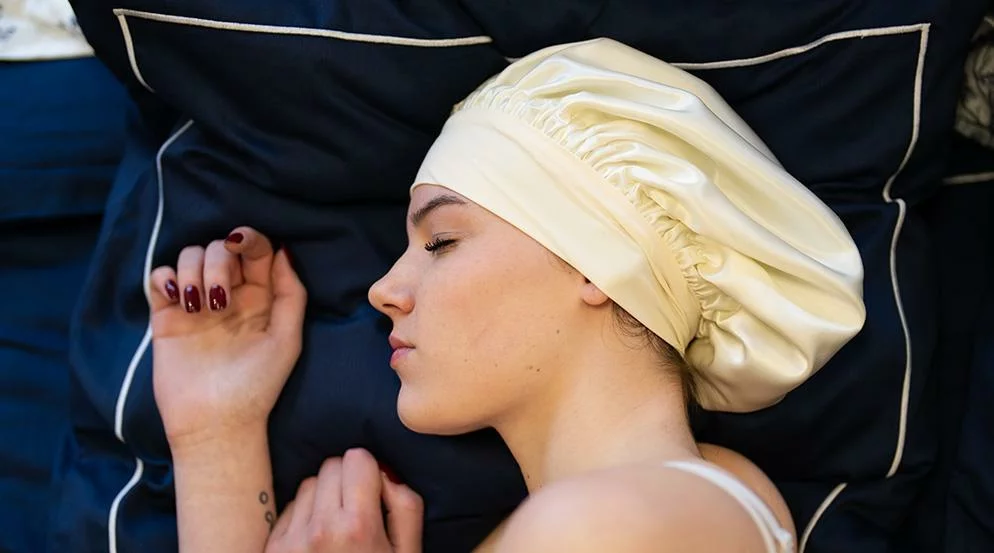
Does Satin Bonnet Help Hair Growth? The Honest Answer
Does satin bonnet help hair growth? No bonnet makes hair grow faster from the scalp — but a satin bonnet stops the nightly breakage that keeps your hair stuck at the same length. Here is the honest science of length retention, realistic timelines, and the mistakes that cancel the benefits.
- No bonnet makes hair grow faster from the scalp — growth rate is set by biology.
- A satin bonnet stops nightly friction breakage, so the length you grow actually stays.
- Pair it with the right night routine (pineapple + moisturized ends) for visible results.
- A too-tight bonnet can cause traction issues — snug, never painful, is the rule.

A consistent wash-day and night routine is the real driver of longer-looking hair
No. If you're wondering 'does wearing a bonnet help hair grow', here's the truth: a satin bonnet will not make your hair grow faster. Growth speed is decided at the follicle — roughly half an inch a month — and no fabric you sleep in changes that rate. What a bonnet changes is how much of that growth you actually keep: it cuts overnight friction, improves moisture retention in the strands, and stops the ends from snapping off while you sleep. The result is longer hair over time — not from faster growth, but from less breakage.
Why does it feel like your hair 'stopped growing'?
Because it almost certainly didn't. Your follicles kept producing new hair; the ends just broke off at roughly the same speed. That is the growth-versus-retention equation, and it is the single most useful thing to understand about hair length — and the key to answering whether a satin bonnet helps hair growth: growth happens at the root, length is what survives. If you grow six inches a year and lose five to breakage, your ponytail looks exactly one inch longer — and the culprit is usually the eight hours a night your unprotected hair spends grinding against a cotton pillowcase.
How does friction actually snap hair at night?
Cotton is rough at the fibre level and thirsty by nature. As you turn in your sleep, those fibres catch and drag on the hair cuticle, lifting it like a shingled roof opened to the wind. A lifted cuticle loses moisture, tangles more easily, and snaps under the next tug — morning brushing, a ponytail holder, a jacket collar. Eight hours of this, night after night, quietly erases your new growth.
The damage is not equal across hair types. 4C hair is the most vulnerable: tight curl patterns mean every bend is a stress point, and high porosity means moisture escapes fast, so cotton does double damage — friction plus dehydration. Fine, straight hair suffers differently: it breaks less dramatically but splits more readily at the ends, and the mechanical drag flattens roots so morning hair looks thinner. Chemically treated hair — bleach, relaxers, keratin — has an already-compromised cuticle, so the same nightly friction that a virgin strand tolerates will snap a lightened strand. Satin's smooth weave lets strands glide instead of catching, which interrupts all three damage paths at once. The satin bonnet benefits for natural hair are strongest on coily textures, because every prevented snap shows up as visible length.
Which bonnet actually protects best?
Not all bonnets are equal, and the differences that matter are specific. Double-lined bonnets beat single-layer ones: with a smooth surface touching your hair on both sides, there is no rough inner seam doing the friction the fabric is supposed to prevent. For the band, adjustable drawstrings and wide stretch bands serve different needs — a drawstring lets you dial tension exactly, which is better if you toss and turn at night, while a wide elastic band distributes pressure over more of the hairline and is gentler on edges. Thin cord bands are the ones to avoid: they dig in, slide, and concentrate tension exactly where thinning starts.
Size matters more than most women expect. Too small, and the bonnet compresses curls, pops off by morning, and stresses the hairline. Too big, and it slides around all night, creating the very friction it is supposed to stop. If your hair reaches past your shoulders or has significant volume, the large size is not optional — it is the correct size.
Satin bonnet vs. silk pillowcase — which one wins?
Honest answer: it depends on your hair, and the best setup is often both. A bonnet wins for curls, coils, and long hair because it holds the shape of your style — a pineapple, twists, or braids stay put inside it, so you wake up with definition instead of a flattened tangle. It also controls the whole head of hair rather than just the strands touching the pillow. A silk or satin pillowcase wins as the safety net: it covers you on nights the bonnet slips off, and for short or straight hair it may be enough on its own, since there is less length to protect and no curl pattern to preserve.
Our take: if you have curly, coily, or past-shoulder hair, wear the bonnet and add the pillowcase underneath. If your hair is short and straight and you find bonnets uncomfortable, start with the pillowcase alone — you will still see less morning breakage than on cotton. Either way, anything smooth beats cotton by a wide margin — a silk bonnet works the same way, since it's the smooth fabric, not the brand name, doing the protecting.
What's the exact night routine that makes a bonnet work?
A bonnet preserves moisture; it cannot create it. So the order matters: moisture first, bonnet second. Detangle gently with fingers or a wide-tooth comb from ends to roots, then apply a water-based leave-in or a drop of oil on the ends — the oldest, driest part of your hair. Next, shape matters: gather curls into a loose high 'pineapple' ponytail so the curl pattern doesn't crush, or put longer hair in two loose braids or twists so strands can't tangle inside the bonnet. Sleeping with past-shoulder hair loose under a bonnet just traps a tangle. Pull the bonnet on front-to-back, tuck every strand in, and seat the band on the hairline — not the forehead, not the ears.
Can a bonnet CAUSE hair loss?
It is one of the most-searched fears about nightly bonnet wear, so let us be straight: a properly fitted satin bonnet does not cause hair loss — but a band worn too tight absolutely can thin your edges over time. Constant pressure on the hairline creates traction — the same mechanism behind edge loss from tight ponytails and braids — and the bonnet's band presses on the exact same spot, night after night, for eight hours at a time.
Headaches are the warning sign. If you wake up with a headache, or the band leaves marks on your skin that linger more than a few minutes, the bonnet is too tight — full stop. Do not try to "break it in"; elastic does not loosen in the right places, it just stretches and then starts slipping.
Test the fit with the two-finger rule. After putting the bonnet on, slide two fingers under the band all the way around your hairline. If they fit snugly without forcing, the tension is right. If only one finger fits — or none — size up, or switch to an adjustable tie style where you control the tension yourself. Re-test monthly, because elastic quietly relaxes with washing and you will be tempted to compensate by tying tighter.
Traction or normal shedding? Here is how to tell. Normal shedding shows up as loose hairs everywhere; traction damage shows up in one place — thinning, short broken hairs, or tenderness along the hairline and temples, exactly where the band sits. If your edges are already thinning there, switch to a looser band immediately and consider a tie-band bonnet so you can position the knot away from the fragile areas. Ease the pressure first, then give the edges time to recover — and if thinning keeps spreading even after the pressure is gone, that is a conversation for a dermatologist, not a new product.
What else helps hair look longer, faster
The bonnet protects your growth overnight. These companion habits protect it the other sixteen hours:
- Moisturize ends before bed. A water-based leave-in or a light oil on the ends seals in hydration — and the bonnet then locks that moisture in instead of locking in dryness. A bonnet preserves what is there; it cannot create what is not.
- Detangle gently with a wide-tooth comb. Work from ends to roots, never roots to ends, and never force through a tangle — every forced stroke is a snap the bonnet cannot undo. Fingers first, comb second.
- Keep wash-day styles protective. Loose twists, braids, or a high pineapple mean less daily manipulation all week, so the length the bonnet saved stays saved instead of breaking off at your desk.
- Trim on schedule — every 8 to 12 weeks. A small trim stops split ends from travelling up the strand and stealing inches you already grew. Skipping trims to "grow it out" is the most common way women lose length while thinking they are gaining it.
None of these speed up growth either — but together with the bonnet, they close every exit your length could slip through.
What mistakes cancel out the benefits?
- A band that's too tight. Constant pulling on the hairline stresses edges and can cause the exact thinning you're trying to prevent. If the band leaves marks on your skin, it's too tight — adjust or size up.
- A dirty bonnet. Product build-up, oils and sweat collect on satin and transfer straight back onto clean hair and skin. Wash it weekly in cold water with gentle detergent.
- Dry hair under the bonnet. A bonnet locks in what's there — if your hair goes in dry, it comes out dry, and dry hair snaps. Moisturize first, protect second.
- Rough daytime handling. Eight protected hours can't undo sixteen hours of tight ponytails, aggressive brushing and daily heat. Night care and day care have to match, or the breakage just moves to daylight hours.
How long before a satin bonnet helps your hair look longer?
Set the timeline honestly and you won't quit too early. Weeks one to two: mornings get easier — less tangling, less frizz, styles that survive the night. Weeks four to six: noticeably less broken hair on the pillow, brush and bathroom floor. Months three to six: the real payoff — visibly retained length, because protected new growth has finally accumulated into obvious inches. A bonnet can't fix everything alone: it won't replace trims, deep conditioning or gentle handling, and if your hair is breaking from bleach damage or tight protective styles, those causes need addressing too. But for mechanical overnight breakage — the kind most women don't know is happening — it's the cheapest fix available.
So — does a satin bonnet help hair growth?
They don't speed up growth — so to answer 'does satin bonnet help hair growth' honestly: no. But for most women, growth was never the problem — breakage was. By cutting friction and holding in moisture every single night, a satin bonnet lets the hair your follicles are already producing survive long enough to become visible length. It's not a miracle and it's not instant, and it works best alongside moisture, a sensible style, and trims every eight to twelve weeks. As a low-effort protective hairstyle habit, a satin bonnet for hair growth and length retention remains one of the simplest ways to finally see the length you've been growing all along.
Frequently asked questions
- Does wearing a bonnet make hair grow faster?
- No. Growth speed is set at the follicle — roughly half an inch a month — and no bonnet changes it. A satin bonnet protects the length you grow from overnight friction and moisture loss, so the ends survive and your hair looks longer over time.
- How long until I see results from wearing a satin bonnet?
- Less morning tangling within one to two weeks, noticeably less breakage on the pillow and brush by four to six weeks, and visible length retention after three to six months of consistent nightly wear.
- Can a satin bonnet cause hair loss?
- A properly fitted bonnet does not cause hair loss. Problems only come from a band so tight it pulls constantly on the hairline, which can stress edges over time. Choose a wide, gentle band and never tie it tight enough to leave marks.
- Is satin or silk better for retaining hair length?
- Both are smooth, low-friction fabrics that beat cotton easily. Silk is a natural fibre and pricier; good-quality satin gives nearly the same glide for far less, which is why most women choose satin bonnets.
- Should I wear a bonnet every single night?
- Yes — consistency is the whole mechanism. Unprotected hair takes friction and moisture damage every night, so nightly wear, ideally with a satin pillowcase as backup, gives the best retention results.
- Do I still need trims if I wear a satin bonnet?
- Yes, every eight to twelve weeks. A bonnet reduces breakage but cannot stop split ends from forming entirely. Small regular trims keep splits from travelling up the strand.
- Can wearing a satin bonnet every night cause hair loss?
- No — a properly fitted bonnet protects hair; only a band worn too tight can stress the edges over time. Use the two-finger rule under the band, and if your hairline feels sore or the band leaves marks, switch to a looser or adjustable tie style.