7 Best Satin Bonnets for Curly Hair (Picked for All-Night Hold)
Not all bonnets are equal: the size, band, and fabric features that decide whether it stays on — and seven styles that get it right.
- Four features decide all-night hold: size, wide band, real satin fabric, and secure closure.
- Buy by features, not brand names — seven winning styles are listed with honest pros and cons.
- Avoid shower-cap styles with thin elastic: they roll, dig, and come off by 2 a.m.
- The pineapple method plus correct band placement keeps any good bonnet on all night.
The right bonnet stays put till morning — it is all in the band and the fit
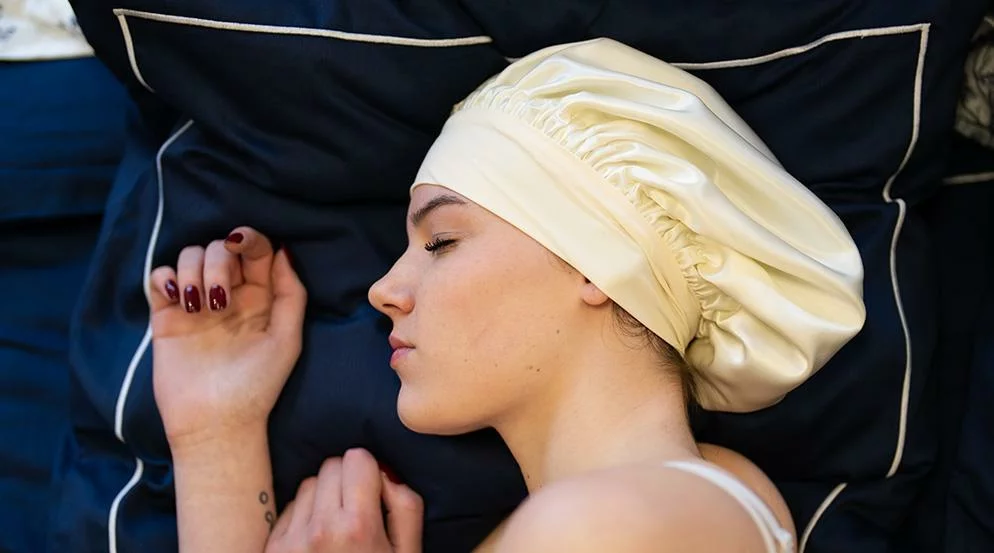
The best satin bonnet for curly hair is a double-layer satin style with a wide, soft elastic band, sized generously for your hair's volume. That combination — not the brand name, not the price — is what decides whether it protects your curls till morning or ends up on the pillow by 2 a.m. Below are the seven styles worth your money, organized by hair type and sleep style, plus the exact features to check before you buy and three types to avoid outright.
What actually makes a satin bonnet good for curly hair?
Four features do nearly all the work. Check these before anything else:
1. The band, not the fabric, decides all-night hold. Wide, soft elastic (at least 1 inch) grips the hairline without digging in. Skinny elastic rolls, twists, and migrates upward as you move in your sleep — it is the number-one reason bonnets slip off. Adjustable bands with a toggle are the gold standard: you set the tension once and it stays.
2. Size for your hair's volume, not your head. Curly hair takes up space — a bonnet that fits your head but compresses your curls will get pushed off by the hair itself. When in doubt, size up. Crushed curls also lose definition faster, so the right size protects both your sleep and your wash day.
3. Double-layer beats single-layer. Two layers of satin mean the outer layer takes the pillow friction while the inner layer stays smooth against your hair. Single-layer bonnets work, but they pill faster and slide more.
4. Real satin finish, smooth seams. 'Satin' describes a weave, not a fiber — most affordable bonnets are polyester satin, which is fine and genuinely protective. What is not fine: rough interior seams, scratchy elastic edges, or a lining that feels like costume fabric. Run your finger along the inside before committing.
Quick comparison: the 7 bonnets at a glance
Short on time? Here is how the four standout picks compare — the full breakdown follows below.
| Pick | Best for | Band style | Key strength | Typical price |
|---|---|---|---|---|
| Best Overall | Most curl types, from loose waves to dense coils | Wide elastic + adjustable toggle | Dial-in tension that stays put all night | $12–$25 |
| Best Budget | First-time bonnet wearers, simple routines | Wide classic elastic band | Reliable friction protection with zero learning curve — buy one size up | $8–$15 |
| Best for Thick High-Volume Hair | Dense 3C–4C curls, braids, and locs | Wide elastic, extra-roomy cut | 30–50% more room, so hair stops pushing the bonnet off | $12–$22 |
| Best Adjustable Fit | Restless side sleepers, in-between sizes | Drawstring / tie band | Exact custom tension, knot placed where it cannot dig in | $10–$20 |
Typical price ranges — check the current price before buying, as prices vary by brand and sales.
What size bonnet do you need? (by hair type)
Brands size inconsistently, so buy by measurements and hair type, not by the letter on the tag:
| Hair type | Recommended size | Why |
|---|---|---|
| Fine / short (above chin) | Small–Medium | Less hair means less room needed; oversized bonnets slide off fine hair |
| Wavy to loose curls (2A–3A) | Medium–Large | Enough room for volume without compression |
| Thick curls / coils (3B–4C) | Large–Extra-large | Dense hair pushes small bonnets off; room prevents flattening |
| Long hair (past shoulders) | Large / elongated "long" cut | Length needs somewhere to go or it bunches at the nape |
| Braids, locs, protective styles | Jumbo / Extra-large | Added weight and volume need maximum room; size up twice |
Pros and cons of each pick
Honest trade-offs at a glance — no pick is perfect for everyone, and knowing the downside before you buy is what stops the drawer of abandoned bonnets:
Best Overall: adjustable-band double-layer
- Pros: Fits nearly every curl pattern — the adjustable band covers the in-between sizes that fixed bands miss, so you set the tension once and it holds for weeks. The double layer keeps the inside smooth even after months of washing, and it is the style least likely to end up on the pillow by 2 a.m.
- Cons: Slightly heavier and warmer than single-layer styles, which hot sleepers notice. The toggle or drawstring takes two or three nights to dial in — if you dislike anything adjustable, it feels fiddly at first.
Best Budget: classic wide-band satin
- Pros: Delivers the core 90% win — overnight friction protection — with the simplest routine: put it on, sleep, done. Easy to replace anywhere, quick to hand-wash, and dries fast.
- Cons: Fixed elastic means the fit is either right or wrong with no way to adjust — sizing up one is not optional. The elastic typically loosens after about six months of nightly wear, so plan on a replacement rather than being surprised by it.
Best for Thick High-Volume Hair: jumbo extra-large
- Pros: The only style that genuinely contains dense, long, braided, or loc'd hair without compression — and compression is what causes both slipping and flattened curls. Roomier cut keeps wash-day definition intact till morning.
- Cons: Too much fabric for fine or short hair — it will slide off and create the exact problem it solves for thick hair. The larger size also takes longer to wash and air-dry.
Best Adjustable Fit: tie-band
- Pros: You decide exactly where the tension sits — position the knot at the back or side so nothing presses into your forehead while side-sleeping. The best answer for head sizes that fall between standard S/M/L, and for heavy braids that drag elastic bands downward overnight.
- Cons: Takes a minute longer to put on each night, and a loosely tied knot can come undone if you toss and turn. Not the grab-and-go option — this one rewards a tiny bit of ritual.
The 7 best satin bonnets for curly hair
Rather than brand names that change with every restock, these are the seven styles that consistently perform — buy whichever well-reviewed version matches your hair:
1. Best overall: the adjustable-band double-layer bonnet. Wide band with a drawstring or toggle, double satin layers, generous cut. It fits everyone from loose waves to dense coils because you dial in the tension yourself. If you buy one bonnet, make it this style.
2. Best for thick 4C hair: the extra-large jumbo bonnet. High-volume hair needs room — jumbo cuts are 30 to 50 percent roomier than standard larges. The extra fabric means your curls sit inside the bonnet instead of fighting it, which is the difference between staying on and sliding off.
3. Best for long hair: the elongated 'long' bonnet. Standard bonnets are round; long hair bunches at the nape and pushes the band up. Elongated styles give length somewhere to go. Pineapple your hair first, then let the length drop into the extra room.
4. Best for side sleepers: the tie-band bonnet. Elastic bands can press uncomfortably when your head is on the pillow; tie bands let you position the knot where it does not dig — usually at the back or side. Slightly more fiddly to put on, noticeably more comfortable for dedicated side sleepers.
5. Best budget: the classic elastic-band satin bonnet. The simple, cheap, everywhere style — and honestly fine if you get the size right. Buy one size up from what you think, check that the elastic is at least an inch wide, and replace it when the elastic goes (usually 6 months of nightly use).
6. Best premium: the mulberry silk bonnet. Silk is smoother and more breathable than polyester satin, and it lasts years instead of months. The performance gap over good satin is modest — this is a longevity and luxury buy, not a curl-protection necessity. Worth it if you wear one every single night.
7. Best for kids: the small adjustable bonnet. Children's hair needs the same protection with a band that will not give them a headache. Look for the smallest adjustable style you can find — adult smalls are usually too loose for kids under ten.
Which bonnet types should you avoid?
Shower-cap style 'satin' bonnets with thin elastic. The elastic is usually under half an inch, which means rolling, digging, and 2 a.m. removal. They are cheap for a reason — and the reason is that the band is the entire product, and theirs is the worst version of it.
'Satin-lined' bonnets with cotton outsides. The concept sounds fine, but cheap versions skimp on the lining — thin, rough, or partial. If you cannot feel smooth satin across the entire interior, it is not doing the job. Flip it inside out in the store (or check review photos) before you trust the label.
One-size bonnets for very thick or very long hair. One size fits all fits nobody at the extremes. If your hair is dense, long, or high-volume, one-size styles will compress, slip, or both. Size-specific is non-negotiable for 3C–4C hair.
"Silk" bonnets at suspiciously low prices with no momme listed. Real mulberry silk is measured in momme (19–22 is standard for bonnets) — if a listing screams "100% silk" at a $9 price point and never mentions momme, it is polyester satin wearing a costume. Polyester satin is fine and genuinely protective; just do not pay a silk premium for it, and do not expect silk longevity.
How do you keep a satin bonnet on all night?
Even the right bonnet needs the right technique. The pineapple method first: gather hair loosely at the very top of your head — high enough that no hair sits under the band line. Then place the bonnet's band just behind your hairline, not on your forehead, and smooth the fabric down over everything. The band should feel snug but never tight; if you get a headache within an hour, it is too tight and you need the next size up, not more tolerance.
For extra security, some women layer a satin pillowcase underneath as backup — if the bonnet migrates, the pillowcase still protects. And if your bonnet used to stay on and recently started slipping, check the elastic before blaming your sleep: stretched elastic is the most common cause of a previously-good bonnet going rogue. Our full troubleshooting guide covers all nine fixes, from band hacks to when it is simply time to replace.
What about bonnets for braids, locs, and protective styles?
Protective styles change the equation: braids and locs add both volume and weight, and they snag on rough fabrics more easily than loose curls. The rules shift slightly. First, size up twice, not once — box braids down the back need a jumbo or elongated bonnet, full stop. A standard large will compress the braids at the nape, which causes tension at the roots overnight and undoes the whole point of the protective style.
Second, prioritize smooth interiors even more. Braids catch on pilled or rough satin, and every snag is a pulled edge or a frizzy braid. Double-layer styles win here again: the smooth inner layer glides over braids instead of gripping them. And third, consider a tie-band style if your braids are heavy — the weight of long braids can drag an elastic band downward over the night, while a tied band stays exactly where you put it.
For locs specifically, the same jumbo sizing applies, with one addition: make sure the bonnet is deep enough that locs are not folded double inside it. Folded locs under pressure develop kinks that take days to relax. When in doubt, the pineapple-then-bonnet method — gathering locs loosely upward before covering — keeps everything in its natural fall.
Satin vs. silk: does it actually matter?
Honestly? Less than the internet suggests. Both are smooth, low-friction fabrics that protect curls from cotton pillowcases — and the cotton pillowcase is the real enemy here, responsible for most overnight frizz, dryness, and breakage. Moving from cotton to either satin or silk is the 90 percent win.
The remaining 10 percent: silk (real mulberry silk) is more breathable, so hot sleepers notice the difference, and it outlasts polyester satin by years. Polyester satin is nearly as smooth, far cheaper, and easier to wash. For most curly-haired women, a well-fitting budget satin bonnet protects curls just as well night-to-night as a premium silk one. Spend the extra only if you sleep hot or want the multi-year lifespan.
How do you wash a satin bonnet without ruining it?
Hand wash in cool water with a drop of gentle shampoo, squeeze (never wring), and air dry away from direct heat. Machine washing is possible in a mesh laundry bag on delicate — but the agitation shortens the elastic's life, so hand washing is worth the two minutes if you want the bonnet to last its full 6 to 12 months. Wash every one to two weeks; product buildup on the satin transfers back to your hair and defeats the purpose.
When should you replace your bonnet?
Every 6 to 12 months with nightly use — sooner if any of these show up: the elastic stays stretched instead of snapping back, the satin has gone rough or pilled on the inside, the band leaves marks that last more than a few minutes, or the bonnet has started slipping when it used to stay put. A worn bonnet does not just underperform; rough, pilled satin creates the exact friction you bought it to prevent.
Keep a spare. Bonnets are small, cheap, and miserable to be without on wash day — a backup in the drawer means you never sleep unprotected while one is drying.
Frequently asked questions
- What is the best satin bonnet for curly hair that stays on all night?
- A double-layer satin bonnet with a wide, soft elastic band and a size matched to your hair volume. The band does the staying-on work, not the fabric: wide bands distribute pressure and grip without sliding, while skinny elastic rolls and migrates.
- Is satin or silk better for a bonnet for curly hair?
- Silk is the premium option: smoother, more breathable, and longer-lasting. But a good polyester-satin bonnet protects curls nearly as well at a fraction of the price. What matters more than satin vs silk is the fit: a well-fitting satin bonnet beats a slipping silk one.
- What size bonnet do I need for thick curly hair?
- Measure around your hairline where the band will sit, then size up if your hair is dense, long, or high-volume. Most brands run small, medium, large, and extra-large; thick type 3C to 4C hair usually needs large or extra-large so curls are not compressed.
- Why does my satin bonnet keep slipping off at night?
- Three usual causes: the band is too loose or too skinny, the bonnet is too small so hair pushes it off, or the fabric is single-layer and slides. Fix it with a wider band, one size up, or a double-layer style.
- Can a satin bonnet damage curly hair?
- A well-fitting satin bonnet protects hair; a bad one can cause friction at the hairline or tension headaches from a too-tight band. Avoid bonnets with rough seams inside and never size down to make a slipping bonnet stay.
- How often should you replace a satin bonnet?
- Every 6 to 12 months with nightly use. Replace sooner if the elastic is stretched, the satin has gone rough or pilled, or the bonnet has started slipping when it used to stay put.
- Which satin bonnet is best for thick curly hair that slips off?
- Choose a double-layer bonnet in an extra-large cut with a wide, soft band made for high-volume hair. The roomier sizing stops dense curls from pushing the bonnet off, the wide band grips without sliding, and the double layer keeps the interior smooth against thick hair all night.