
How to Clean Carpet in 2026: Vacuum First, Wet Last, Dry Fast
Short answer: vacuum the carpet slowly in two directions first, because most of the dirt in it is dry; blot any spill straight away from the outside edge toward the center and never scrub; spot-clean with 2 cups of warm water, 1 tablespoon of white vinegar, and 1 teaspoon of mild dish soap, tested on a hidden patch first; deep-clean with a machine or by hand only when the whole carpet needs it; then dry it fast with open windows and fans so the pad is dry within 24 hours.
If you read this guide, you will know how to tell what kind of carpet you have, which method fits which mess, how to remove the common stains, which mixes work and which cancel each other out, and how to dry the carpet properly in a rented home — without soaking it, mixing chemicals, or risking the deposit.
This guide contains no affiliate links and no product picks.
The mixes named here — warm water, white vinegar, mild dish soap, baking soda — are things you already own, not things to buy. The advice comes from the professional cleaners' own guides and the safety bodies they cite, not from a seller.
The fastest honest answer to how to clean carpet is this: vacuum slowly in two directions first, because most of the dirt in a carpet is dry; blot any spill straight away from the outside edge toward the center and never scrub; spot-clean with 2 cups of warm water, 1 tablespoon of white vinegar, and 1 teaspoon of mild dish soap; deep-clean only when the whole carpet needs it; and dry it fast so the pad is dry within 24 hours.
This guide is built for the carpet in a rented flat, the hallway that takes every shoe, and the living room where pets sleep and children play. It does not ask you to buy a machine or a cabinet of chemicals. Most of the cleaning in it costs nothing at all.
The short answer
Vacuum first, always. The Carpet and Rug Institute estimates that about 74% to 79% of carpet soil is dry particulate matter — dust, grit, crumbs, hair — that should be removed through vacuuming before the carpet gets wet. Wetting dry soil turns it into mud inside the fibres, and mud is far harder to remove than dust.
Spills are the opposite: they need speed, not strength. Roughly 90% of carpet spills can be completely removed when action is taken immediately, according to Agar Cleaning Systems, Blot the spill straight away with a clean white cloth, working from the outside edge toward the center so it does not spread, and never scrub — scrubbing pushes the liquid deeper into the fibres, spreads it across a larger area, and can fray the pile.
For a light spot, the homemade mix that the freshest professional guide recommends is 2 cups of warm water, 1 tablespoon of white vinegar, and 1 teaspoon of mild dish soap. Cleaner left behind in carpet attracts new dirt, so a cleaned area can become dirty again faster than the carpet around it.
Pick your approach: carpet type, mess type, then method
The best way to clean your carpet depends on its fibres, how heavily soiled it is, whether you are dealing with specific stains, and how quickly the carpet will dry afterward. Answer three questions before you touch a bottle, and the method picks itself.
First, what is the carpet made of? Nylon is durable and commonly responds well to routine cleaning. Polyester is generally stain-resistant but tends to hold onto oily soils. Olefin, also known as polypropylene, resists moisture well but is prone to attracting oily soil. Wool and other natural fibres need more care, because excessive moisture, heat, or unsuitable chemicals could cause discoloration or other damage.
Second, what is the mess? Dry surface dirt needs vacuuming only. A fresh spill needs blotting and a spot treatment. A set-in stain needs a matched treatment and patience. Ground-in soil across the whole carpet needs a deep clean.
| Carpet | Mess | Method |
|---|---|---|
| Any fibre | Dry dust, crumbs, hair | Vacuum only, two directions, crevice tool on edges |
| Synthetic (nylon, polyester, olefin) | Fresh spill | Blot, then the warm water, vinegar, and dish soap mix |
| Synthetic | Set-in stain | Matched stain treatment, test hidden first, blot and rinse |
| Synthetic | Whole carpet dull or soiled | Machine deep clean, or hand-clean small areas |
| Wool or natural fibre | Any wet cleaning | Gentle vacuuming and wool-compatible products only; test hidden; never soak; consider a professional |
| Any fibre | Pet urine returning, pad wet, flooding | Professional extraction — DIY will not reach the pad |
If you are unsure about the fibre, do the hidden test before anything else: apply a small amount of the diluted cleaning solution to a clean white cloth, blot an inconspicuous area of carpet, wait for the area to dry, and check the cloth and carpet for dye transfer or colour changes. No colour on the cloth means it is safe to use on the rest of the carpet.
The 10-minute version
Some evenings you have ten minutes, not a Saturday. This is the version that makes the biggest visible difference in the shortest time, and it is the version I use most often.
Pick up everything off the carpet — shoes, bags, toys, the laundry pile. Run the crevice tool along the skirting boards, under the furniture edges, and into the corners, because that is where dust and pet hair collect and where a normal vacuum pass never reaches. Then vacuum the high-traffic lane — the path from the door to the sofa, the strip in front of the kitchen — slowly, in two directions: one pass north to south, then another east to west. Slow matters more than strong. Rushing leaves dirt behind, and a second direction lifts fibres from a different angle and catches what the first pass missed.
If there is one visible spot, blot it now with a clean white cloth and a little of the warm water, vinegar, and dish soap mix, then blot again with a plain-water cloth and press a dry towel into it. Do not pour cleaner on the carpet, and do not scrub. Ten minutes, one lane, one spot — and the room looks cared for.
For pet hair, there is a trick worth knowing before you vacuum: damp rubber gloves gather the hair that collects where pets sit and sleep. Run a gloved hand over the spot and the hair comes up in a clump.
The full reset: deep-clean the whole carpet
When the whole carpet is dull, or it has been a year since the last deep clean, a full reset is worth a free morning. Work in this order, and do not skip the drying step at the end — it is half the job.
Clear the room. Move lightweight furniture out, or to one side.
Vacuum thoroughly before any water touches the carpet. Go over it slowly, working in multiple directions to loosen dirt trapped deep in the fibres, and use a vacuum with strong suction and a rotating brush head to agitate the fibres. A carpet that is vacuumed well first will clean much more easily, because the loose surface soil is not just getting pushed into the wet pile by the machine.
Spot-clean stains before the main clean. Walk the carpet, mark visible stains with a bit of paper, and treat each one with its matched method from the stain section below. Leave pre-treatment on for the dwell time on the product — most need five to ten minutes.
Deep-clean with a machine or by hand. A carpet cleaning machine is the best way to remove deep-seated dirt, odours, and allergens. Fill the clean water tank with hot water, not boiling, and add the cleaning solution at the dilution ratio stated on the bottle — using too much product is a common mistake and leaves residue in the fibres that re-attracts dirt quickly. Start cleaning in a far corner of the room and work your way toward the exit so you do not get trapped mid-room surrounded by wet carpet. Move the cleaner slowly, overlapping each pass slightly, squeezing the trigger to release the solution while pushing forward, then releasing the trigger and pulling back to extract the moisture. A consistent slow walking pace is about right: too fast and you are not injecting enough solution or extracting properly, too slow and you are over-wetting the carpet. After cleaning, make additional extraction or dry passes without dispensing more solution — these passes help remove as much moisture as possible.
By hand, the method suits small sections rather than an entire heavily soiled room. After vacuuming thoroughly, lightly apply your tested cleaning solution, gently work it into the surface with a soft brush if your carpet's care instructions permit it, then blot with a cloth lightly dampened with clean water to remove the cleaning solution, and blot repeatedly with dry towels. The goal is to clean the carpet without saturating the backing or pad.
Rinse with clean water. Once you have finished cleaning with the carpet solution, go over the carpet again using clean water. This helps remove any leftover cleaning solution, which can leave a sticky residue if not rinsed properly — and leftover residue attracts dirt more quickly, making your carpet look dirty again sooner than it should.
Vacuum again once fully dry. This lifts the pile back up, removes any dried residue, and leaves the carpet looking fresh rather than flat. It is also the point at which you will notice whether any stains need a second treatment — some older stains come back as the carpet dries, particularly protein stains like urine. If that happens, pre-treat and spot-clean once more rather than rewetting the whole carpet. For the full room-by-room order, my deep-cleaning checklist keeps the same sequence for the whole home.
Know your carpet before you wet it
A carpet's appearance does not always reveal its material. A rug that looks like wool may contain synthetic fibres, and a decorative rug may have a backing that cannot tolerate soaking. A cleaning method that works on a washable synthetic rug may damage a delicate wool or natural-fibre carpet.
Wall-to-wall carpeting and area rugs are not the same thing, so do not assume you can use the same cleaning methods. Rugs need slightly different care than fitted carpets: vacuum both sides, because rugs trap dirt underneath too; test cleaning products on a hidden corner first, especially for wool or dyed rugs; use a gentle detergent, because mild dish soap and warm water work well for surface cleaning; dry thoroughly by hanging outside in sunlight, which helps reduce odours and prevent mould growth; and avoid overwetting, which can cause shrinkage or mould.
Low-pile carpet traps less debris and may not need as frequent vacuuming as more plush, high-pile carpet. High-pile carpets and older carpets with jute backing are particularly at risk from over-wetting, because the backing and underlay hold moisture for a long time, and damp underlay is where mould and mildew come from.
And whatever you do, avoid steam cleaning a wool rug, because it will damage the carpet.
Vacuum first: the step that does most of the work
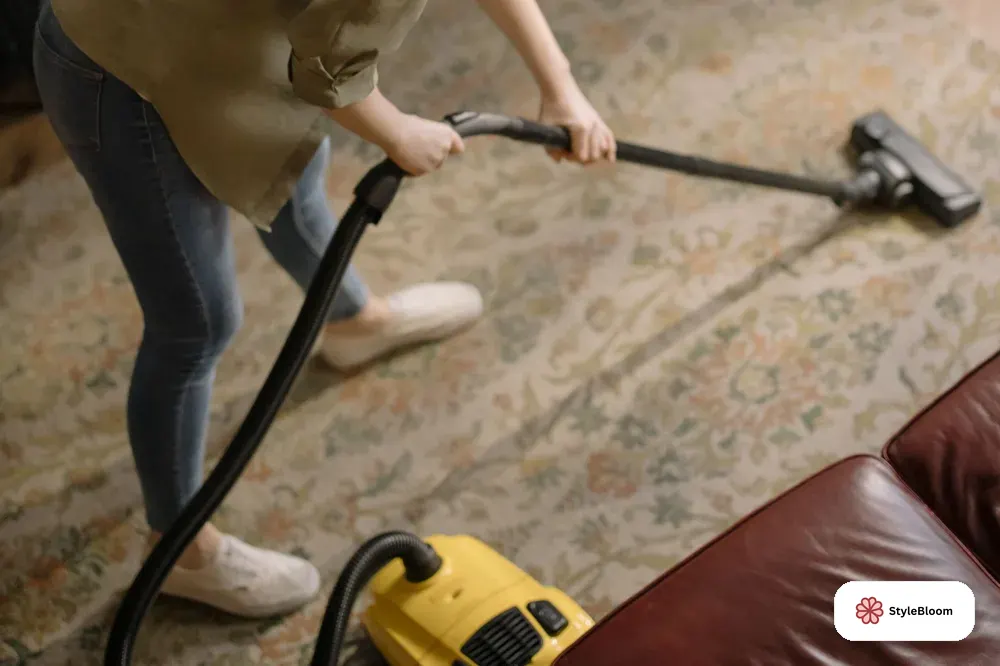
Vacuuming is the single most important thing you can do to keep your carpets clean. It removes loose dirt, dust mites, pet hair, and allergens before they work deeper into the pile.
| Traffic level | Examples | How often |
|---|---|---|
| High traffic | Entryways, hallways, living rooms | Daily |
| Medium traffic | Dining rooms, home offices | Twice a week |
| Light traffic | Guest bedrooms, formal rooms | Once a week |
| Home with children | Busy family areas | 1–2 times a week, extra attention to busy areas |
| Home with pets | Where pets sit and sleep | 2 or more times a week, depending on shedding |
| Shoes worn indoors | High-traffic areas | 2 or more times a week |
Technique matters as much as frequency. Go slow — push the vacuum forward and pull it back in overlapping passes, because rushing leaves dirt behind. Vacuum in two directions, one pass north to south and another east to west, which lifts carpet fibres from multiple angles and removes dust you would otherwise miss. Use the crevice tool along baseboards, under furniture, and in corners. Empty the bag or canister frequently, because a full vacuum loses suction and pushes dirt around instead of picking it up.
Hair is the quiet enemy of a vacuum. Long hair and pet hair wrap around the brush roll and choke the suction, so check the roll every few weeks and cut the wrapped hair away with scissors. The same care applies to the tools that touch hair in the rest of the home — my hairbrush cleaning guide covers how to strip hair and residue out of a brush properly, and the habit is the same: clear the hair before it becomes a blockage.
If anyone in your home has allergies or asthma, have them leave the room while you vacuum, and use a vacuum with a HEPA filter to reduce the amount of dust that escapes back into the air. A clean cleaning schedule is what turns this from a chore into a habit — little and often beats a heroic monthly session every time.

Stain by stain: the decision table
Different stains respond to different treatments, and the wrong first move can set a stain permanently. Hot water is the most common mistake: it can set some types of stains, and it sets protein stains — blood, milk, urine — so cool or lukewarm water is the safer starting point for many fresh spills.
| Stain | What to do first | What to avoid | Call a professional when |
|---|---|---|---|
| Coffee or tea | Blot immediately; a small amount of dish soap mixed with warm water, about a quarter teaspoon per cup; rinse well | Scrubbing or soaking | Discoloration remains after treatment |
| Red wine or juice | Blot up as much liquid as possible, then sprinkle salt or baking powder generously, let it settle, vacuum it up; then a carpet-safe spot cleaner | Rubbing, heat, or untested chemicals | The stain remains after careful spot treatment |
| Grease or oil | Sprinkle baking soda, let it sit, vacuum, then blot with dish soap solution; remove excess material first and use a product approved for oily stains | Spreading the grease while rubbing; oversaturating | A dark or oily patch keeps returning |
| Mud | Let heavy mud dry first, vacuum the loose soil, then treat the remaining marks with soap and water | Wetting heavy dry soil immediately | Soil remains embedded in the fibres |
| Pet mess | Remove solids, blot the liquid, then use an enzyme cleaner labelled for carpet use | Heavy scrubbing, masking odour with fragrance, ammonia products | Odour returns or contamination has reached the carpet pad |
| Blood | Cold water first — never hot; two parts hydrogen peroxide and one part dish soap on a cloth, blot; or cold water and white vinegar, soak a few minutes, then blot | Hot water, which sets the stain | The stain is old and set after treatment |
| Paint | Identify the paint: water-based blots with a paper towel, scrape the rest with a dull knife, then rubbing alcohol on a cloth; oil-based needs paint thinner and a one-to-one mix of dish soap and warm water | Scrubbing wet paint deeper in | Dried paint will not lift |
| General dirt and grime | Dish soap and warm water solution, a small amount on a cloth, rinse and blot dry | Pouring cleaner directly on the carpet | The whole carpet is dull and soiled |
Pet stains deserve a longer word, because they are the stain most people treat wrong. Enzymatic cleaners break down the organic material that causes lingering smell, which is something soap and water alone cannot do. If a pet stain keeps coming back after you clean it, moisture from the padding may be wicking up to the surface. That is a sign the mess went deeper than the carpet itself, and it is a good time to hire professionals for a thorough extraction. And never use ammonia products on a pet stain: they can encourage pets to re-mark the area.
For light-coloured carpets, hydrogen peroxide at 3% household strength only can be effective on organic stains — but it is an oxidiser that can lighten carpet dye, so always test on a hidden spot first and let it dry completely before deciding if it is safe for your carpet type.
DIY mixes: what works, what cancels out, what is dangerous
You do not need a cabinet full of chemicals to handle most carpet messes. These simple solutions use ingredients you probably already have, and they cover nearly everything a household carpet meets.
The all-purpose mix is the one from the freshest professional guide: 2 cups of warm water, 1 tablespoon of white vinegar, and 1 teaspoon of mild dish soap. Test the solution in a hidden area first. Apply a small amount to a cloth rather than soaking the carpet, blot the area gently, then follow with a clean cloth lightly dampened with plain water to remove cleaner residue, and blot dry.
Baking soda is for odours, not for deep cleaning. Sprinkle a generous layer over the problem areas, let it sit for 15 to 30 minutes, or overnight for stubborn odours, then vacuum it up. Be careful with baking soda on dark or patterned carpet: a heavy layer left too long can sometimes leave a lighter residue that is difficult to vacuum out completely.
Vinegar is for acidic stains. Spot-clean with vinegar by mixing it with an equal volume of cold water in a spray bottle, spray the stain with a light mist to avoid saturating the area, let it sit for 10 to 15 minutes, then sprinkle on baking soda to absorb the moisture and the odour; once the baking soda is dry, vacuum the area. Vinegar is a great option for tackling pet urine and wine, both of which are acidic. For pet urine, equal parts white vinegar and warm water in a spray bottle will get rid of the odour — spritz the area, then blot with a paper towel.
Here is the mix that does not work: baking soda and vinegar together. Do not assume combining them creates a stronger cleaner. A 2023 comparative study explains that mixing the two actually causes an acid-base reaction, and the fizz produces carbon dioxide and water while neutralising much of the cleaning properties of the individual ingredients. Use them one after the other, never mixed in the same bottle.
And here is the mix that is dangerous: never mix cleaning chemicals. Combining common household products like bleach and ammonia can release dangerous fumes — mixing bleach with ammonia produces toxic chloramine gas, and mixing it with acids produces chlorine gas. Use one product at a time, exactly as its label directs. If one stain remover does not work, rinse it out completely and let the carpet dry before trying something different. The same care applies to the cloths you clean with: always blot with a clean white cloth, because a dyed towel can transfer its dye to the carpet, and my microfiber guide explains which cloths are safe on which surfaces and how to wash them so they stay absorbent.

Machine, hand, or professional: choose once, clean once
Once you have vacuumed and treated the obvious stains, you might decide the entire carpet needs a deeper clean. There are two main DIY approaches, plus the professional route, and the right one depends on the size of the job and the state of the carpet.
| Method | Best for | Drying | Main DIY risk |
|---|---|---|---|
| Carpet cleaning machine | Larger carpeted areas and heavier soil | Requires good airflow and thorough extraction; wait four to six hours before furniture or walking | Over-wetting or detergent residue |
| Manual cleaning by hand | Small areas and light soil | Less moisture when solution is used sparingly | Uneven cleaning or residue |
| Dry carpet products | Light maintenance where appropriate | Generally less drying time | Product residue |
| Professional carpet cleaning | Deep soil, widespread staining, delicate carpet, recurring stains | Technicians use extraction equipment and drying practices | Lower DIY risk |
Rent or buy is a frequency question, not a brand question. If you do not see yourself using a carpet-cleaning machine that often, or if you do not have the room to store it, rent one from your local home improvement store. If you have pets and children and deep-clean several times a year, owning starts to make sense — but only if you have somewhere dry to store it and you will actually maintain it.
Hire a professional when the job is beyond DIY. Call one if a large section of carpet has been saturated, if flooding or contaminated water is involved, if the carpet pad remains wet after 24 hours, if you notice a persistent musty odour, if pet urine or other stains repeatedly return, if you have widespread or deeply embedded soil, if you are dealing with delicate, natural-fibre, or high-value carpet or rugs, or if previous DIY cleaning has left residue or discoloration. Professionals use detergents and steam to really get in there, and commercial machines are far stronger than domestic ones when it comes to getting bacteria and dirt out of any pile. If your home has wall-to-wall carpeting, you might want a professional clean once a year.
Drying: how to know it is actually dry
Drying is an important part of the carpet cleaning process, not an afterthought. Open windows when outdoor conditions permit, and position your fans so air moves across the carpet's surface. In humid conditions, run a dehumidifier. Keep people and pets off damp carpet as much as possible, and always wait until the carpet is fully dry before replacing furniture.
How long? Depending on the carpet material, thickness, and indoor humidity levels, it can take anywhere from six to twelve hours to dry completely. The hard limit comes from the New York State Carpet Care and Maintenance Training Manual: carpet should dry completely within 24 hours after extraction, because damp padding creates conditions where mold could grow. If the carpet pad still feels wet or you notice a musty smell after a day, consider calling a professional rather than continuing to add DIY cleaning products.
Here is how to prove it is dry, not just guess. Press your palm flat on the carpet and hold it for ten seconds: if your palm feels cool and damp, it is not dry. Press into the pile with your fingers and feel the backing underneath — the surface can feel dry while the pad below is still wet, and a wet pad is the real problem. And watch for wicking: stains that seem to disappear and then return are caused by moisture and staining material deeper in the carpet migrating back toward the surface as the carpet dries. Repeatedly applying stronger chemicals will make that problem worse, not better.
What to skip: the things that make carpet worse
Most carpet damage I have seen comes from doing too much, not too little. This table is the short version of every mistake the professional guides list — skip these and the carpet stays safe.
| Skip it | Why |
|---|---|
| Scrubbing a stain | Pushes the liquid deeper, spreads it, frays the pile |
| Pouring cleaner directly on the carpet | Oversaturates one spot; apply to a cloth instead |
| Hot water on a fresh or protein stain | Sets the stain — blood, milk, urine, and some food stains |
| Mixing baking soda and vinegar | They neutralise each other; the fizz is not cleaning |
| Mixing bleach with anything | Toxic gas — chloramine with ammonia, chlorine with acids |
| Hydrogen peroxide above 3% | An oxidiser that lightens dye; test hidden first, always |
| Steam-cleaning wool or delicate rugs | Heat and moisture damage natural fibres |
| Store-bought carpet powders | Residue attracts dirt unless the manufacturer recommends them |
| Too much cleaning product | Residue re-attracts dirt; the spot gets dirty faster |
| Soaking the carpet and pad | Damp pad grows mold; dry within 24 hours or call a professional |
| Replacing furniture before the carpet dries | Rust and stain transfer from the legs; use foil until dry |
| Using a dyed towel to blot | The dye can transfer to the carpet |
| Skipping the rinse | Leftover cleaner attracts dirt to the cleaned spot |
Two more habits to drop. First, do not compensate for a stubborn stain with more cleaner. Too much product can leave residue, while too much water can reach the backing and carpet pad.
Rental, shared homes, kids, pets, and the desk chair
If you rent, the carpet is not yours to experiment on. Check the manufacturer's care instructions and your tenancy paperwork before applying any cleaning product, because some fibres tolerate water and cleaning solutions better than others, and some tenancy agreements expect a professional clean at move-out. Nothing bolted, drilled, or stuck down permanently applies to carpet too: no harsh chemicals that could bleach a patch, no soaking that could reach the pad, no steam on a carpet you have not identified. A professional clean every 18 to 24 months, with a truck-mounted system, is what the flooring guides recommend — and for a renter, that receipt is also your deposit protection.
In a shared home, the carpet fails the same way a shared drawer does: nobody owns the maintenance, so nobody does it. Give the carpet one owner — one person vacuums the high-traffic lane twice a week, and spills are blotted by whoever is nearest, immediately, with the white cloths kept by the door.
Kids change the schedule, not the method. A home with children needs vacuuming one to two times a week with extra attention to busy areas, and deep cleaning more often than a quiet household. Keep the cleaning products out of reach, use the mildest mix that works, and rinse thoroughly — a crawling baby's hands and mouth are on that carpet.
Pets change the tools. Groom your pets regularly, because brushing reduces the amount of pet hair and dander that ends up in your carpet fibres. Use the crevice tool where they sleep, damp rubber gloves for the hair clumps, and an enzyme cleaner for accidents — never an ammonia product, which can encourage a pet to re-mark the area. If the smell returns after cleaning, the mess has reached the padding, and that is a professional extraction, not a stronger spray.
The desk chair is the carpet's quietest enemy. A rolling chair grinds dirt into one patch, flattens the pile, and wears a bald lane across the carpet. Rearrange your furniture periodically and place it on coasters to prevent it from wearing down the carpet, and put a chair mat under a rolling desk chair — it spreads the load and keeps the pile from crushing.
Keep it clean: the routine that makes deep cleans rare
Keeping carpet clean and looking fresh takes a little effort every week. Combining cleaning, maintenance, and protection tips, here is the recipe for a long-lasting carpet: vacuum high-traffic areas twice a week and low-traffic areas once a week; act quickly to address spills and avoid set-in stains; always blot stains and never rub; test carpet cleaning solutions in an inconspicuous spot before using them on a stain; deep-clean your carpet every 12 to 18 months or as often as the manufacturer recommends; use doormats and rugs to trap dirt and debris before it gets tracked through the house; avoid wearing shoes indoors unless they are dedicated house shoes; rearrange your furniture periodically
The first win is the entrance. Put a mat outside and a mat inside the front door, take shoes off there, and vacuum the hallway lane twice a week.
The post-use routine is two minutes, once a week: a slow vacuum of the high-traffic lane in two directions, a check for new spots, and a blot of anything you find. That is the whole maintenance plan. Do that, and the deep clean stays a once-a-year job instead of a rescue mission. Soft furnishings share the same logic — the same vacuum-first, blot-first, dry-fast rules keep a mattress fresh too, and my mattress deodorizing guide walks through the odour side of the same routine.
Verdict: a carpet stays clean when vacuuming comes first, spills are blotted immediately, wet cleaning is rare and gentle, and drying is finished within a day. Buy nothing you do not need, mix nothing you should not mix, and let the vacuum do the work it was built for.
How this guide was put together
This guide was built by reading the top carpet-cleaning guides in full — the professional cleaner COIT, Reader's Digest with its cleaning experts, Floor Coverings International, and the independent cleaner Sweetly Clean — and tracing every number back to its source: the Carpet and Rug Institute for the soil and schedule figures, Agar Cleaning Systems for the spill figures, the CDC for the chemical-safety rules, and the New York State Carpet Care and Maintenance Training Manual for the 24-hour drying limit. Where the guides disagreed, this guide follows the stricter rule. Nothing here was tested hands-on for this article, and no product was tried on a carpet for it — the methods are the ones the professional sources agree on, stated exactly as they state them.
What to try first: Vacuum the high-traffic lane slowly in two directions tonight and empty the bag or canister first. Good looks like: the pile standing up again, no grey lane in front of the sofa, and nothing crunching underfoot. If it fails: the lane is still grey — the soil is ground in, so spot-clean it with the warm water, vinegar, and dish soap mix and let it dry fully. Learn next: Deep Cleaning Checklist: Room-by-Room Plan — the room-by-room checklist: the same sequence for the whole home, not just the carpet.
Frequently asked questions
- How often should you vacuum carpet?
- Vacuum high-traffic areas daily, medium-traffic areas twice a week, and low-traffic rooms at least once a week. This schedule, recommended by the Carpet and Rug Institute, prevents loose dirt and dust from grinding into carpet fibres.
- How often should you deep clean carpet?
- The Carpet and Rug Institute recommends a professional deep cleaning every 12 to 18 months, and more often in homes with pets, kids, or heavy foot traffic.
- What is the best homemade carpet cleaner?
- For light soil on compatible carpets, a solution of 2 cups of warm water, 1 tablespoon of white vinegar, and 1 teaspoon of mild dish soap is one option.
- Does baking soda really clean carpet?
- Baking soda helps absorb some odours and can freshen carpet before vacuuming, but it is not a substitute for deep cleaning or proper stain treatment. Sprinkle a light layer on dry carpet, leave it for 15 to 30 minutes, and vacuum thoroughly.
- Can you use hydrogen peroxide on carpet?
- Yes, but only 3% household-strength hydrogen peroxide, and only after testing it on a hidden spot. Hydrogen peroxide is an oxidiser that can lighten carpet dye, so it is not safe for every carpet type. Never use higher concentrations, and never mix it with vinegar or other chemicals.
- How do you get red wine out of carpet?
- Blot up as much as you can straight away, then sprinkle salt or baking powder generously on the stain, give it a few minutes to settle, and vacuum it up. If you can still see the stain, use a carpet-safe spot cleaner
- How do you get pet urine out of carpet?
- Blot up as much liquid as possible with paper towels or a clean cloth, then apply an enzymatic cleaner designed for pet stains and follow the product label. Enzymatic cleaners break down the organic material that causes lingering smell, which soap and water alone cannot do.
- How do you get blood out of carpet?
- Use cold water first — never hot water, which sets the stain. Mix two parts hydrogen peroxide and one part dish soap, wet a cloth with the mixture, and blot the stain.
- How long does carpet take to dry after cleaning?
- Depending on the carpet material, thickness, and indoor humidity, it can take anywhere from six to twelve hours to dry completely. A machine-cleaned carpet usually needs four to six hours before furniture goes back. The hard limit is 24 hours: the carpet pad must be dry within a day, or mold can grow — if the pad still feels wet after a day, call a professional.
- Can you clean carpet without a machine?
- Yes, for small areas and light soil. Vacuum thoroughly, lightly apply your tested cleaning solution, then blot with a cloth lightly dampened with clean water, and blot repeatedly with dry towels. The goal is to clean without saturating the backing or pad.
- Should you rent or buy a carpet cleaner?
- It is a frequency question, not a brand question. If you will use it rarely or have nowhere to store it, rent one from a home improvement or grocery store. If you have pets and children and deep-clean several times a year, owning starts to make sense
- How do you clean carpet in a rented home?
- Vacuum thoroughly, spot-clean gently with the mildest mix that works, and test everything on a hidden patch first. Never soak the carpet, never use harsh chemicals that could bleach a patch, and never steam a carpet you have not identified.
- Why does the stain keep coming back?
- The stain is wicking: moisture and staining material deeper in the carpet migrate back toward the surface as the carpet dries. It usually means the mess reached the padding below, especially with pet urine. Pre-treat and spot-clean once more rather than rewetting the whole carpet, and if it keeps returning, hire a professional extraction.
- Is steam cleaning safe for all carpets?
- No. Steam cleaning can damage wool rugs and delicate natural-fibre carpets, and excessive moisture can harm the backing and pad. Always check the manufacturer's care instructions first, and for vintage, delicate, or high-value rugs, use a professional hand-wash with a pH-balanced shampoo instead.
- What should you never do when cleaning carpet?
- Never scrub a stain, never mix cleaning chemicals — especially bleach with ammonia or acids — never use hydrogen peroxide above 3% strength, never soak the carpet and pad, and never replace furniture before the carpet is fully dry. Test every cleaner on a hidden spot first.