
Best Silk Bonnet in France (2026): 6 Styles That Stay On, With Prices Verified in France
France has no local silk-bonnet buying guide worth the name, only product pages and marketplace listings, and the one guide searchers find is written for the United States. This guide fixes that: six styles, prices checked live on French-facing shops on 31 October 2026, and honest advice for straight, wavy, curly, and coily hair.
By the end of this guide, you will know what a silk bonnet can and cannot do, how to tell real silk from a satin lookalike, what real silk should cost in France, where to buy it, and how to keep it on all night.
- Silk is a fibre; satin is a weave. A "silk bonnet" that never states its fibre content on the listing has not proven it is silk at all.
- Prices checked live on 31 October 2026: Blissy bonnets €81.95 to €86.95 on the French storefront, and the Emily's Pillow Paris bonnet $80.00 USD as shown on its Paris storefront. Prices seen only in search snippets could not be verified and are not used here.
- Fit beats brand: size for hair volume, a wide soft band, and an adjustable closure matter more than any label.
- A bonnet reduces breakage from friction. It does not make hair grow, and no bonnet repairs split ends.
As an Amazon Associate I earn from qualifying purchases.
Last updated: 31 October 2026. Prices were checked on retailer pages on 31 October 2026 and can change; the Amazon.fr links are search links, so always check the price, the fibre content, and the seller on Amazon.fr before you buy.
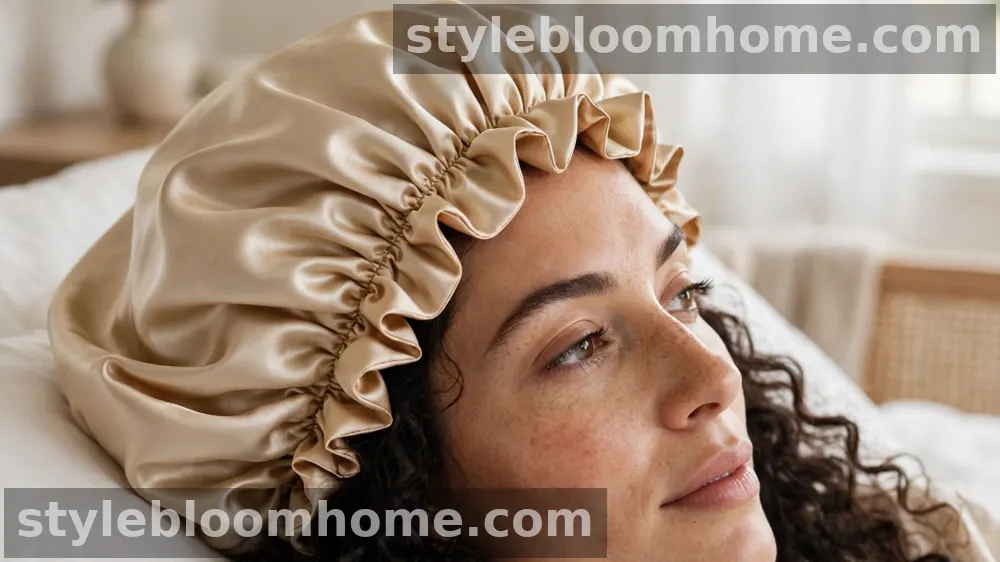
Illustration: a woman in a champagne silk bonnet, resting on a white pillow.
What a silk bonnet actually does for your hair
A silk bonnet does one job, and it does it quietly. While you sleep, your hair rubs against your pillowcase. Cotton grips. It catches the cuticle, pulls at tangles, and drinks the moisture your hair spent the day holding. A silk surface lets hair glide instead of catching. The result is not magic. It is less friction, night after night, and hair that keeps its shape, its moisture, and its ends in better condition than hair that has been abraded for eight hours.
That is the whole mechanism, and it is worth stating plainly because bonnet marketing rarely does. A bonnet does not feed your hair. It does not add protein, repair split ends, or grow new hair. What it does is protect the hair you already have from the most boring damage there is: rubbing. Over weeks, that shows up as fewer tangles in the morning, curls and waves that hold their pattern to the second day, less frizz at the hairline, and ends that do not thin out as fast.
Silk earns its place here for two reasons beyond smoothness. It is a natural protein fibre, so it breathes and does not trap heat the way a synthetic cap can, and it absorbs far less moisture than cotton, so leave-in products and natural oils stay on the hair instead of moving into the pillowcase. Those are properties of the fibre itself, not of any single brand. A polyester satin bonnet gives you the smooth glide at a lower price, and for many people that is enough. Silk adds breathability and moisture behaviour that satin, being a weave rather than a fibre, cannot promise on its own. Which one you need depends on how hot you sleep, how dry your hair runs, and what you are willing to spend — the comparison later in this guide works through it honestly.

The best silk bonnets in France at a glance
Every pick below is a style, not a promise. Two of them name a specific product whose price and fabric specification we verified live on the retailer's own page on 31 October 2026. The other four describe a type, with the checks that type must pass before you pay.
| Style | Best for | Fabric, verified | Price, verified |
|---|---|---|---|
| Blissy Classic Large | Long, thick, or high-volume hair | 100% 22-momme 6A mulberry silk | €86.95, Blissy France storefront |
| Blissy Classic Regular | Short to medium hair, first silk bonnet | 100% 22-momme 6A mulberry silk | €81.95, Blissy France storefront |
| Emily's Pillow Paris bonnet | Adjustable fit; French brand | 100% 19-momme grade 6A mulberry silk | $80.00 USD as shown, Paris storefront |
| Long silk sleep cap | Very long hair, braids, extensions | Check listing: mulberry silk + momme stated | Check at checkout; no price verified |
| Double-layer silk bonnet | Dry hair, overnight treatments | Check listing: silk on the inside layer | Check at checkout; no price verified |
| Budget silk bonnet | Testing the habit at the lowest spend | Check listing: fibre content stated, or walk away | Check at checkout; no price verified |
How we chose these picks
We did not test these bonnets at home, and this guide does not pretend otherwise. What we did, on 31 October 2026, was open the retailer pages themselves and read what the sellers actually state: fibre content, momme weight, grade, size, closure, care instructions, price, shipping, and returns. Where a page stated a fact, this guide repeats it with the source named. Where a page stayed silent, this guide says so instead of filling the gap with a guess.
The search behind this guide started with the questions people actually ask. The largest groups in the keyword research were where to buy, what a bonnet does, whether it helps, what to use instead, reviews and comparisons, satin against silk, curly-hair benefits, comfort, and price. This guide answers all of them, because the shop name is rarely the only thing the searcher needs.
We excluded two kinds of evidence. Prices seen only in search snippets were not used, because a snippet is not a shop page and snippet prices go stale. And marketplace listings that call a product "silk" without stating fibre content were treated as unproven, however many stars they carry. The honest version is the short version: two verified products, four types with checks, and no invented bargains.
The 6 best silk bonnet styles for France
Read these as six answers to six different heads of hair. The first three name verified products; the last three are types — buy them only when the listing passes the checks under each one.
1. Best verified silk: Blissy Classic Large — €86.95
Best for: long, thick, or high-volume hair, and anyone whose last bonnet felt crowded. Verified live on 31 October 2026: the Blissy France storefront lists the Pink Classic Large at €86.95 with free shipping and a 60-day returns window for eligible purchases. The fabric specification is stated in full on the product page: 100% 22-momme 6A grade mulberry silk, Oeko-Tex certified, machine washable on a gentle cycle in a mesh bag. Why it earns the top spot: it is the only bonnet in this guide whose every claim — fibre, weight, grade, size, price, shipping, returns — was readable on one page, in euros, on a storefront that serves France. Watch out for: the price. At €86.95 this is a considered purchase, not an impulse one. Search Amazon.fr for mulberry silk bonnets.
2. Best standard size: Blissy Classic Regular — €81.95
Best for: short to medium hair, finer hair, and a first silk bonnet. Verified live on 31 October 2026: the Blissy France storefront lists the Classic Regular in Silver, Taupe, and Rose Gold at €81.95 each, with the same free shipping and the same fabric specification as the Large: 100% 22-momme 6A grade mulberry silk, Oeko-Tex certified. The Regular measures 8 by 10 inches. Why it earns its place: most heads of hair do not need the Large. A bonnet that fits the head stays on; a bonnet with room to spare slips, and a slipped bonnet protects nothing. Watch out for: volume. Thick hair, a lot of length, braids, or extensions will crowd this size, and crowding flattens curls and loosens the band. Search Amazon.fr for 19-momme silk bonnets.
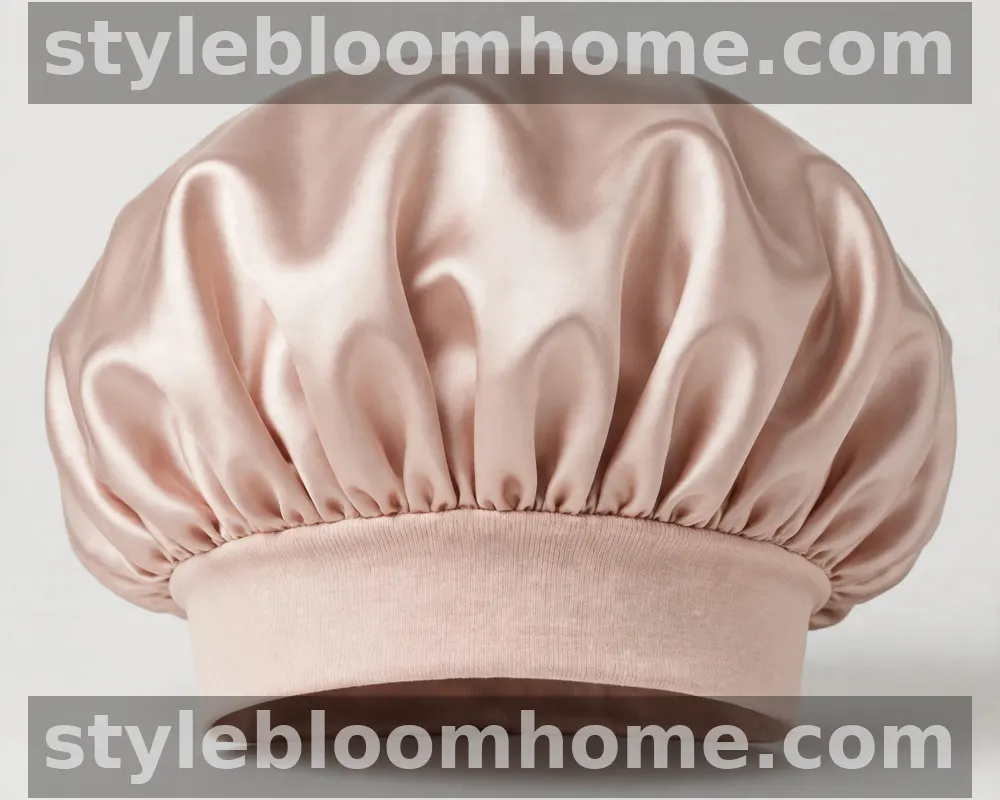
3. Best French brand: Emily's Pillow Paris bonnet — $80.00 USD as shown
Best for: anyone who wants an adjustable fit and a French brand behind the product. Verified live on 31 October 2026: the Emily's Pillow Paris storefront lists its silk hair bonnet at $80.00 USD, in stock, in Midnight Blue and Rosewood. Read that price as shown: the Paris storefront displays dollars, and this guide does not convert it into euros, because a converted price is a guess dressed as a fact. The composition is stated on the page: 100% organic mulberry silk, excluding the elastic and velcro, 19 momme, grade 6A fibres, handcrafted in the Jiangsu region, with an adjustable velcro closure and a stretchy elastic band. The page states the bonnet fits thick, long, and high-volume hair, and names curl patterns from 2C through 4C. Why it earns its place: it is the only French brand in this guide with a full specification on its own page, and the velcro adjustment solves the commonest fit complaint — a fixed elastic that is either too tight or too loose — without a tie to retie at 3 a.m. Watch out for: the currency. Check what you will actually be charged in euros, including any conversion your bank applies, before you decide this is cheaper or dearer than the Blissy. Search Amazon.fr for adjustable silk bonnets.
4. Best long-form: long silk sleep cap
Best for: very long hair, braids, locs, and extensions that a standard cap flattens or fails to contain. What to look for: length first. The long-form caps whose listings state dimensions run around 64 cm long and 26 cm wide, with an elastic band that stretches from about 52 to 66 cm, plus a ribbon or tie at the back. Checks before you pay: the listing must state 100% mulberry silk and a momme weight. A long cap that states neither is a long satin cap wearing a silk title, and the price should be judged accordingly. Watch out for: the "one size fits all" claim. On a long cap it is usually true for head circumference and false for hair volume: if your braids are thick, the stated stretch range matters more than the headline. No price is stated here; check the listing before you buy. Search Amazon.fr for long silk bonnets.
5. Best double-layer: double-layer silk bonnet
Best for: dry hair, overnight treatments, and anyone whose single-layer cap feels too thin to trust. What double-layer means: two layers of fabric, with the inner layer the one that touches your hair. The inner layer is where the money goes: it should be silk, and the listing should say so. Checks before you pay: "silk inside and out" or "double-lined silk" in the specification, a momme weight, and care instructions that match silk rather than polyester. If the care instructions say tumble dry hot without a second thought, the fabric is probably not the silk the title claims. Watch out for: heat. Two layers are warmer than one. If you sleep hot, a double-layer cap can become the reason the bonnet comes off at 2 a.m., and a bonnet on the floor protects nothing. No price is stated here because no double-layer listing was verified live for this guide. Search Amazon.fr for double-layer silk bonnets.
6. Best budget entry: budget silk bonnet
Best for: testing whether you will actually wear a bonnet every night before spending €80 or more. What budget silk usually means: a lower momme weight, typically 19 rather than 22, a simpler elastic, and fewer colours. What budget usually does not mean, whatever the listing title says, is 22-momme 6A silk at a third of the verified price. Checks before you pay: fibre content stated as a percentage, a momme weight stated, a returns window you can actually use from France, and a seller with a reachable address. If any of those four is missing, the saving is not a saving; it is a gamble with the postage. Watch out for: the word "silk" doing all the work. "Silk-feel", "silky", "satin silk", and "silk-like" are not silk. Neither is a bonnet that is 15% silk blended with cotton, however honestly the blend is labelled — that is a knit hat with silk in it, not a silk bonnet, and it will not behave like one. No price is stated here because no budget listing was verified live for this guide. Search Amazon.fr for budget silk bonnets.
Where to buy a silk bonnet in France
There is no French high street of silk bonnets. What France has is three routes, and they are not equal. The first is the brand storefront: Blissy sells to France in euros from its en-fr storefront with free shipping, and Emily's Pillow sells from Paris with its own storefront. The second is Amazon.fr: a wider range, faster-moving prices, and search results that mix real silk, satin, and blends under the same search words. The third is the French-facing specialist collections that appear in search results — MYSILK, Chillsilk, and SilkSilky among them. We could not verify a bonnet specification or a price for any of those three at writing time, so none of them is recommended here.
Delivery and returns are part of the price, not an afterthought. Blissy states free shipping on its France storefront and a 60-day returns window for eligible purchases, with conditions on packaging and item condition. Emily's Pillow states free shipping over $200 on its storefront — again, dollars as shown — and easy returns, with the detail that its silk travels to France principally by rail. A silk bonnet bought from a seller you cannot contact is a silk bonnet you cannot return.
The "near me" question deserves a direct answer. Searchers ask for a silk bonnet near them, and the honest answer for France is that no national shop chain stocks a verified mulberry silk bonnet range you can walk in and inspect. If you find one in a shop, read the label in your hand before you pay — the same checks apply, and a shop label you can read is worth more than any online description.
How expensive is a real silk bonnet, then? On verified evidence: €81.95 to €86.95 for a 22-momme 6A bonnet from Blissy, and $80.00 USD as shown for a 19-momme grade 6A bonnet from Emily's Pillow Paris. Everything below that range is either a lower momme weight, a simpler construction, or an unverified claim, and the honest way to judge it is by the specification on its listing, not by how far below €80 it sits. A €30 bonnet with a stated 19-momme mulberry silk specification and a usable returns window can be a good buy.
How to read a silk label: momme, grade, and the claims to check
Two words do most of the work on a silk label, and both are routinely misused. Momme, pronounced "mommy", is a weight: the weight in pounds of a piece of silk 45 inches wide and 100 yards long. For bonnets, 19 momme is standard and light; 22 momme is heavier and longer-wearing. Neither number is a quality score on its own. A 22-momme bonnet is not "better" than a 19-momme one in any absolute sense; it is heavier, longer-wearing, and warmer.
Grade is the other word. Silk fibre is graded, and 6A is the top grade: long, uniform fibres that make a smoother, stronger fabric. Both verified products in this guide state grade 6A — Blissy as "6A grade", Emily's Pillow as "grade 6A fibres". Here is the honest limit of that fact: grade is a claim the seller makes about its own fibre, and no bonnet listing we read carried an independent certificate proving the grade of the finished bonnet. Oeko-Tex certification is a safety certification, not a silk-content certificate. Both facts are reasons not to treat "6A" printed on an unknown listing as proof of anything.

The label check takes under a minute, and it is the single most useful skill in this guide. Read the composition line first: it should state a percentage and a fibre, as in "100% mulberry silk". If it states no percentage, the product has not told you what it is. If it says "silk-feel", "silky", or "satin silk", it has told you what it is not. Read the momme weight second: a stated number can be judged; an absent number cannot. Read the care instructions third: silk asks for cold water and air drying.
Two traps deserve naming. The first is the blend trap: a bonnet that is 15% silk and 85% cotton is honestly labelled and still not a silk bonnet. Such a knit bonnet is a hat with silk in it, not a silk bonnet. The second is the satin trap: satin is a weave, and a satin bonnet can be woven from silk, polyester, or anything else. "Satin bonnet" tells you how the fabric shines, not what it is made of. The Blissy product page puts it well: a shiny finish does not tell the whole story, and the fibre content is what you check. When a listing says "satin" and nothing else, assume polyester until the composition line proves otherwise.
A final honesty note, because the keyword research contained no momme, grade, or charmeuse rows at all: This section exists anyway, because the number is the difference between a verified purchase and a hopeful one, and a buying guide that skipped it would be leaving its readers unarmed at the exact moment they pay.
Straight hair: does a silk bonnet help?
Yes, with a narrower promise than the curly-hair case. Straight hair does not need a bonnet to keep a curl pattern, because there is no pattern to keep. What it needs protection from is the same nightly friction: ends that catch and split, lengths that tangle at the nape, and a blowout that goes flat by morning. A silk bonnet reduces all three, because the hair glides instead of catching and the style is held, loosely, in one place instead of being dragged across a pillowcase all night.
The honest limit is that a bonnet will not give straight hair volume, and it can flatten the roots if the cap is tight or the hair is tucked flat against the head. The fix is fit, not force: gather the hair loosely, choose a cap with room rather than compression, and let the bonnet hold the length without pressing the roots down. If your blowout still falls flat, the bonnet is probably too small or too tight, or the hair went in damp — the wet-hair section below explains why damp hair undoes the benefit. The benefit is real, it is just friction and tangle reduction rather than moisture rescue, and a guide that promised more would be overselling. Search Amazon.fr for silk bonnets for straight hair.
Wavy hair: keeping the wave without the frizz
Wavy hair sits between the two clear cases, and it is where a bonnet earns its keep most quietly. A wave pattern is strong enough to be worth preserving and loose enough to be destroyed by one night on cotton. The bonnet's job for wavy hair is to hold the wave's shape without pressing it flat and without adding frizz at the crown, where wavy hair frizzes first. Gather the hair loosely, do not twist it tight, and choose a cap with enough room that the wave is not compressed into a single clump. A tie or adjustable closure helps here, because the fit can be loose at the hairline and secure at the nape, which is the combination that preserves a wave.
The morning test for wavy hair is simple: does the wave need only a shake and a little water, or does it need restyling from scratch? If the bonnet is doing its job, the answer trends toward the shake. If the wave comes out flattened on one side, the cap was too tight on that side or the hair went in twisted.
Curly, coily, and protective styles
This is the hair a bonnet was made for, and the research agrees: curly-hair benefits were one of the largest question groups, and the French brand page itself names curl patterns from 2C through 4C. A night on cotton pulls curls apart, lifts the cuticle, and dries the lengths. A silk bonnet holds the curls together in their shape, keeps the cuticle lying flat, and leaves the moisture where the hair put it.
For coily hair, the fit rules change. Volume is the constraint, not length. A cap that fits the head but not the hair will compress coils, and compressed coils lose definition and gain tangles at the roots. Size up, choose a gathered or halo shape with real interior room, and check that the band is wide and soft, because a narrow band on dense hair concentrates pressure at the hairline, which is exactly where edges are most fragile. Protective styles — braids, twists, locs — need the long-form cap from the styles section, because the style itself is the volume. Extensions need the same room.
A bonnet preserves a style; it does not create one. Put the bonnet on hair that is dry, detangled, and gathered loosely, and it will return the favour. Put it on a knot, and it will keep the knot.
Silk bonnets for men
Men wear bonnets for the same reasons women do: friction, frizz, and keeping a style or a texture intact overnight. The research contained a visible group of men asking about bonnets, and the answer is straightforward: hair does not know who owns it. Long hair, curly hair, coily hair, braids, locs, and hair that is thinning all benefit from less nightly friction, and a bonnet is the simplest way to buy that. The fit questions are the same: size for volume, a wide soft band, a closure that stays put without a headache.
Ignore the marketing and read the specification: fibre, momme, size, closure. A plain dark bonnet in the right size does the same work as a patterned one, and the Blissy Regular in Silver, Taupe, or Grey is as unisex as a cap gets. There is no hair-care reason for a man not to wear a bonnet. Search Amazon.fr for silk bonnets for men.
Silk bonnets for children
Children's hair tangles just as readily as adults', and a bonnet can save a genuinely miserable morning of detangling. The research contained a small group of questions about bonnets for children, and the advice is practical rather than technical: buy the child's size, not a shrunken adult one; choose a soft, wide band that cannot tighten into discomfort; and prefer a tie or adjustable closure over a fixed elastic, because a child's head grows and a fixed band does not.
Two cautions. First, a bonnet is not a sleep aid and not a toy: a very young child should not wear anything with long ties unsupervised, and if the child pulls it off every night, that is the child voting, not a failure to be corrected. Keep the routine simple: dry hair, loose gather, bonnet on. Search Amazon.fr for children's silk bonnets.
Wet hair: should you put a bonnet on damp hair?
No. Put the bonnet on dry hair, and treat that as a rule rather than a preference. Wet hair is at its most fragile: the shaft swells, the cuticle lifts, and the hair stretches and breaks more easily than dry hair does.
If your routine is a wash night, let the hair dry first — fully dry, not "mostly dry" — and then gather it loosely into the bonnet. The bonnet's job starts when the hair is dry. Before that, its job is to stay in the drawer. Leave-in products on dry hair are fine; water is the problem, not product.
Silk vs satin: which one should you buy in France?
Start with the distinction, because the whole market depends on blurring it. Silk is a fibre: a natural protein filament from the silkworm, graded and weighed in momme. Satin is a weave: a way of weaving any fibre so the surface shines and feels smooth. A satin bonnet can be woven from silk, from polyester, or from a blend, and the word "satin" alone tells you nothing about which. A silk bonnet is always silk, because the word names the fibre.
On performance, the honest summary is this. Both reduce friction against a pillowcase, and for that job alone, a polyester satin bonnet is good value: it is cheaper, it washes easily, and it does the glide. Silk adds three things satin cannot promise: breathability from a natural fibre, lower moisture absorption so hair keeps its moisture, and temperature regulation that keeps a hot sleeper cooler. On price in France, the verified silk in this guide sits at €81.95 to €86.95 and $80.00 USD as shown, while satin bonnets verified for the companion satin guide sat at €12.90 to €34.99. That gap is the real choice: silk is the better fibre and roughly three times the price of good satin. Buy silk if your hair is dry, curly, coily, or heavily styled, and if you will wash it properly. Buy satin if the budget is tight, the hair is short or straight, or you are testing whether the habit sticks.
How to choose: size, band, lining, and closure
Four checks, in order, and no fifth is needed. Size first: measure the hair gathered, not the head. A gathered bundle of curls needs a cap with interior room; a cap that fits the head and crushes the hair has failed. Check stated dimensions before you buy. Band second: wide and soft beats narrow and tight, every time. A narrow elastic is the commonest cause of both slipping and headaches, and it is the first thing to check in the listing photographs.
Lining third: the inside is the product. The surface that touches your hair should be the silk the listing claims, smooth, with no exposed elastic, rough seam, or scratchy edge. Double-layer caps must state silk on the inside layer, not just the outside. Closure fourth: elastic, tie, or velcro, chosen for how you sleep. A tie adjusts to any head but needs retying and can come undone. Velcro adjusts finely and stays; check the tab cannot catch hair at the edge. Active sleepers should weight the closure more heavily than any other feature: the best bonnet in the world is useless on the pillow beside you. Search Amazon.fr for 22-momme silk bonnets.
How to wear it so it stays on
Staying on is the complaint that dominates every bonnet discussion, and it is mostly a fit problem wearing a mystery costume. The method is simple. Start with dry, detangled hair. Gather it loosely — a low, loose gather for length, a pineapple gather for curls, braids laid flat rather than piled. Hold the bonnet open with both hands, tip the head forward slightly, and let the hair fall into the cap rather than stuffing it in. Settle the band at the hairline. Adjust the closure until the bonnet feels secure without pressure, then shake your head gently. If it moves, tighten one step. If it hurts, loosen one step.
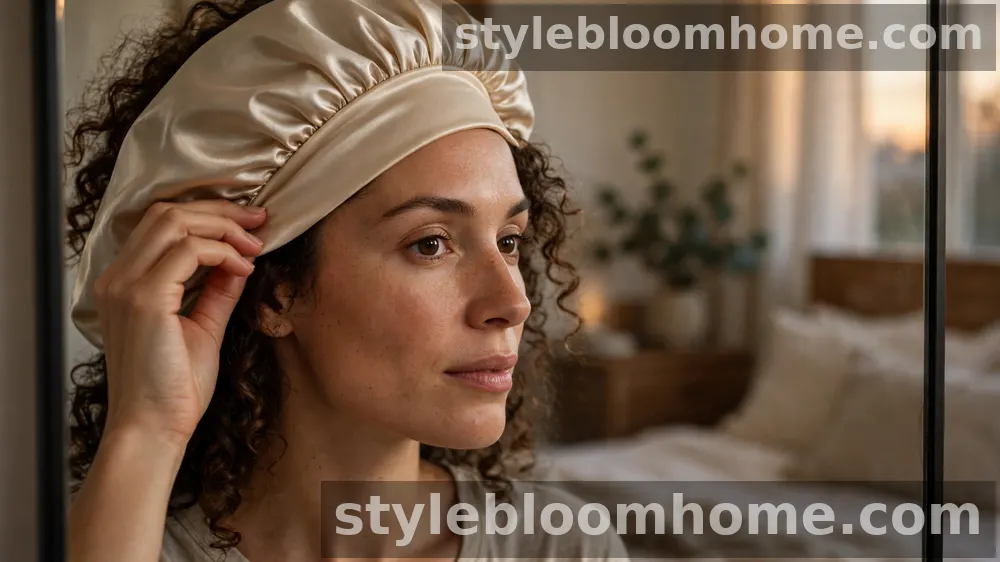
If it still slips, work through the causes in order. Wrong size is first: a cap that is too big for the hair will migrate, and a cap that is too small will pop off when the hair settles. Band second: a stretched elastic, a band that has gone smooth with washing, or a band that was narrow to begin with. Tie and velcro closures solve most of the rest, because they let you set the tension instead of accepting the elastic's opinion. Hair texture third: very silky, fine hair slips more than textured hair, and a tie or velcro closure earns its keep there. Finally, try a silk pillowcase underneath: the combination helps persistent slippers. If none of that holds it, the bonnet is the wrong shape for your head, and no technique will fix a shape mismatch.
How to wash a silk bonnet
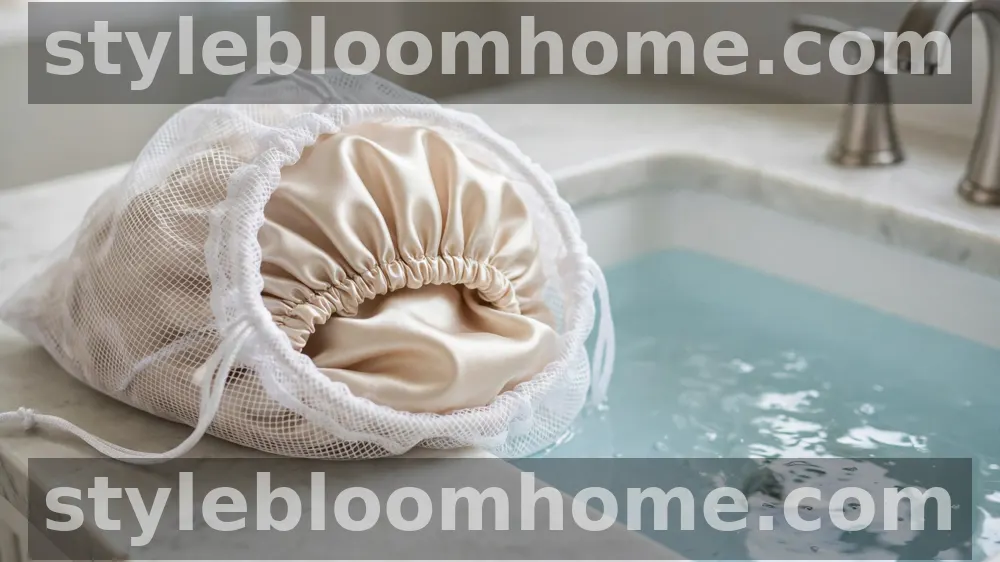
Silk asks for gentleness, and it repays gentleness with years. Hand wash or machine wash cold, on a delicate cycle, at no more than 30°C, with a mild detergent made for silk or delicates, inside a mesh laundry bag. Turn the bonnet inside out before washing, so the surface that touches your hair is the surface that gets cleaned. Rinse without wringing: press the water out gently between your hands or a clean towel, never twist. Lay flat or hang to air dry, away from direct sun and radiators. No bleach, no fabric softener, no tumble dryer. Search Amazon.fr for machine-washable silk bonnets. Fabric softener coats silk fibres and dulls the smoothness you bought the bonnet for; heat damages the fibre itself.
How often? Weekly is the honest rhythm for nightly wear, because the bonnet collects oils, leave-in products, and shed hair, and a dirty lining is a rough lining. Inspect the lining monthly: run a finger over the inside surface and look for pilling, roughness, or thinning at the band. A lining that has gone rough is no longer protecting your hair, however good the bonnet once was. When the elastic loosens and slipping returns after months of good service, or the lining pills despite correct washing, replace the bonnet. A silk bonnet is not a lifetime purchase; it is a durable one, and knowing when it is done is part of owning it well.
What to use instead of a silk bonnet
Not everyone wants a cap on their head at night, and the alternatives are real, not consolation prizes. The silk pillowcase is the best of them: the same smooth, low-friction, low-absorption surface, with nothing to wear and nothing to slip off. It protects less than a bonnet, but pairs with one rather than competing with it. A satin pillowcase does the same job at a lower price with a synthetic surface; judge it by the same fibre honesty as a bonnet. Search Amazon.fr for silk pillowcases.
A silk or satin scarf, wrapped and tied, is the traditional alternative and the cheapest: it contains the hair, it glides, and it costs little. Its weakness is the knot, which loosens, and the edges, which can catch. The pineapple method — a loose, high gather held with a soft scrunchie — preserves curls without any purchase at all, though it does nothing about friction at the nape. Short healthy hair washed daily may need nothing at all. Choose the alternative that you will actually use every night. A pillowcase used nightly beats a bonnet worn twice.
Skip it if: honest objections answered
Skip the bonnet if you sleep hot and will not tolerate anything on your head: a bonnet on the floor helps nobody, and a silk pillowcase is the better spend for you. Skip it if you cannot commit to the washing rhythm: a dirty silk bonnet is worse than no bonnet, because a rough lining abrades the hair it should protect, and a bonnet washed badly will go rough fast.
Two objections deserve longer answers because they come up in the questions people actually ask. The first is the cultural question: is it okay to wear a bonnet, and does it belong to one group? The honest answer is in the FAQ below, and the short version is this: a bonnet is a hair-care tool with deep roots in Black hair care, where protective styling and nighttime protection have a long and serious history. Wearing one to protect your hair is not barred to anyone, of any background. What matters is respect: wear it for hair care, not as a costume, a joke, or a mimicry, and do not treat a tool other people rely on as a novelty. The second objection is the price: €80 or more for a sleep cap feels absurd until you divide it by the nights. A bonnet worn nightly for two years costs about eleven cents a night at €80.
First night and first month: what to expect
The first night feels strange. That is normal, and it passes. The bonnet feels present on the head in a way a pillowcase never does, the band is noticeable for the first hour, and most people check twice that it is still there.
The first week brings the first visible change: less tangling in the morning, and styles that hold to the second day with a shake rather than a restyle. The first month brings the change that matters: ends in better condition, less frizz at the hairline, curls and waves that keep their pattern longer, and quieter mornings. Judge it after a month of nightly wear, washed weekly, on dry hair.
Frequently asked questions
- Is a silk bonnet good for hair?
- Yes, for most hair. A silk bonnet reduces friction while you sleep, so hair tangles less, keeps its shape better, and breaks less at the ends. It protects the hair you have; it does not grow new hair or repair split ends.
- What does a silk bonnet do?
- It lets hair glide instead of catching on a pillowcase. That means less friction, fewer tangles, less frizz, and less moisture lost to cotton overnight. The benefit is cumulative: quieter mornings and ends in better condition over weeks.
- Which is better, a silk or satin bonnet?
- Silk is the better fibre: breathable, low-absorption, temperature-regulating. Satin is a weave, usually polyester, and it is cheaper, easier to wash, and does the friction job well. Buy silk for dry, curly, coily, or heavily styled hair; buy satin for a tight budget or a first try.
- How expensive is a real silk bonnet?
- On verified evidence in France: €81.95 to €86.95 for a 22-momme 6A bonnet from Blissy, and $80.00 USD as shown for a 19-momme grade 6A bonnet from Emily's Pillow Paris. Cheaper bonnets exist, but judge them by the specification on the listing, not by the price alone.
- Where can I buy a silk bonnet in France?
- From brand storefronts that serve France — Blissy in euros with free shipping, and Emily's Pillow Paris — or from Amazon.fr search links, where you must check the fibre content yourself. No national shop chain stocks a verified mulberry silk bonnet range you can inspect in person.
- Does a silk bonnet help straight hair?
- Yes, more narrowly than for curly hair. It reduces tangles, protects a blowout overnight, and limits end damage from friction. It will not add volume, and a cap that is too tight can flatten the roots, so fit matters more than brand.
- Should I sleep with a silk bonnet every night?
- Yes, if the fit is right. The benefit comes from nightly use, because friction happens every night. If the bonnet slips off or hurts, fix the fit — size, band, closure — before giving up the habit.
- How do I keep a silk bonnet on all night?
- Size for hair volume, set the band at the hairline, and adjust the closure until it feels secure without pressure. Gather hair loosely, start with dry detangled hair, and prefer a tie or velcro closure if a fixed elastic slips. A silk pillowcase underneath helps persistent slippers.
- How do I wash a silk bonnet?
- Cold water at no more than 30°C, mild detergent, inside a mesh laundry bag, on a delicate cycle or by hand. Press water out gently, never wring, and air dry away from sun and radiators. No bleach, no fabric softener, no tumble dryer. Wash weekly for nightly wear.
- What can I use instead of a silk bonnet?
- A silk pillowcase is the best alternative: the same smooth surface with nothing to wear. A satin pillowcase, a wrapped silk or satin scarf, a loose pineapple gather, or a loose braid all do part of the job. Short healthy hair washed daily may need nothing at all.
- Is a silk bonnet good for curly hair?
- Yes, curly hair benefits most. A bonnet holds the curl pattern together overnight, keeps the cuticle flat, and preserves moisture, so curls need refreshing rather than rebuilding in the morning. Size up for volume and choose a wide soft band.
- Can men wear a silk bonnet?
- Yes. Hair does not know who owns it, and long, curly, coily, braided, or thinning hair all benefits from less nightly friction. Read the specification — fibre, momme, size, closure — and ignore the marketing colours.
- Can children wear a silk bonnet?
- Yes, in a child's size with a soft wide band and an adjustable closure, never a fixed elastic that can tighten as the child grows. If the child pulls it off every night, use a silk pillowcase instead, and never leave long ties unsupervised on a very young child.
- Silk bonnet or silk pillowcase — which first?
- A bonnet first if your hair is long, curly, coily, braided, or styled, because containment is the bigger half of the job. A pillowcase first if you will not wear a cap, sleep hot, or have short hair. The two together are the fullest protection, and neither is wasted.
- Is it okay to wear a bonnet as a white person?
- Yes. A bonnet is a hair-care tool, and protecting hair while you sleep belongs to no one group. Bonnets and protective styling have deep roots in Black hair care, and that history deserves respect: wear a bonnet for hair care, not as a costume or a joke, and do not mock or mimic. No rule bars anyone from wearing one.
The bottom line
France has no local silk-bonnet guide. This guide set out to be the France-first answer, and the honest version of that answer is shorter than the marketing would like. Two products verified live, with full specifications and readable prices: the Blissy Classic at €81.95 and €86.95, and the Emily's Pillow Paris bonnet at $80.00 USD as shown. Four types with checks, for everyone else.
Buy the bonnet that states 100% mulberry silk and a momme weight, in the size your gathered hair actually needs, with a band that stays put without biting. Wash it gently, weekly, and put it on dry hair. Give it a month. The mornings will tell you whether it was worth it, and unlike most beauty promises, this one can be checked every single morning, in the mirror, for free.