Satin Bonnet vs Silk Bonnet: Which One Does Your Hair Actually Need?
Silk sellers will tell you silk wins. Satin sellers will tell you it makes no difference. Both are selling something — so here is the comparison with the selling taken out: what each material actually does at 3 a.m., where the difference is real, where it is marketing, and the three questions that settle it for your hair.
- Satin is a weave, silk is a fibre. Most satin bonnets are polyester; silk is a natural fibre that is itself usually woven as satin. Comparing the two words is the first mistake — compare labels instead.
- On friction — the main job — they are close. Cotton is the real enemy; leaving cotton behind is most of the win, whichever smooth fabric you choose.
- Silk genuinely wins on breathability and lifespan — cooler for hot sleepers, and it lasts years where satin lasts months.
- Satin genuinely wins on price, washing and rotation — several bonnets for the price of one silk one, machine-washable, and kinder to heavy oil-and-butter routines.
- The worst outcome in this whole comparison is not choosing the "wrong" fabric — it is paying silk prices for polyester, which the label check below prevents.
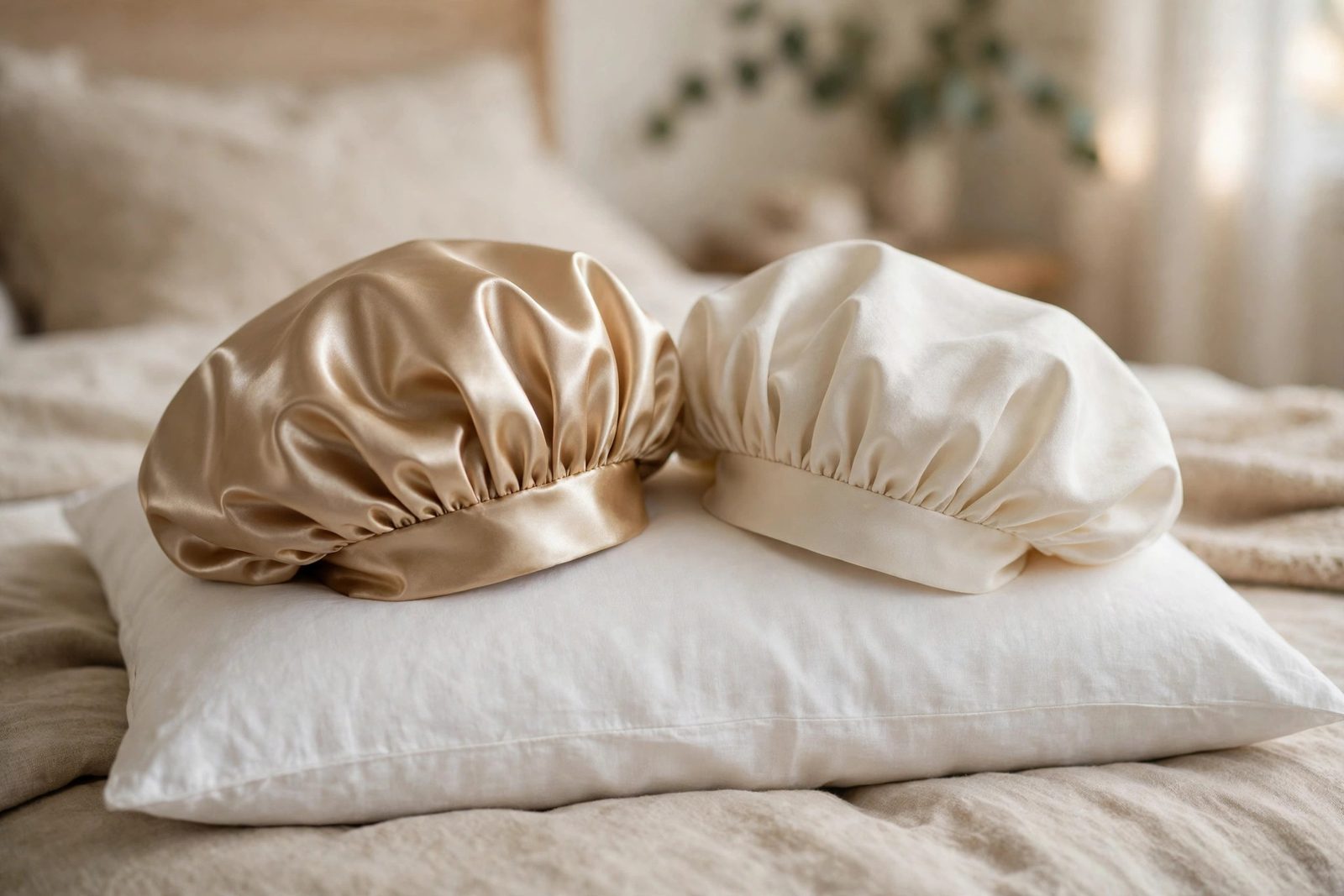
Same shape, same job, two different fabrics — a satin bonnet and a silk bonnet side by side
If you have ever stood in front of two bonnets — one satin, one silk, the silk one costing several times more — and wondered whether the expensive one is genuinely better or just better marketed, you are asking the right question in a market full of convenient answers. Almost every page that ranks for this comparison was written by a company that sells one of the two fabrics, and by a remarkable coincidence, the fabric they sell always wins. Full disclosure of our own position before we start: this site does not make bonnets, but our guide to the best satin bonnets for curly hair recommends satin picks — which is exactly why this page has to be fair to silk, including the places where silk honestly wins, or it would not be worth your trust.
Here is the shape of the honest answer, before the detail. The thing both fabrics do — glide over your hair instead of grinding against it — they do almost equally well, and it is the thing that matters most. The differences that are real live elsewhere: in heat, in lifespan, in the wash, and in the price. Whether those differences are worth paying for depends on three things about you — your hair, how hot you sleep, and how rough your wash routine is. Everything below is organised around those three questions, because a verdict that ignores them is just an advertisement.
As an Amazon Associate, StyleBloom earns from qualifying purchases. This guide contains affiliate links — it costs you nothing extra and keeps our content free.
Last updated: 21 October 2026
Satin vs silk bonnet: the 20-second verdict
Short answer: For most women, a good satin bonnet does the protective job nearly as well as silk for a fraction of the price. Choose silk if you sleep hot, have a sensitive scalp, or want one bonnet that lasts for years — those are the three situations where silk's premium is real.
The whole comparison on one screen. Every row is argued properly in the sections that follow, so if a row surprises you, the reasoning is a scroll away:
| Satin bonnet (usually polyester) | Silk bonnet (real mulberry silk) | |
|---|---|---|
| What it actually is | A weave, not a fibre — most satin bonnets are polyester woven smooth and glossy | A natural protein fibre from silkworms, usually woven in a satin weave (charmeuse) |
| Glide against hair | Very low friction — the main job, done well | Very low friction — marginally smoother than satin |
| Breathability | Low — traps heat and sweat against the scalp | High — naturally temperature-regulating |
| Moisture behaviour | Absorbs almost nothing — your leave-in stays on your hair, but so does sweat | Absorbs and releases moisture gradually without feeling wet |
| Feel | Smooth, glossy, can feel warm; slight static in dry air | Smooth, fluid, cool to the touch; less static |
| Durability | Roughly 6–12 months of nightly use before it pills or dulls | Years with gentle care — but snags and hates rough washing |
| Care | Easy — hand-wash, or machine delicate in a mesh bag | Delicate — hand-wash cool, gentle detergent, air-dry |
| Price band | The budget band — several bonnets for the price of one silk one | The premium band — typically several times the price of satin |
| Best for | Most hair, tight budgets, braids and locs, heavy product routines | Hot sleepers, sensitive scalps, buy-once readers, drier fine hair |
And the three questions that actually decide it. Do you sleep hot? If yes, silk's breathability is a real, nightly difference — keep reading the heat section. Do you load your hair with oils and butters? If yes, satin's washability usually beats silk's delicacy — the care section explains. Are you buying your very first bonnet? Then buy satin first: if the habit does not stick, you have lost very little, and if it does, you will know exactly what you want from an upgrade. Every other consideration — including most of what the internet argues about — is smaller than these three.
The thing nobody explains properly: satin is a weave, silk is a fibre
Short answer: "Satin" describes how a fabric is woven, "silk" describes what it is made of. Most satin bonnets are polyester in a satin weave; a silk bonnet is silk fibre, usually also woven as satin — so the two words were never opposites.
Start with the confusion itself, because it is where the money is made. Satin is a weaving pattern: the threads are floated across the surface in long runs, which is what produces that glossy face and the smooth, slippery feel. Any fibre can be woven that way. Silk is a fibre: a natural protein thread produced by silkworms, with mulberry silk — from worms raised on mulberry leaves — the longest, most even, most prized version. When a shop sells you a "satin bonnet", it has told you the weave and nothing about the fibre; in practice, at bonnet prices, the fibre is almost always polyester. When it sells you a "silk bonnet", the fibre is silk — and the weave is very often satin weave too, where it may also be called charmeuse. A silk bonnet can be a satin bonnet. A satin bonnet is almost never silk.

Glossy satin on the left, silk's softer lustre on the right — the sheen differs, the smoothness barely does
Why does this matter beyond pedantry? Because every real difference between the two bonnets — breathability, lifespan, care, price — comes from the fibre, not the weave. Polyester is a plastic filament: cheap, tough, washable, and nearly airless. Silk is a protein fibre: breathable, temperature-regulating, gentle — and correspondingly expensive and delicate. Once you see that the debate is really "polyester versus silk", the marketing fog lifts: of course the natural protein fibre breathes better and costs more; of course the plastic one washes easier and costs less. Neither fact is a scandal. The scandal is only in the labelling that hides which fibre you are actually buying, and there is a whole section on that below.
One more label word worth decoding now: momme. It is silk's weight measure — higher momme, denser fabric. Bonnet silk is commonly sold at 19 to 22 momme, and that range is the sweet spot for something you sleep in: lighter silk can feel flimsy and wear through faster, while much heavier silk adds cost and weight without adding protection. If a silk bonnet's listing never mentions momme at all, treat that silence as information.
Friction, heat and moisture: what actually differs at 3 a.m.
Short answer: On glide — the reason bonnets exist — silk is only marginally smoother than good satin. The differences you can genuinely feel are heat and moisture: silk breathes and steadies temperature, polyester satin traps warmth and sweat against your scalp.
Friction first, because it is the whole point. A bonnet protects hair by giving strands a surface they slide across instead of snagging on. Judged on that job alone, quality polyester satin and real silk are close — silk is the smoother of the two, but by a margin most heads cannot detect, and our night-routine guide's advice stands for both: rub the fabric on your cheek, and skip anything that drags. Where readers go wrong is comparing a premium silk bonnet against a bargain-bin satin one and crediting the fibre for what construction did. A double-layer satin bonnet with a smooth inner face protects better than a flimsy single-layer silk one, because the layer against your hair is the layer that counts.
Heat is where the tie ends. Polyester barely breathes. Worn all night, a satin bonnet — especially a double-layer one — holds warmth and sweat against your scalp, and if you are a hot sleeper, in a warm room, or going through the night-sweat years, you will feel it by 3 a.m. Silk is a temperature-regulating fibre: it feels cool going on, warms to you, and lets excess heat and moisture escape. This is silk's most honest advantage, the one even satin's defenders concede, and the reason hot sleepers are the readers who most consistently say the upgrade was worth it.
Moisture cuts both ways, so be suspicious of one-sided claims. Silk absorbs a measure of moisture and releases it gradually, which keeps the overnight environment steadier for dry, fragile hair. Polyester absorbs almost nothing — silk sellers present this purely as a flaw, but it has a genuine upside: your leave-in and oils stay on your hair instead of wicking into the fabric, which is part of why satin is so popular for moisture-hungry textured hair. The honest summary: silk manages the climate better; satin keeps your products where you put them. Which one your hair needs more is a real question with a personal answer, not a slogan. (One small extra: polyester can carry a little static in dry winter air; silk is less prone to it — a minor point unless your hair is fine and floaty, in which case it is not minor at all.)
The verdict by hair type and situation
Short answer: Satin is the right default for curly and coily hair, braids and locs, tight budgets and heavy product routines. Silk earns its price for hot sleepers, sensitive scalps, and fine or fragile hair where breathability and gentleness matter most.
Curly and coily hair. Your hair's needs are glide, room, and moisture kept in — and both fabrics glide. Satin is the practical default for most curls: it comes in genuinely roomy sizes, survives the weekly washing that oils and butters demand, and costs little enough that owning two or three in rotation is normal. Silk becomes the better answer if your curls dry out quickly and you sleep hot. If you are still deciding whether bonnets help curls at all, start with whether they protect length — our guide to whether a satin bonnet helps hair growth covers the evidence honestly.
Straight, fine or silk-pressed hair. Your margin for error is smaller — fine strands show friction damage and static sooner — but your protection needs are also simpler, since there is no curl pattern to preserve. A good satin bonnet is usually enough, and many straight-haired readers find even a smooth pillowcase sufficient. Silk earns consideration if static and floatiness are your specific complaints, or if your hair is fragile from colour or heat and you want the gentlest, coolest surface available.
Braids, twists and locs. Choose satin, and choose it by size first. Protective styles need volume — jumbo and extra-long bonnets — and those sizes are widely available in satin and rare, expensive, or simply absent in silk. The glide your braids need is identical from either fabric. Our dedicated guide to the best satin bonnet for box braids covers sizing for braids, twists and locs in detail; whichever fabric you buy, size up, because a bonnet stretched drum-tight over braids stresses the hairline it is meant to protect.
Hot sleepers. This is silk's clearest win, and it is not close. If you have ever peeled off a satin bonnet at 3 a.m. because your head felt swampy, the fibre was the problem, not you. Silk's temperature regulation is the difference between a bonnet you wear all night and one you abandon — and an abandoned bonnet protects nothing. One cheaper experiment first: a single-layer satin bonnet traps far less heat than a double-layer one. If that still sleeps hot, silk is your answer and it is money honestly spent.
Sensitive or itchy scalps. Silk has the edge: a natural, smooth protein fibre that breathes tends to be kinder to reactive skin than a synthetic that holds sweat against it. One caveat applies to both fabrics — detergent residue irritates more scalps than fabric does, so rinse thoroughly and keep the wash gentle. And a boundary we will not blur: a bonnet is comfort, not treatment. Ongoing scalp conditions belong with a doctor, not a fabric upgrade.
Tight budgets and first-time buyers. Buy satin, buy two, and rotate them. The maths in words: several decent satin bonnets change hands for the price of one genuine silk bonnet, which means the budget route also buys you a rotation — a clean bonnet every night while the other dries — something a single silk bonnet cannot do. If the habit sticks and you later upgrade, the satin ones retire gracefully to travel and wash-day duty. Nothing is wasted.
Heavy product routines. If your nightly routine involves oils, butters and leave-ins, your bonnet absorbs the evidence and needs washing every one to two weeks to avoid transferring it all back. Satin shrugs this off — machine-wash it in a mesh bag on delicate and it barely notices. Silk asks for hand-washing, cool water and gentle detergent, every time, and repeated product exposure is harder on it. Readers with rich routines are the ones silk quietly fails — not on their heads, but in their laundry baskets.
Readers avoiding animal products. A short, factual note: polyester satin is synthetic and involves no animal product; silk is an animal fibre, produced by silkworms. If that distinction decides it for you, satin is your fabric, and you lose nothing on protection by choosing it.
Durability and care: the honest lifespan comparison
Short answer: A satin bonnet worn nightly lasts roughly 6 to 12 months before it pills, dulls or loses its elastic — then it starts causing the friction it was bought to prevent. A silk bonnet, hand-washed gently, lasts years. Silk wins lifespan; satin wins the washing itself.
Polyester satin's decline is gradual and easy to miss. The glossy face dulls, tiny pills form where it rubs the pillow, the band's elastic relaxes — and one morning the bonnet that used to stay put is on the pillow instead. Our standing advice in the bonnet cluster is to replace a nightly satin bonnet every 6 to 12 months, sooner if the inside has gone rough; a worn bonnet is worse than a cheap new one, because rough satin is just friction with better marketing. Silk ages differently: looked after, it keeps its smoothness for years, which is the strongest single argument for its price. But "looked after" is doing real work in that sentence — silk snags on rough nails and jewellery, weakens with heat and harsh detergent, and its enemy is the careless wash, not the pillow.
The washing rules, side by side. Both fabrics: wash every one to two weeks — product build-up on the fabric transfers straight back to your hair and quietly defeats the purpose; cool water; air-dry away from direct heat. Satin: hand-wash in minutes, or machine-wash on delicate inside a mesh laundry bag — the bag matters, because agitation is what shortens the elastic's life. Silk: hand-wash only, cool water, a drop of gentle detergent — and avoid enzyme (protease) detergents, because silk is a protein and those detergents are built to digest protein. Squeeze, never wring. Our step-by-step guide to how to wash a satin bonnet walks through the satin routine in full.
So which works out better value? It depends entirely on which kind of owner you are. If you are disciplined — you will hand-wash one bonnet gently for years — silk's cost spreads across so many nights that it stops looking expensive. If your bonnets live a harder life — tossed in with the towels, replaced when they tire — satin's rotation of cheap spares wins easily. Neither answer is the smart one in general; each is the smart one for a specific person, and you know which person you are.
How to read a bonnet label (and spot fake silk)
Short answer: Ignore the product name entirely and read the materials line. Genuine silk says "100% silk" or "100% mulberry silk", usually with a momme weight. "Silky", "silk-like" and "premium satin" all mean polyester.
Sixty seconds with any bonnet listing, in this order. One: find the fibre content. It is the only line that legally has to tell the truth, and it settles everything — "100% polyester" ends the debate whatever the headline says. Two: if it claims silk, look for the specifics real silk sellers provide: mulberry, a grade, a momme weight in the 19–22 range. Vagueness is a tell; silk is expensive enough that honest sellers document it. Three: apply the price sanity check — genuine silk fibre costs real money before anyone sews it into a bonnet, so a "100% mulberry silk" bonnet priced like the polyester ones beside it is, with near certainty, not what it claims. Four: when it arrives, use the cheek test from our satin bonnet night routine: the fabric should glide against your cheek without dragging — that test judges smoothness (which is what your hair feels), even if it cannot prove fibre.
Ready to look at actual bonnets with the label rules in hand? The satin picks we have already vetted — sizes, bands and who each suits — are in our guide to the best satin bonnets for curly hair. If you are shopping silk, the same guide's honesty rules apply: fibre line first, momme second, price sanity always.
See mulberry silk bonnets on Amazon
Who should skip silk — and who should skip satin
Short answer: Skip silk if your routine is product-heavy, your budget is tight, your hair is in braids or locs, or you know you will not hand-wash anything. Skip satin if you sleep hot enough to abandon bonnets, or your scalp reacts to synthetics.
Skip silk if: you are buying a first bonnet and unsure the habit will stick; you need jumbo sizes for braids or locs; your nightly products would demand constant delicate washing; you avoid animal fibres; or the honest truth is that a hand-wash-only item in your home becomes a never-washed item — a dirty silk bonnet is worse than a clean satin one. Skip satin if: heat has already made you abandon a bonnet once (the fibre was likely the reason); your scalp is reactive and synthetics bother you; or you are a genuine buy-once person who will care for one good thing for years. And skip both upgrades if your current bonnet fits well, stays on, and gets washed — the best bonnet is the one already working. If yours keeps ending up on the pillow, that is a fit problem, not a fabric problem: our 9 fixes for keeping a satin bonnet on all night solve it more cheaply than any upgrade.
Red flags: what not to buy in either material
Short answer: The traps are the same in both fabrics — lying labels, mystery fibres, one-size-fits-none sizing and miracle claims. A bonnet is a simple product; anything complicated in its marketing is there to hide something simple.
"Silk" in the name, polyester in the materials. The single most common trap in this category, covered in the label section — check the fibre line before the price tempts you. No fibre content listed at all. A seller who will not say what a bonnet is made of has answered your question. "Silk satin blend" with no percentages. Blends exist, but an unquantified blend at a silk price is polyester wearing a silk name-tag. Growth and repair claims. No bonnet — satin, silk, or woven from unicorn hair — grows hair, repairs split ends, or treats a scalp. Brands implying otherwise are telling you how they do business. One-size claims on bonnets for big hair. Volume is the whole sizing question for curly, braided and locked hair; a bonnet that will not state its size will not fit it either. Suspiciously cheap "mulberry silk". Covered above, worth repeating: the fibre sets a price floor, and listings beneath it are fiction.
How we compared these (the honest version)
Short answer: We did not lab-test fabrics, and we do not sell either one. This comparison is built from what the materials verifiably are, the published care and construction facts, and the patterns that repeat across sellers, makers and wearers — with sellers' own statistics left out.
Three ground rules shaped this page. First, the fibre facts — what satin and silk are, what momme means, how each is washed — are checkable material facts, and we have stuck to the versions every source agrees on. Second, where silk brands publish dramatic statistics (precise friction percentages, moisture figures), we have not repeated them as facts: they originate with the sellers, and a comparison that borrows one side's marketing is not a comparison. Third, our own position is declared at the top of this page: this site recommends satin bonnets elsewhere and earns affiliate commission when readers buy through our links, including the two buttons above. We have tried to make that impossible to mistake for the conclusion — which is why the situations where silk wins are stated as plainly as the ones where satin does.
Frequently asked questions
- Is a silk bonnet better than a satin bonnet?
- For the main job — gliding over your hair instead of dragging on it — barely. Good satin and real silk are close on friction, and both are a different world from cotton. Silk genuinely pulls ahead on breathability and lifespan: it sleeps cooler and lasts years instead of months. Satin genuinely wins on price, washing and rotation. So the honest answer is: silk is better at some things, satin is better at others, and which list matters more depends on your hair and your sleep.
- Is satin a material?
- No — satin is a weave, not a material. It describes how threads are woven (long floats on the surface, which is what makes it glossy and smooth), not what they are made of. A satin bonnet can be woven from silk, polyester, nylon or viscose, and most satin bonnets on sale are polyester. The fibre — the part that decides breathability, care and price — is in the small print of the materials line, not in the word satin.
- What is mulberry silk, and what does momme mean?
- Mulberry silk is silk from silkworms raised on mulberry leaves; it produces the longest, most even fibres and is the standard quality silk used for bonnets and pillowcases. Momme (written mm) is silk's weight measure — the higher the number, the denser the fabric. Bonnet silk is commonly sold at 19 to 22 momme: below that range can feel flimsy and wear fast, and much above it you are paying for weight a sleep cap does not need.
- Will a silk bonnet make my hair grow faster than a satin one?
- No — and neither bonnet makes hair grow faster at all. Growth happens at the follicle at its own pace; a bonnet's job is protecting the length you grow from overnight friction and moisture loss so it stops snapping off before you see it. That is true of satin and silk equally. If growth is your actual question, our growth guide explains what bonnets can and cannot do.
- Which is better for curly hair, satin or silk?
- Both protect curls well, because curls mainly need low friction and room to keep their shape. Satin is the practical default for most curly hair: it comes in bigger sizes, survives weekly washing alongside oils and butters, and costs little enough to own two or three in rotation. Silk becomes the better choice if your curls dry out fast and you sleep hot — breathability is where it earns its price. Fit matters more than fibre: a silk bonnet that crushes your curls protects worse than a roomy satin one.
- Which is better for braids, twists and locs?
- Satin, in most cases. Protective styles need volume, and satin bonnets are widely sold in jumbo and extra-long sizes made for braids and locs, while silk bonnets in those sizes are rare and expensive. The smooth surface is what your braids need; either fabric provides it. Choose by size first, fibre second — and size up, because a bonnet stretched tight over braids stresses the hairline.
- How long does a satin bonnet last compared with a silk one?
- A polyester satin bonnet worn nightly typically lasts 6 to 12 months before the surface pills or dulls, the elastic gives out, or it starts slipping — at which point it creates friction instead of preventing it and should be replaced. A genuine silk bonnet, hand-washed gently and kept away from heat, lasts years. That lifespan gap is the strongest argument for silk; the counter-argument is that you can rotate several satin bonnets for the price of one silk one.
- Can I machine-wash a silk bonnet?
- It is not recommended. Silk is a protein fibre and rough treatment breaks it down: hand-wash in cool water with a drop of gentle detergent (avoid enzyme or protease detergents, which digest protein), squeeze rather than wring, and air-dry away from heat. Satin is more forgiving — hand-wash, or machine-wash on delicate inside a mesh laundry bag — and either fabric should be washed every one to two weeks, because product build-up on the fabric transfers straight back to your hair.
- How can I tell if a bonnet is real silk?
- Read the materials line, not the product name. Genuine silk says so plainly: 100% silk or 100% mulberry silk, usually with a momme weight. Wording like silky, silk-like, silk-feel or premium satin means polyester. Treat two things as red flags: silk in the headline but polyester in the materials, and a price far below every other genuine-silk listing — real silk fibre costs real money, and a bonnet priced like polyester usually is polyester.
- Is satin vegan? Is silk?
- Polyester satin is made from synthetic fibre, so it involves no animal product — if avoiding animal-derived materials matters to you, satin is your option. Silk is an animal fibre, produced by silkworms, so a silk bonnet is not vegan, however natural and biodegradable it is. Neither answer makes one fabric better than the other; it is simply a real difference worth knowing before you buy.
- My satin bonnet makes my head hot. Will silk fix that?
- Quite possibly, yes. Heat is polyester satin's genuine weakness: the fibre barely breathes, so warmth and sweat stay against your scalp, and a double-layer satin bonnet makes it worse. Silk regulates temperature noticeably better, which is why hot sleepers are the readers who most often say the upgrade was worth it. Before you spend, though, try a single-layer satin bonnet — construction traps as much heat as fibre does.