
Best Silk Bonnet in Germany (2026): 6 Styles That Stay On, With Prices Verified in Germany
Germany has no local silk-bonnet buying guide worth the name: only brand pages, marketplace listings, and guides written for the United States. Six styles, prices checked live on 31 October 2026, honest advice for every hair type.
By the end, you will know what a silk bonnet can and cannot do, how to tell real silk from a satin lookalike, what it should cost in Germany, where to buy it, and how to keep it on.
- Silk is a fibre; satin is a weave. A "silk bonnet" that never states fibre content has not proven it is silk.
- Prices checked live on 31 October 2026: Blissy €81.95 to €86.95, SilkSilky €24.95 and €29.99, each on its German storefront. Snippet-only prices were not used.
- Fit beats brand: size for hair volume, a wide band, and an adjustable closure matter more than any label.
- A bonnet reduces breakage from friction. It does not make hair grow, and no bonnet repairs split ends.
As an Amazon Associate I earn from qualifying purchases.
Last updated: 31 October 2026. Prices were checked on retailer pages that day and can change; the Amazon.de links are search links, so always check price, fibre content, and seller on Amazon.de before buying.

Illustration: a woman in a champagne silk bonnet, resting on a white pillow.
What a silk bonnet actually does for your hair
A silk bonnet does one job, quietly. While you sleep, hair rubs against the pillowcase. Cotton grips: it catches the cuticle, pulls at tangles, and drinks the moisture hair spent the day holding. Silk lets hair glide instead. The result is not magic — less friction, night after night, and hair that keeps its shape, moisture, and ends in better condition than hair abraded for eight hours.
That is the whole mechanism. A bonnet does not feed hair, add protein, repair split ends, or grow new hair. It protects the hair you have from the most boring damage there is: rubbing. Over weeks, that shows up as fewer morning tangles, curls and waves that hold to the second day, less frizz at the hairline, and ends that thin out more slowly.
Silk earns its place for two reasons beyond smoothness. As a natural protein fibre it breathes, and it absorbs far less moisture than cotton, so leave-in products and natural oils stay on the hair instead of moving into the pillowcase. A polyester satin bonnet gives the smooth glide at a lower price, and for many people that is enough. Silk adds breathability and moisture behaviour that satin, a weave rather than a fibre, cannot promise. Which you need depends on how hot you sleep, how dry your hair runs, and what you will spend.
One honest limit before the picks. A bonnet protects hair while you sleep and does nothing for the other sixteen hours. Heat styling, harsh brushing, tight ponytails, and chemical treatments do more damage in minutes than a pillowcase does in a night, and no bonnet undoes them. Think of the bonnet as the last step in a routine that already treats hair gently, not as a rescue for one that does not.

The best silk bonnets in Germany at a glance
Five picks name a specific product whose price and specification we verified live on the retailer's German-facing page on 31 October 2026. The last describes a type, with the checks it must pass before you pay.
| Style | Best for | Fabric, verified | Price, verified |
|---|---|---|---|
| Blissy Cascade | Very long hair, braids, extensions | 100% 22-momme 6A mulberry silk | €81.95, Blissy (DE) |
| Blissy Classic Large | Long, thick, or high-volume hair | 100% 22-momme 6A mulberry silk | €86.95, Blissy (DE) |
| Blissy Classic Regular | Short to medium hair, first silk bonnet | 100% 22-momme 6A mulberry silk | €81.95, Blissy (DE) |
| SilkSilky double-layer turban | Verified silk at the lowest spend | 6A mulberry silk, no momme stated | €24.95, SilkSilky (DE) |
| SilkSilky long-tie bonnet | Adjustable tie closure; slipping bonnets | 100% mulberry silk, no momme stated | €29.99, SilkSilky (DE) |
| Budget silk bonnet | Testing the habit at the lowest spend | Check listing, or walk away | Check at checkout; no price verified |
How we chose these picks
We did not test these bonnets at home, and this guide does not pretend otherwise. On 31 October 2026 we opened the retailer pages and read fibre content, momme weight, grade, size, closure, care, price, shipping, and returns. Where a page stated a fact, this guide repeats it with the source named. Where a page stayed silent, this guide says so rather than guessing.
The search behind this guide started with the questions people actually ask: where to buy, what a bonnet does, whether it helps, what to use instead, reviews and comparisons, satin against silk, curly-hair benefits, comfort, and price. Two smaller groups appear only in the Germany file, and this guide answers them too: ears and comfort, and making a bonnet from a pillowcase.
We excluded snippet-only prices — a snippet is not a shop page — and marketplace listings calling a product "silk" without stating fibre content, however many stars they carry. Five verified products, one type with checks, no invented bargains.
A note on the Germany evidence. The keyword research contained no genuine Germany-specific demand rows: no German retailer rows, no euro prices, no German-language demand. The Germany case rests on the fresh search check, which found no Germany-local buying guide — only brand pages, marketplace listings, and one thin European retailer guide. Every price and specification here was verified on a German-facing shop page; nothing was assumed from another country's listing.
The 6 best silk bonnet styles for Germany
Six answers to six different heads of hair. The first five name verified products; the last is a type — buy it only when the listing passes its checks.
1. Best verified silk for very long hair: Blissy Cascade — €81.95
Best for: very long hair, braids, locs, and extensions that a standard cap flattens or fails to contain. Verified live on 31 October 2026: the Blissy Germany storefront lists the Cascade in Lavender at €81.95 with free shipping and a 60-day returns window for eligible purchases. The product page states the specification in full: 100% 22-momme 6A grade mulberry silk, Oeko-Tex certified, machine washable on a gentle cycle in a mesh bag. Why it earns the top spot: its shape is built for length: the elongated silhouette gives waist-length hair, braids, and extensions room to rest without folding, and the full specification is readable on one page, in euros, on a storefront serving Germany. Watch out for: on short or fine hair the extra length is fabric with nothing to fill it. Buy the Cascade for length, not as a default. Search Amazon.de for long silk bonnets.
2. Best verified silk for thick or high-volume hair: Blissy Classic Large — €86.95
Best for: long, thick, or high-volume hair, and anyone whose last bonnet felt crowded. Verified live on 31 October 2026: the Blissy Germany storefront lists the Pink Classic Large at €86.95 with free shipping and a 60-day returns window for eligible purchases. The product page states the specification in full: 100% 22-momme 6A grade mulberry silk, Oeko-Tex certified, machine washable on a gentle cycle in a mesh bag. The Large measures 9 by 11 inches. Why it earns its place: every claim — fibre, weight, grade, size, price, shipping, returns — was readable on one page, in euros, on a storefront serving Germany, in the roomiest standard shape. Watch out for: the price: at €86.95 this is a considered purchase, and on a smaller head the extra room can loosen the band. Search Amazon.de for mulberry silk bonnets.
3. Best verified silk for most hair: Blissy Classic Regular — €81.95
Best for: short to medium hair, finer hair, and a first silk bonnet. Verified live on 31 October 2026: the Blissy Germany storefront lists the Classic Regular in Emerald at €81.95, with the same free shipping and specification as the Large: 100% 22-momme 6A grade mulberry silk, Oeko-Tex certified. The Regular measures 8 by 10 inches. Why it earns its place: most heads of hair do not need the Large. A bonnet that fits stays on; one with room to spare slips, and a slipped bonnet protects nothing. Watch out for: volume: thick hair, length, braids, or extensions will crowd this size, flattening curls and loosening the band. If gathered hair fills two hands, size up. Search Amazon.de for 22-momme silk bonnets.
4. Best verified budget silk: SilkSilky double-layer turban — €24.95
Best for: testing real silk at the lowest verified spend, and anyone who wants silk on both sides of the fabric. Verified live on 31 October 2026: the SilkSilky Germany storefront lists the pure-silk double-layer night turban at €24.95, one size, with free shipping from €59 and a 365-day returns and exchange window. The page states 6A quality mulberry silk, OEKO-TEX Standard 100, and a double-layer design whose smooth inner layer sits against the hair. The honest limit, stated plainly: the page states no momme weight. That makes it an unverified weight, not a bad bonnet, and this guide will not guess one. Judge it on what is stated: 6A mulberry silk, double-layer, one size at 26 centimetres wide. Watch out for: the fit: one size, and one buyer review on the page calls it a bit small for her hair. For long or high-volume hair, the one-size turban is a gamble the returns window exists to cover. Search Amazon.de for budget silk bonnets.
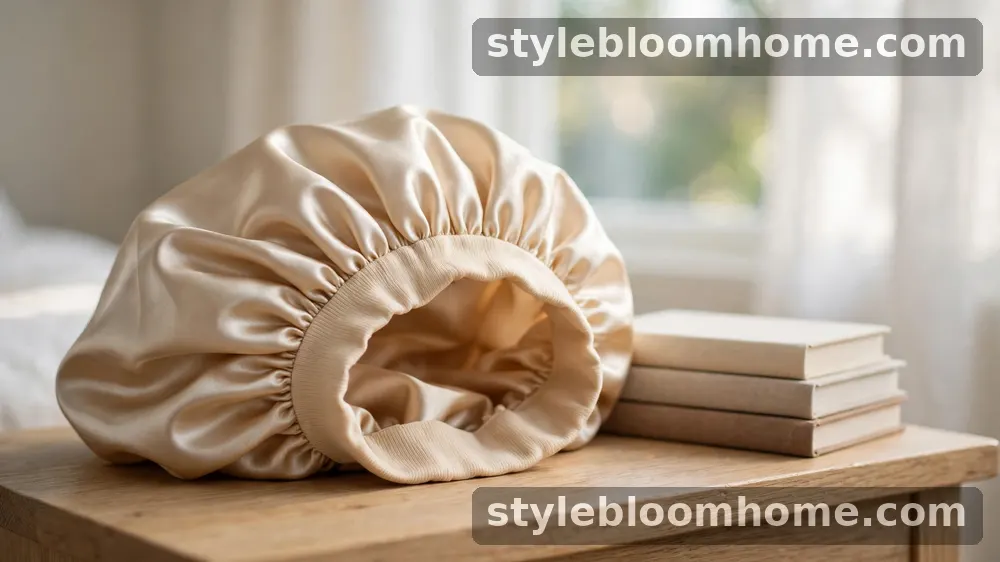
5. Best tie closure: SilkSilky long-tie bonnet — €29.99
Best for: anyone whose fixed-elastic bonnet slips off, and sleepers who want the fit adjusted night by night. Verified live on 31 October 2026: the SilkSilky Germany storefront lists the pure-silk double-layer sleep cap with an adjustable long tie at €29.99, one size at 26 centimetres wide, with long ribbons stretching the fit to 48 centimetres. The page states 100% mulberry silk, free of harmful substances, a wide elastic headband, and long ties for a comfortable, pressure-free fit. The honest limit, stated plainly: as with the turban, the page states no momme weight and no grade. The fibre is stated; the weight is not. Watch out for: the ties: tie them snugly, tuck the ends flat, and never leave long ties loose around a very young child. One buyer review notes the bonnet runs large even tied tight on a smaller head — the tie helps, but it cannot shrink the cap. Search Amazon.de for tie-closure silk bonnets.
6. Budget silk bonnet (type): testing the habit
Best for: testing whether you will actually wear a bonnet every night before spending €80 or more. What budget silk usually means: a lower momme weight, typically 19 rather than 22, a simpler elastic, and fewer colours. What it usually does not mean, whatever the title says, is 22-momme 6A silk at a third of the verified price. Checks before you pay: fibre content as a percentage, a stated momme weight, a returns window usable from Germany, and a seller with a reachable address. If any of the four is missing, the saving is a gamble with the postage. Watch out for: the word "silk" doing all the work. "Silk-feel", "silky", "satin silk", and "silk-like" are not silk. Neither is a bonnet 15% silk blended with cotton — that is a knit hat with silk in it, not a silk bonnet. No price is stated here because no budget listing was verified live. Search Amazon.de for 100% silk bonnets.
Where to buy a silk bonnet in Germany
Start with the two storefronts whose pages this guide verified. Blissy serves Germany in euros, with free shipping and a 60-day returns window for eligible purchases. SilkSilky serves Germany in euros, with free shipping from €59 and a 365-day returns and exchange window. Both state their fabric specifications on the product page, and both were readable in full on 31 October 2026. That is the whole verified list: the shops whose claims this guide could check.
Amazon.de is the second route, and it needs more care, not less. The Amazon.de links here are search links, not product links, because a search link stays honest while a product link goes stale. Read the composition line before the stars: the listing must state a fibre percentage and a momme weight, and the seller must offer a returns window usable from Germany. Listings that call a product "silk" in the title and say nothing about fibre content are unproven, however many stars they carry. The Yanibest listing seen in research is satin at a satin price — fine as satin, misleading if bought as silk. Search Amazon.de for silk bonnets.
The "near me" question deserves a direct answer: no national shop chain stocks a verified mulberry silk bonnet range you can walk in and inspect. German-language shop collections exist — AfricanFabs and Zilk Sleep show silk bonnet collections in search — but a collection page is not a buying guide, and none was verified on any German shop. If you find a bonnet in a shop, read the label in your hand — the same checks apply. Galaxus, the one German retailer with a published bonnet editorial, wrote about satin, not silk: useful on the satin question, no help on the silk one.
How expensive is a real silk bonnet? On verified evidence in Germany: €24.95 to €29.99 for the SilkSilky bonnets, whose pages state the fibre but no momme weight, and €81.95 to €86.95 for the Blissy bonnets, whose pages state 100% 22-momme 6A silk in full. Below that range sits a lower momme weight, a simpler construction, or an unverified claim — judge by the specification on the listing, not by how far below €80 it sits. A €30 bonnet with a stated 19-momme specification and a usable returns window can be a good buy.
How to read a silk label: momme, grade, and the claims to check
Two words do most of the work on a silk label, and both are routinely misused. Momme, pronounced "mommy", is a weight: the weight in pounds of silk 45 inches wide and 100 yards long. For bonnets, 19 momme is standard and light; 22 momme is heavier and longer-wearing. Neither is a quality score on its own: a 22-momme bonnet is heavier, longer-wearing, and warmer, not absolutely "better".
Grade is the other word. Silk fibre is graded, and 6A is the top grade: long, uniform fibres that make a smoother, stronger fabric. The verified products state grade 6A — Blissy as "6A grade" on all three pages, SilkSilky as "6A quality" on the turban page. The honest limit: grade is the seller's claim about its own fibre, and no listing we read carried an independent certificate proving the grade of the finished bonnet. Oeko-Tex is a safety certification, not a silk-content certificate. Neither fact makes "6A" on an unknown listing proof of anything.
The label check takes under a minute and is the most useful skill in this guide. Read the composition line first: it should state a percentage and a fibre, as in "100% mulberry silk". No percentage means the product has not told you what it is; "silk-feel", "silky", or "satin silk" tells you what it is not. Read the momme weight second: a stated number can be judged, an absent one cannot. Two of the five verified products state no momme weight, and this guide says so next to each rather than guessing. Read the care instructions third: silk asks for cold water and air drying. Care instructions that say tumble dry hot suggest the fabric is not the silk the title claims.

A final honesty note: the keyword research behind this guide contained no momme, grade, or charmeuse rows at all — zero for each, by direct count of the research file. This section exists anyway: the number is the difference between a verified purchase and a hopeful one. Charmeuse, the weave that gives silk its shine, describes how silk is woven, not a different fibre — and a listing trumpeting "charmeuse" without stating fibre content has told you about the shine and nothing about the silk.
Straight hair: does a silk bonnet help?
Yes, more narrowly than for curly hair. Straight hair tangles less, so the bonnet's biggest win matters less, and the remaining wins are quieter: fewer tangles at the nape, a blowout that survives the night, and less end damage from eight hours of rubbing. The research backs it: 38 rows ask about straight hair, against 101 for curly hair.
The risk for straight hair is the fit. A cap that is too tight flattens the roots, and flattened roots show immediately — no curl pattern hides them. Size for volume, not head circumference alone, and set the band at the hairline rather than pulled low. A tie closure helps, letting you set tension night by night instead of accepting the elastic's decision. If the hair is straight and fine too, the fine-hair section gives the same answer: bigger cap, softer band, less tension.
Wavy hair: keeping the wave without the frizz
Wavy hair gets the worst of both if the bonnet is wrong: enough pattern to frizz, not enough curl to hide a bad fit. The bonnet's job is preservation. Gather the waves loosely — a loose pineapple gather or low twist — and let the cap hold the shape without pressing it flat. Contained but not compressed, the wave survives the night, and the silk keeps the cuticle flat so morning hair reads as wave, not frizz.
Twenty rows ask about wavy hair, and the practical answer matches the curly-hair one with one change: go easier on volume. Wavy hair rarely needs the roomiest cap, and a cap with room to spare slips. The Blissy Classic Regular or the SilkSilky turban, sized honestly, will do more than the largest cap in the guide. If the wave falls flat by morning, the cap or the gather is too tight — loosen one, not both, so you know which change helped.
Curly, coily, and protective styles
Curly hair benefits most: 101 rows on curly-hair benefits, the largest single cluster in the file. A bonnet holds the curl pattern together overnight, keeps the cuticle flat, and preserves moisture, so curls need refreshing rather than rebuilding. Size up for volume, choose a wide soft band.
For coily hair and protective styles — braids, twists, locs — containment is the bigger half of the job. Gathered hair must fit inside the cap without hard folding, because a fold pressed all night becomes a kink that takes a wash to remove. The Blissy Cascade exists for exactly this: length first, then volume. For waist-length braids, measure the gathered length before buying, and distrust any listing claiming one size for every head of braids. Two rows ask about locs, both framed for men; the advice is the same: room for the locs, a band that does not bite, an adjustable closure.
One plain limit: no product was verified for 4C hair specifically, and the research file contains no 4C rows. The advice above — size up, wide soft band, double-layer, tie closure — is general advice applying to 4C hair as much as to any high-volume hair, but it is not a 4C-specific recommendation. If a listing claims a 4C-specific design, apply the same checks: fibre, momme, size in centimetres, closure, returns window.
Fine or thin hair: the flat-roots problem
Fine hair has the opposite problem: not enough volume to fill the cap, and roots that flatten at slight pressure. Twelve rows ask about fine and thin hair, and the answer is counterintuitive: do not buy the smallest bonnet. A small bonnet pulls its band tight to stay on, and a tight band flattens roots. Buy the size that fits comfortably with the band doing almost no work, gather loosely, and let silk do the friction job without tension doing damage of its own.
Thinning hair deserves one direct sentence: a bonnet does not treat thinning, and no listing implying otherwise should be trusted. What it does is gentler: less nightly pulling at fragile strands, less end breakage, a cap that does not snag. For thinning hair and a sensitive scalp, the band matters more than the brand — wide, soft, at the hairline, never pulled low. If a bonnet hurts, comes off, or leaves marks, the fit is wrong, not the habit: fix the fit before giving up.
Silk bonnets for men
Yes. Hair does not know who owns it, and long, curly, coily, braided, thinning, or extension-wearing hair all benefits from less nightly friction. Forty-four rows ask about men and bonnets, and the answer is the same in every one: ignore the marketing colours, read the specification — fibre, momme, size, closure. There is no hair-care reason for a man not to wear a bonnet, and the tie-closure SilkSilky suits shorter hair well, securing a smaller volume without a band pulled tight. Search Amazon.de for silk bonnets for men.
Silk bonnets for children
Yes, in a child's size with a soft wide band and an adjustable closure — never a fixed elastic that tightens as the child grows. Thirty-four rows ask about children, and safety rules matter more than shopping ones. If the child pulls the bonnet off nightly, use a silk pillowcase instead: the fight is not worth the friction saving. Never leave long ties unsupervised on a very young child, and never buy an adult one-size cap hoping the elastic sorts it out — on a small head it slips, twists, and ends up around the neck. Blissy makes Junior sizes; German availability was not verified, so check the storefront. For most children, the honest first buy is a silk pillowcase, a bonnet only once the child wants one. Search Amazon.de for silk bonnets for children.
Wet hair: should you put a bonnet on damp hair?
No — start with dry hair. Twenty-six rows ask about wet hair, and the answer is consistent: a bonnet on wet hair traps dampness against the scalp, and damp hair is weaker hair. Wet strands stretch, snag, and break more easily, and a cap holding wet hair against a warm scalp means a damp pillow, a chilled head, and frizz set in the shape of the tangle. After washing, let hair dry most of the way — air dry or diffuse on low heat — and put the bonnet on when dry to the touch. The exception is a deliberate overnight treatment: leave-in product applied, hair gathered loosely, in a double-layer cap. Even then the hair should be damp with product, not wet from the shower, and the cap comes off to dry hair in the morning.
Ears, pressure, and hot sleepers
This section exists because the Germany research file asks for it and the other silk files do not: rows about hurting ears, bonnets over the ears, and bonnets feeling hot appear only here. Small rows — but they name the two comfort failures that end the habit.
Ears first. A bonnet hurts ears two ways: the band presses the ear flat all night, or the cap is pulled low and folds the ear forward. Both are fit problems, not silk problems. Set the band at the hairline, above the ear, and let the cap sit on the hair. If the band still presses, the cap is too small or the elastic too firm: size up, or switch to a tie closure, where tension is set by hand. A wide soft band spreads pressure; a narrow firm band concentrates it. Sore ears in the morning mean change the band before the brand.
Heat second. Silk breathes better than polyester satin, but a double-layer cap is still two layers, and two layers run warmer than one. A hot sleeper gains more from a single-layer bonnet, a looser gather, and a cool bedroom than from any "cooling" claim. Both SilkSilky bonnets are double-layer — the reason they feel substantial, and the reason they run warmer. Waking with the bonnet off is not a failure of the habit; the bonnet failed at the temperature. Try single-layer first, keep double-layer for winter or overnight treatments.
Make your own from a silk pillowcase?
Four rows in the Germany file, and no other silk file, ask how to make a silk bonnet. You can — but it is a sewing project, not a shortcut. A pillowcase gives the fabric, real mulberry silk if the pillowcase is real silk, but a bonnet needs a shape, a band, and a closure, and a rectangle gathered with elastic is a sleep cap only loosely. If you sew: a circle of silk with a casing for wide soft elastic, sized to the gathered hair plus two centimetres, seams finished so no raw edge touches hair. If you do not sew, the pillowcase itself is the better buy: most of the friction benefit, nothing to wear, sew, or slip off. Either way the fibre check is the same: the pillowcase must state 100% mulberry silk, or the homemade bonnet is a homemade satin bonnet.
Silk vs satin: which one should you buy in Germany?
Start with the distinction, because the market depends on blurring it. Silk is a fibre: a natural protein filament, graded and weighed in momme. Satin is a weave: a way of weaving any fibre so the surface shines and feels smooth. A satin bonnet can be silk, polyester, or a blend, and "satin" alone says nothing about which. A silk bonnet is always silk, because the word names the fibre.
On performance: both reduce friction, and for that job alone a polyester satin bonnet is good value — cheaper, easy to wash, does the glide. Silk adds three things satin cannot promise: breathability, lower moisture absorption, and temperature regulation for hot sleepers. On price in Germany, verified silk sits at €24.95 to €86.95, while satin bonnets sit in the low teens to around €30 — the Yanibest satin seen during research is €14.99. That gap is the real choice: silk is the better fibre at several times the price of good satin. Buy silk for dry, curly, coily, or heavily styled hair, washed properly. Buy satin for a tight budget, short or straight hair, or testing the habit. Twenty-seven rows ask the question directly, thirty more the other way round; the answer is the same from both sides — a budget question wearing a fibre question's clothes. Search Amazon.de for satin bonnets.
Satin instead? Our German satin bonnet guide covers the same six styles in satin, at lower prices.
How to choose: size, band, lining, and closure
Size first: it decides everything else. Measure the gathered hair, not the head — gather it as you will sleep in it, and measure around the bundle. The Blissy Regular is 8 by 10 inches, the Large 9 by 11; the SilkSilky bonnets are one size at 26 centimetres wide, stretching to 30.5 on the turban and 48 on the long-tie version. If gathered hair fills two hands, size up. A cap with room to spare will slip — a size error made at checkout, not a defect in the cap.
Band second. A wide soft band spreads pressure and stays put without biting; a narrow firm band concentrates pressure and leaves a mark. The research asks about bands constantly — 84 rows on tie, fit, and staying on: the band decides whether a bonnet stays on or migrates. Prefer a wide band and an adjustable closure — tie, drawstring, or velcro — over fixed elastic if you have ever woken with the bonnet on the pillow. The tie-closure SilkSilky is the verified adjustable option here; the Blissy bonnets use elastic, so their fit depends on choosing the right size. Search Amazon.de for adjustable silk bonnets.
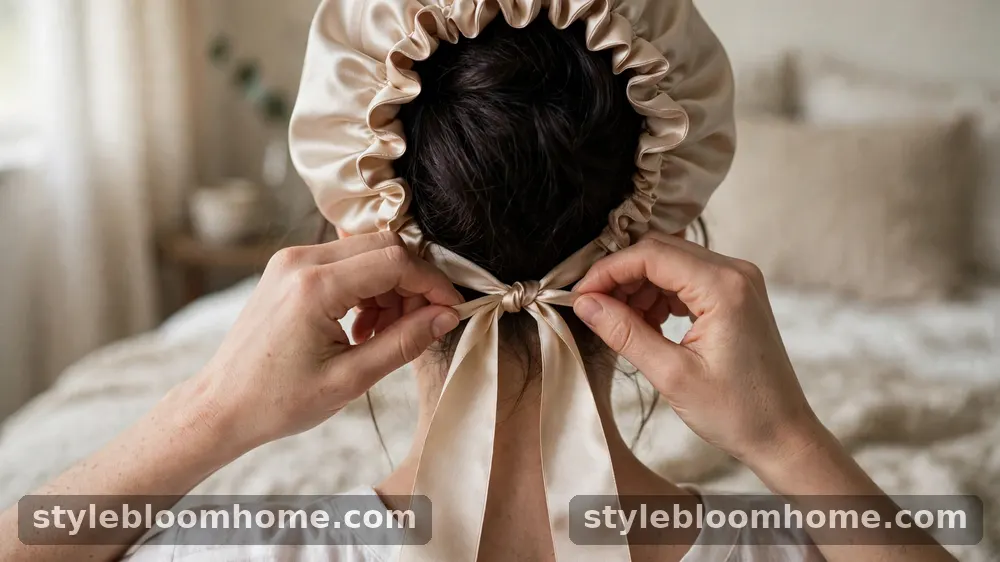
Lining third. Double-layer means two layers, and the inner layer touches your hair — it should be silk, and the listing should say so. Look for "silk inside and out" or "double-lined silk"; a double-layer cap with a polyester inner lining is a satin-lined cap wearing a silk title. Closure last: ties adjust, elastics do not, velcro adjusts until it collects lint. Choose the closure you will use at midnight, not the one that photographs best.
How to wear it so it stays on
Sixty rows ask how to wear a bonnet, eighty-four about tie, fit, and staying on — the largest practical cluster in the file. The routine is short: start with dry, detangled hair, gather loosely, and put the bonnet on before hair tangles again. Set the band at the hairline, adjust the closure until secure without pressure. With a tie, tie at the nape and tuck the ends flat; with elastic, the size does the work, and a cap needing constant adjustment is the wrong size.
Three details make the difference. Gather loosely: a tight gather pulls roots all night and flattens curls. A silk pillowcase underneath helps persistent slippers — if the bonnet comes off, the pillowcase is still silk. Give it a week: the first nights feel strange, which is evidence that sleeping in a cap is new, not that the bonnet fails. If it still comes off after a week of correct sizing, change the closure type before the brand: a tie closure solves most slipping elastic cannot.
How to wash a silk bonnet
Cold water at no more than 30 degrees, mild detergent, inside a mesh laundry bag, on a delicate cycle or by hand. Press water out gently, never wring, air dry away from sun and radiators. No bleach, no fabric softener, no tumble dryer. Wash weekly for nightly wear. That is the routine the verified sellers state: Blissy says machine washable on a gentle cycle in a mesh bag with silk-safe detergent, then air dry; SilkSilky's guidance matches. Forty-three rows ask about washing; the commonest mistake is treating silk like cotton. Hot water, wringing, and the dryer shorten the fabric's life, and a bonnet washed hard stops feeling like silk before it looks worn.

One note on products: silk-safe detergent means mild, without enzymes that attack protein fibre and without bleach or brighteners. Ordinary detergent is formulated for cotton, and the difference shows as a bonnet feeling rougher month by month. A mesh bag is not frippery: it stops snagging on zips and hooks, and stops ties tangling around the load. Buy two bonnets if the budget allows — not for variety, but so one dries while the other is worn.
What to use instead of a silk bonnet
A silk pillowcase is the best alternative: the same smooth surface with nothing to wear. Thirty-nine rows ask what to use instead, and the pillowcase wins outright. A satin pillowcase, a wrapped silk or satin scarf, a loose pineapple gather, or a loose braid all do part of the job. One caution: a scarf that unwraps at 3 a.m. protects nothing after 3 a.m., and technique matters more than fabric. A loose braid is free, suiting straight and wavy hair better than curly hair, where braiding disturbs the pattern. Short healthy hair washed daily may need nothing — a bonnet is optional, a good pillowcase enough. Search Amazon.de for silk pillowcases.
Skip it if: honest objections answered
Skip the bonnet if you will not wear it — the most useful sentence in this section: a €86 bonnet in a drawer protects nothing, and a €25 bonnet worn nightly beats it every time. Skip it for very short healthy hair washed daily: the friction saving is real but small, and a silk pillowcase covers it. Skip the expensive end if the budget is tight and the habit unproven: start with the verified €24.95 SilkSilky turban or a satin bonnet, and spend more once the habit has survived a month. Skip any listing that will not state fibre content, whatever the price — a listing hiding the fibre is hiding the product. Skip the idea that a bonnet replaces the rest of hair care: the last step, not the whole routine, and bleached, daily heat-styled, hard-brushed hair will not be saved by silk at night.
First night and first month: what to expect
The first night, expect strangeness: a cap feels odd, the band noticeable, the hair contained in an unfamiliar way. It passes, usually within three or four nights. The first week, expect adjustment: band position, gather, tie tension. Note what slipped, pressed, felt hot. The first month, expect fewer morning tangles, curls and waves holding to the second day, smoother ends, less frizz. Do not expect growth, repair, or transformation. A bonnet is friction control, and friction control shows as absence — of tangles, frizz, breakage — quieter than a promise and verifiable in the mirror. Give it the month; the mornings will tell you.
Frequently asked questions
- Is a silk bonnet good for hair?
- Yes, for most hair. A silk bonnet reduces friction while you sleep, so hair tangles less, keeps its shape better, and breaks less at the ends. It protects the hair you have; it does not grow new hair or repair split ends.
- What does a silk bonnet do?
- It lets hair glide instead of catching on a pillowcase: less friction, fewer tangles, less frizz, less moisture lost to cotton overnight. The benefit is cumulative — quieter mornings, ends in better condition over weeks.
- Which is better, a silk or satin bonnet?
- Silk is the better fibre: breathable, low-absorption, temperature-regulating. Satin is a weave, usually polyester, and it is cheaper, easier to wash, and does the friction job well. Buy silk for dry, curly, coily, or heavily styled hair; buy satin for a tight budget or a first try.
- How expensive is a real silk bonnet?
- On verified evidence in Germany: €24.95 to €29.99 for the SilkSilky bonnets, whose pages state the fibre but no momme weight, and €81.95 to €86.95 for the Blissy bonnets, whose pages state 100% 22-momme 6A silk in full. Judge cheaper bonnets by the specification on the listing, not the price alone.
- Where can I buy a silk bonnet in Germany?
- From brand storefronts serving Germany — Blissy in euros with free shipping, SilkSilky in euros with free shipping from €59 — or Amazon.de search links, where you must check fibre content yourself. No national shop chain stocks a verified mulberry silk bonnet range to inspect in person.
- Does a silk bonnet help straight hair?
- Yes, more narrowly than for curly hair. It reduces tangles, protects a blowout overnight, and limits end damage from friction. It will not add volume, and a cap that is too tight can flatten the roots, so fit matters more than brand.
- Should I sleep with a silk bonnet every night?
- Yes, if the fit is right. The benefit comes from nightly use, because friction happens every night. If the bonnet slips off or hurts, fix the fit — size, band, closure — before giving up the habit.
- How do I keep a silk bonnet on all night?
- Size for hair volume, set the band at the hairline, adjust the closure until secure without pressure. Gather loosely, start with dry detangled hair, prefer a tie closure if fixed elastic slips. A silk pillowcase underneath helps persistent slippers.
- How do I wash a silk bonnet?
- Cold water at no more than 30°C, mild detergent, inside a mesh laundry bag, on a delicate cycle or by hand. Press water out gently, never wring, and air dry away from sun and radiators. No bleach, no fabric softener, no tumble dryer. Wash weekly for nightly wear.
- What can I use instead of a silk bonnet?
- A silk pillowcase is the best alternative: the same smooth surface with nothing to wear. A satin pillowcase, a wrapped silk or satin scarf, a loose pineapple gather, or a loose braid all do part of the job. Short healthy hair washed daily may need nothing at all.
- Is a silk bonnet good for curly hair?
- Yes, curly hair benefits most. A bonnet holds the curl pattern together overnight, keeps the cuticle flat, and preserves moisture, so curls need refreshing rather than rebuilding in the morning. Size up for volume and choose a wide soft band.
- Can men wear a silk bonnet?
- Yes. Hair does not know who owns it, and long, curly, coily, braided, or thinning hair all benefits from less nightly friction. Read the specification — fibre, momme, size, closure — ignoring the marketing colours.
- Can children wear a silk bonnet?
- Yes, in a child's size with a soft wide band and adjustable closure — never a fixed elastic that tightens as the child grows. If the child pulls it off nightly, use a silk pillowcase instead; never leave long ties unsupervised on a very young child.
- Silk bonnet or silk pillowcase — which first?
- A bonnet first for long, curly, coily, braided, or styled hair, because containment is the bigger half of the job. A pillowcase first if you will not wear a cap, sleep hot, or have short hair. Together they are the fullest protection, and neither is wasted.
- Is it okay to wear a bonnet as a white person?
- Yes. A bonnet is a hair-care tool, and protecting hair while you sleep belongs to no one group. Bonnets and protective styling have deep roots in Black hair care, and that history deserves respect: wear a bonnet for hair care, not as a costume or joke. No rule bars anyone from wearing one.
The bottom line
Germany has no local silk-bonnet guide, and the honest Germany-first answer is shorter than marketing would like: five products verified live — three Blissy bonnets at €81.95 and €86.95 with 100% 22-momme 6A silk in full, two SilkSilky bonnets at €24.95 and €29.99 with the fibre stated and no momme weight on the page — plus one type with checks.
Buy the bonnet stating 100% mulberry silk and a momme weight, in the size your gathered hair needs, with a band that stays put without biting. Wash gently, weekly, put it on dry hair, give it a month. The mornings will tell you whether it was worth it — checkable every morning, in the mirror, for free.