Best Kitchen Gadgets That Actually Earn Their Counter Space (2026)
Big review sites rank stand mixers and $500 blenders. This guide is for the rest of us: nine small, honest kitchen gadgets that save real time on a normal Tuesday — picked for weeknight cooks, tiny kitchens, weak grips, rentals and tight budgets.
- The best first buy is a vegetable chopper with a container. Nothing else under $25 changes weeknight cooking this much.
- Small kitchens win with dead-space tools — over-sink racks, fold-flat designs, adhesive-mounted lights. Footprint matters more than features.
- Weak grip? A hands-free electric can opener is life-changing, and it is the one electric upgrade that genuinely pays for itself.
- Novelty single-use gadgets are clutter. Every pick here does at least one real job weekly — or it is not on the list.
This guide is for normal home cooks: weeknight dinners, small kitchens, tight budgets, hands that ache. It is not for the appliance collector — if you want a $600 stand mixer shootout, the big review sites already wrote it. We have not lab-tested hundreds of products, and we will not pretend we did. What we did is read the top ranking guides, cross-checked them against real buyer complaints, and kept only the gadgets that survive the one question that matters: will you use this on a random Tuesday?
Nine tools that earn their space: small, honest, and built for a normal Tuesday
The top results for “best kitchen gadgets” all sound the same: stand mixers, air fryers, ice cream makers, pizza ovens. Fine machines — but they are appliances, and most of us are not spending $300 on a Tuesday. The gap in every one of those guides is the same: nobody covers the small, cheap, everyday tools — and nobody tells you which ones you will actually use. That is this guide’s whole job.
Here is our rule, and it is the only rule: a gadget that does not save you time, effort, or space on a normal weeknight does not belong in your kitchen. A vegetable chopper passes that test in its first use. An avocado slicer fails it forever. Everything below survived that filter — with honest pros, honest cons, and a section on what not to buy, because the most useful kitchen advice is often what to walk past.
As an Amazon Associate, StyleBloom earns from qualifying purchases. This guide contains affiliate links — it costs you nothing extra and keeps our content free.
Quick comparison: the 9 picks at a glance
Nine small kitchen gadgets worth your money in 2026: the best first buy is a vegetable chopper, the best space-saver is an over-sink dish rack, and the best weak-grip upgrade is a hands-free electric can opener.
| Pick | What it solves | Best for |
|---|---|---|
| Vegetable chopper with container | 15 minutes of chopping becomes 3 — uniform dice for onions, peppers and carrots straight into one bowl | The weeknight cook who hates prep but loves real food |
| Over-sink dish drying rack | Dries dishes in the dead air above your sink — zero counter space used, nothing to store | The tiny kitchen with no room for a drainer |
| Hands-free electric can opener | No twisting, no gripping — it sits on the can and works at the press of a button | Arthritis, carpal tunnel, or any hand that aches |
| Wooden cooking utensil set | Gentle on nonstick, comfortable to hold, never melts — the everyday tools you reach for first | The daily cook who wants tools that feel good and last |
| Battery under-cabinet LED lights | Real task light on dark counters — adhesive mount, no drilling, no electrician | Renters and anyone who chops in the shadows |
| Easy-clean garlic press | Crushes unpeeled cloves with a cleaning flap that sweeps out the trapped garlic | The cook who stopped pressing garlic because of the cleanup |
| Instant-read kitchen thermometer | One number ends the guessing — chicken and steaks done right, no cutting them open | The beginner (or anxious) meat cook |
| Silicone stretch lids set | Seal bowls and half-cut produce directly — no cling film, no matching-container hunt | The leftover packer tired of the plastic-wrap drawer |
| Hand-held mandoline with guard | Even, paper-thin slices for gratins and salads in seconds — with the hand guard always on | The cook who wants pro-looking slices without pro knife skills |
Ask three questions: (1) Will I use it twice a week? — if the honest answer is “probably not,” close the tab. (2) Where will it live? — if you cannot point at its home in your kitchen, it becomes clutter. (3) Is it hard to clean? — tools with ten parts and tight crevices get used once and feared forever. Everything on this list passes all three.
The 9 best kitchen gadgets worth buying in 2026
These nine earned their place because they do real work every week: they chop faster, free up space, spare your hands, or replace something wasteful — with honest downsides listed for each.
1. Best overall: vegetable chopper with container
A vegetable chopper with a catch container is the single highest-impact cheap gadget you can buy — it turns a pile of onions, peppers and carrots into uniform dice in under a minute, right into its own bowl.
If you only buy one thing from this guide, make it this. Dinner prep is the bottleneck of weeknight cooking — not the recipe, not the stove, the chopping. A push-down chopper with interchangeable blades dices an onion in about four presses, catches everything in the container, and the lid snaps on so half an onion just goes in the fridge. Rinse the blades under the tap and it’s done.
Honest downsides: the blades are genuinely sharp — treat it with the respect you’d give a good knife, and keep fingers clear of the press plate. Cheap no-name versions can have flimsy lids; a known brand name and solid reviews matter more here than saving two dollars.
2. Best for tiny kitchens: over-sink dish drying rack
An over-sink dish rack uses the dead air above your sink to dry dishes — the only dish drainer that takes up literally zero counter space.
In a small kitchen, a dish drainer is a land grab: it eats a third of your counter and never moves. An over-sink rack rolls out over the basin, holds plates, bowls and even a cutting board, and drips straight into the sink — no puddle on the counter. When you’re done, most roll up or fold flat into a drawer. If your kitchen has no counter to spare, this is not a luxury; it’s the answer.
Honest downsides: measure your sink first — if your basin is unusually small or has a divider, check the rack’s dimensions before ordering. And it will not hold a full Thanksgiving’s worth of dishes; it’s a daily tool, not a holiday one.
3. Best for weak grip: hands-free electric can opener
A hands-free electric can opener opens cans with zero twisting and zero gripping — place it on the can, press the button, and it walks around the lid on its own.
For hands that ache — arthritis, carpal tunnel, or just years of use — a can opener is the task that announces itself every single time. The hands-free kind removes it entirely: no clamp, no crank, no sharp lid edge to fish out, because most models grip the lid for you and leave a smooth edge. This is the one electric upgrade on this list, and it earns the spot: it doesn’t just save time, it removes pain.
Honest downsides: it’s bulkier than a manual opener and needs drawer or counter space, plus batteries or charging. If your hands are fine, a good manual opener does the job — this is a purchase for need, not for fun.
4. Best everyday tools: wooden cooking utensil set
A wooden utensil set gives you the tools you’ll reach for daily — spoons, turners and spatulas that are gentle on nonstick, comfortable in the hand, and won’t melt into your pan.
Here’s a quiet truth about kitchens: the tools you use most are the ones you’ll never photograph. Wooden spoons and turners are that category. Wood doesn’t scratch nonstick or ceramic coatings, it doesn’t conduct heat into your hand, and it feels right in a way plastic never does. A set with a spoon, slotted spoon, turner and spatula covers 90% of stovetop life. (We’ve got a full wooden-kitchen-gadgets section below — including what to look for and how to keep them from cracking.)
Honest downsides: wood is hand-wash only and needs an occasional rub of food-safe oil, or it dries and cracks. If “everything must go in the dishwasher” is your rule, lean silicone instead — or own both.
5. Best renter upgrade: battery under-cabinet LED lights
Battery under-cabinet LED lights stick to the cabinet with adhesive and turn on by motion — real task lighting on dark counters with no drilling and no electrician.
Half of all kitchen counters live in shadow. Under-cabinet lights fix it in ten minutes: peel, stick, done. Motion-sensor ones turn on when you step up to chop and off when you leave, so the batteries last. When they need charging, most lift off the magnetic mount. Renters, take note — this is the highest-impact no-damage upgrade in this entire guide, and it comes off cleanly when you move.
Honest downsides: they are another thing to charge, every few weeks depending on use. And cheap sets can have weak adhesive — wipe the cabinet surface clean first, and give it 24 hours before trusting it.
6. Best prep shortcut: easy-clean garlic press
An easy-clean garlic press crushes even unpeeled cloves, and the swing-out cleaning flap is the whole point — it sweeps out the trapped garlic that made you quit using your old one.
Almost everyone owns a garlic press. Almost no one uses it, because cleaning it is miserable. The fix is one feature: a cleaning flap or pin plate that pushes the stuck garlic out. Get a press with that, wide comfortable handles, and a chamber that takes unpeeled cloves — and garlic goes from a ten-minute chopping job to ten seconds. This is the archetypal “under $25, used weekly” gadget.
Honest downsides: pressed garlic is stronger and wetter than minced — if a recipe wants gentle garlic flavor, mince by hand. And even easy-clean presses need a rinse right after use; dried garlic in any press is nobody’s friend.
7. Best for confidence: instant-read kitchen thermometer
An instant-read thermometer gives you one number in seconds — the fastest way to stop wondering whether the chicken is done and stop cutting it open to check.
The most common weeknight anxiety is meat: is it done, is it safe, is it dry? A thermometer ends the debate. Insert, read, decide — no more sawing a chicken breast in half and watching the juices run out. For beginners it’s training wheels; for experienced cooks it’s the difference between “pretty sure” and “exactly.” It also pays for itself the first time it saves a roast from the trash.
Honest downsides: the very cheapest ones can be slow or drift — a mid-range name with fast readings is worth the small step up. And you still have to wash it; it’s a drawer tool, not a leave-on-the-counter one.
8. Best waste-cutter: silicone stretch lids set
Silicone stretch lids seal directly onto bowls, jars and half-cut produce — replacing the cling-film drawer with a reusable set that rinses clean.
The plastic-wrap drawer is a special kind of chaos: the roll that tangles, the box that never closes. Stretch lids stretch over whatever you need covered — a mixing bowl, a cut melon, a half onion — and create a real seal. They’re dishwasher-safe, they nest flat, and one set replaces a year of cling film. If you pack lunches or cook in batches, these earn their drawer in the first week.
Honest downsides: they don’t stretch forever — check the size range covers your biggest bowls, and very oily rims can slip. They’re a system, not a miracle: you’ll still want real containers for stacking in the fridge.
9. Best upgrade pick: hand-held mandoline with safety guard
A hand-held mandoline with a safety guard makes paper-thin, perfectly even slices in seconds — gratins, salads and homemade chips without knife skills.
There is exactly one rule with a mandoline: always use the guard. With it on, a mandoline is one of the most satisfying tools in the kitchen — cucumber and potato slices so even they look store-bought, in a fraction of the time. Hand-held versions with a few thickness settings store in a drawer and cost little. The guard’s teeth hold the food; your fingers never go near the blade.
Honest downsides: the blade is razor-sharp by design, so this is not the tool to rush with or to hand to a distracted teenager. Clean it carefully — a brush, not fingertips — and store it in its sheath or box.
Wooden kitchen gadgets: the quiet heroes of the drawer
Wooden kitchen gadgets — spoons, turners, spatulas and boards — are gentle on cookware, comfortable to hold and built to last for years, as long as you hand-wash them and oil them now and then.
Search interest in wooden kitchen gadgets is real and growing (2,400 monthly searches), and it’s easy to see why: in a kitchen full of plastic and silicone, wood feels right. A wooden spoon doesn’t melt if you leave it resting in the pan. A wooden turner won’t gouge your nonstick. Wooden boards are kind to knife edges in a way glass and ceramic never will be. There’s also something no spec sheet captures — the way a wooden spoon that’s been in your kitchen for five years just feels like yours.
What to look for when you buy: one solid piece of wood rather than glued-together sections (fewer failure points), a smooth sanded finish with no rough patches, and hardwoods like beech, acacia or olive wood that stand up to daily use. A basic set — spoon, slotted spoon, flat turner, spatula — plus one good board covers nearly everything.
How to keep them alive: hand-wash only, towel-dry right away — dishwashers are where wooden tools go to crack. Every few months, rub in a little food-safe mineral oil while the wood is dry; it takes two minutes and it’s the difference between a spoon that lasts a decade and one that splits in a year. Never soak wood, and don’t leave it sitting in a wet sink.
Wood vs. silicone, honestly: silicone is dishwasher-proof and handles screaming-hot heat without a thought, which makes it better for candy-making and deep-frying. Wood is kinder to coatings, feels better, and never holds onto last week’s curry smell. Most well-run kitchens quietly keep both — wood for stirring and serving, silicone for the hot jobs.
What NOT to buy: the clutter list
Skip single-use novelty gadgets, duplicate appliances, and giant unitaskers — the most valuable kitchen advice is knowing what to walk past.
Let’s talk about the drawer. You know the one — the drawer that won’t quite close, full of hope purchased at 11pm. Here’s the list that would have kept it empty:
- Single-use novelty tools. Avocado slicers, banana hangers with built-in gadgets, strawberry hullers, corn-buttering stations. Each does one tiny job that a knife already does. If a tool’s entire pitch fits in a 10-second video, that’s usually all the use you’ll get from it too.
- Duplicates of what you own. A second chopper because the first one’s blades dulled? Sharpen or replace the first. A mini food processor when you already own a blender and a chopper? One of them has to go.
- Giant unitaskers. Anything with a footprint bigger than a dinner plate needs to earn that space daily. Countertop real estate is the most expensive square footage in your home.
- The cheapest electric anything. A $12 electric gadget with no brand name and no warranty is a future drawer corpse. If a motor, heating element or battery is involved, a known maker and a real warranty are worth the extra dollars.
- “As seen on TV” impulse buys. If you bought it at midnight because the video was satisfying, you bought entertainment, not a tool.
Kitchen gadgets by situation: find your lane
Match the gadget to your life, not the trend: weeknight cooks need choppers, tiny kitchens need dead-space tools, aching hands need electric help, renters need no-drill upgrades, and gift-buyers need the under-$25 lane.
The weeknight cook (home by 6, dinner by 6:40): the vegetable chopper is your whole strategy — prep collapses to minutes. Pair it with the garlic press and the thermometer, and weeknight dinners stop feeling like a second job. Our cleaning schedule for working moms keeps the rest of the evening from unraveling.
The tiny-kitchen dweller: over-sink rack, fold-flat chopper, stretch lids instead of a wrap drawer. Every pick here was chosen to live in a drawer, on a hook, or in dead air — nothing needs a counter.
The cook with aching hands: electric can opener first, then wide-handle tools and stretch lids. Cooking shouldn’t hurt, and these three remove the three most painful motions: twisting, gripping hard, and prying lids.
The renter: under-cabinet lights, adhesive hooks for the utensil set, nothing that needs a drill or an electrician. It all comes off clean on moving day.
The gift-buyer: garlic press, stretch lids, or a wooden utensil set — all genuinely useful, all comfortably under gift-budget territory. For more ideas in the same lane, our Amazon Christmas gifts guide and stocking stuffers under $25 are built for exactly this.
Frequently asked questions
- What is the most useful kitchen gadget to buy first?
- A vegetable chopper with a catch container. It is the fastest, cheapest upgrade to weeknight cooking: uniform dice for onions, peppers and carrots in under a minute, one bowl to rinse, and it folds into a drawer. Everything else in this guide is a luxury by comparison.
- Are kitchen gadgets worth the money or just clutter?
- Both — it depends on the gadget and your week. A tool you use twice a week earns its drawer; a novelty you use twice a year is clutter. The rule we used for every pick in this guide: if it does not save time, effort, or space on a normal Tuesday, it is not on the list.
- What are the best kitchen gadgets for a small kitchen?
- Choose tools that use dead space or fold away: an over-sink dish rack that uses the air above your sink, fold-flat choppers, stackable utensil sets and battery under-cabinet lights that need no counter space at all. Avoid anything with a footprint bigger than a dinner plate unless it earns it daily.
- Which kitchen gadgets are best for weak or arthritic hands?
- A hands-free electric can opener removes twisting entirely — it sits on the can and works at the press of a button. Also easy on hands: rocker-style garlic presses with wide handles, and silicone stretch lids that seal bowls with a gentle pull instead of muscle.
- Are wooden kitchen utensils better than silicone?
- Different strengths. Wood is gentle on nonstick cookware, feels great in the hand, and does not melt or shed microplastics with heat — but it must be hand-washed and oiled now and then. Silicone is dishwasher-proof and heat-safe to high temperatures but can hold odors and stain. Most cooks end up with both: wood for stirring and serving, silicone for high-heat jobs.
- What kitchen gadgets should I avoid buying?
- Avoid single-use novelty tools (avocado slicers, banana hangers with gadgets attached), anything you already own in another form, and giant unitaskers that eat counter space. Also skip the cheapest no-brand electric tools — if a motor is involved, a known maker and a warranty matter more than saving a few dollars.
- Do I need an electric can opener if I already have a manual one?
- Only if opening cans hurts or is difficult. A decent manual opener works fine for most people. The electric one earns its place when arthritis, carpal tunnel, or weak grip makes twisting painful — it turns a painful task into a one-button job and keeps the lid off your fingers.
- What is a good kitchen gadget gift under $25?
- An easy-clean garlic press or a set of silicone stretch lids — both land well under $25, get used weekly, and feel like a real upgrade rather than a gag gift. A wooden utensil set also gift-wraps beautifully. Our stocking stuffers guide has more small-budget winners in the same lane.
- Can kitchen gadgets really save time on weeknight dinners?
- A few can, most cannot. A vegetable chopper genuinely turns 15 minutes of chopping into 3. A dish rack that fits over the sink clears your counter while you cook. What does not save time: anything with ten parts that takes ten minutes to clean. Buy for the prep you actually do, not the cooking you imagine.
- How do I keep kitchen gadgets from cluttering my drawers?
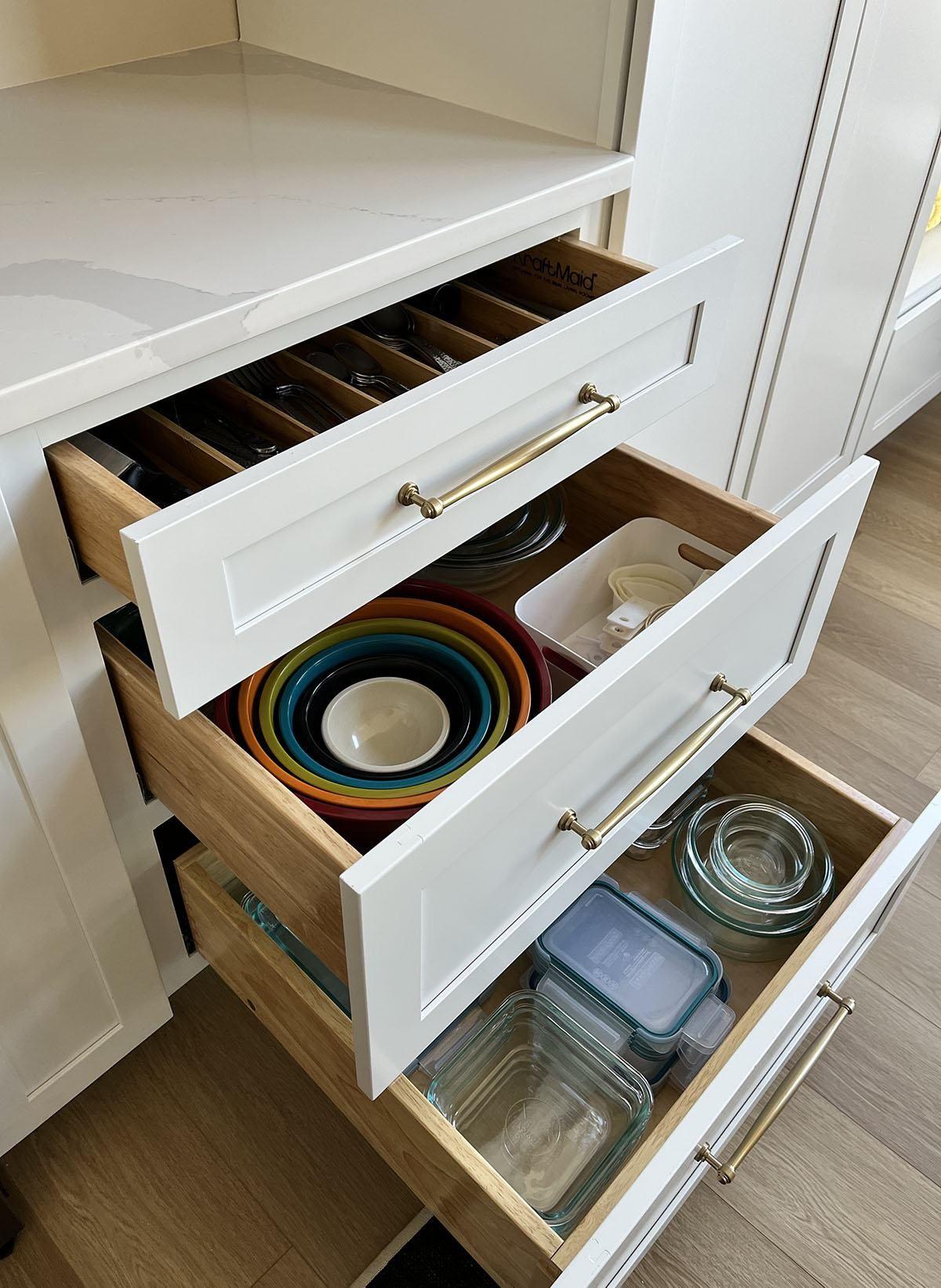
- One home for each tool, and nothing enters a drawer without one. Fold-flat and nesting designs store easily; everything else needs a drawer organizer or a utensil crock. Our kitchen drawer reset and kitchen cabinet organization guides walk through a full system in about an hour.