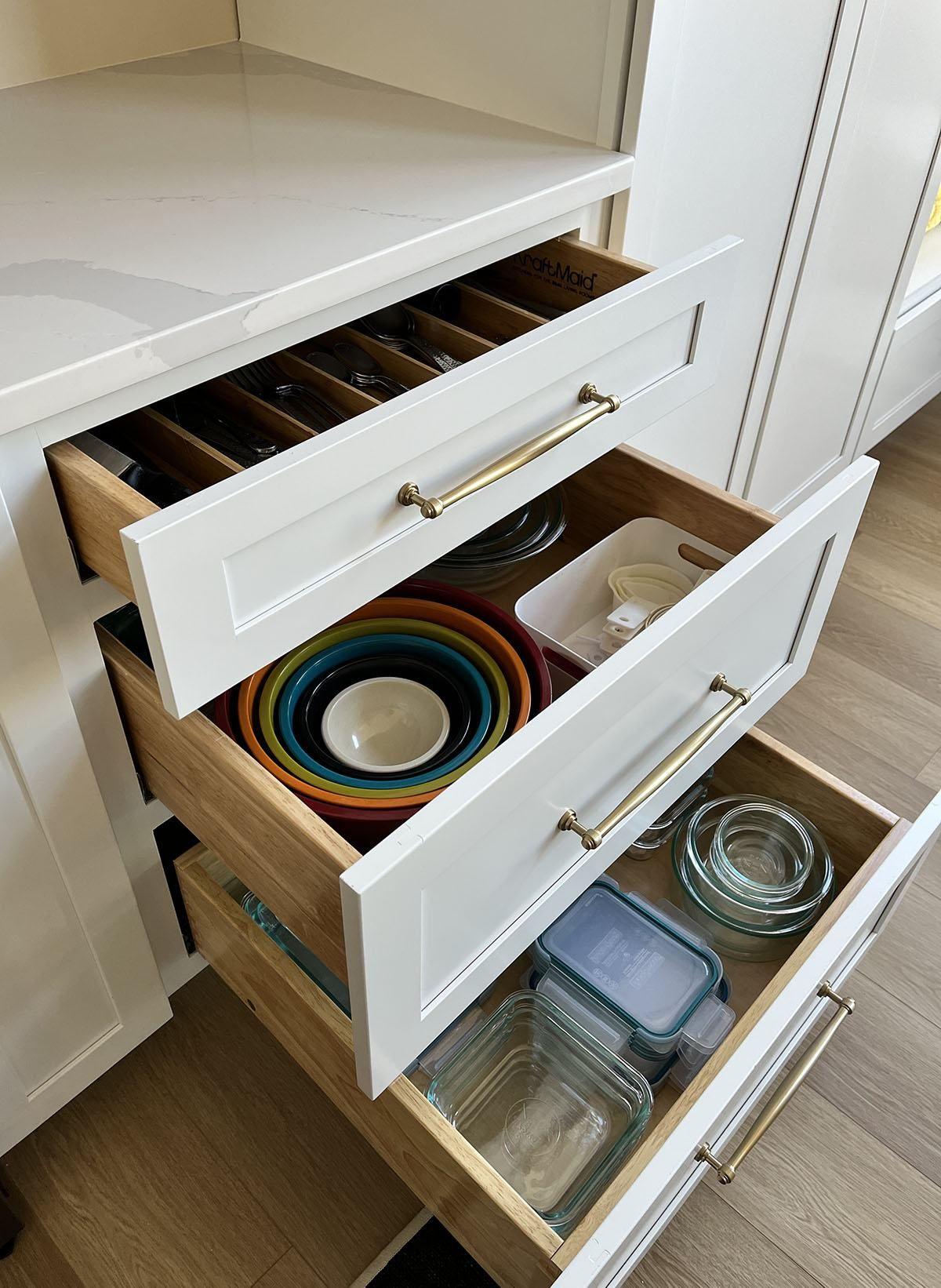
Kitchen Cabinet Organization Hacks: Risers, Turntables and the Zone System
Kitchen cabinet organization hacks that double usable space: shelf risers, turntables for bottles, stackable bins — and zones by task so cooking stops being a treasure hunt.
- Store by task zone (cooking, baking, prep), not by item shape.
- Shelf risers and turntables double usable space without drilling.
- Turntables beat stacking for bottles — everything stays visible and reachable.
- Keep daily-touch items between hip and shoulder height.
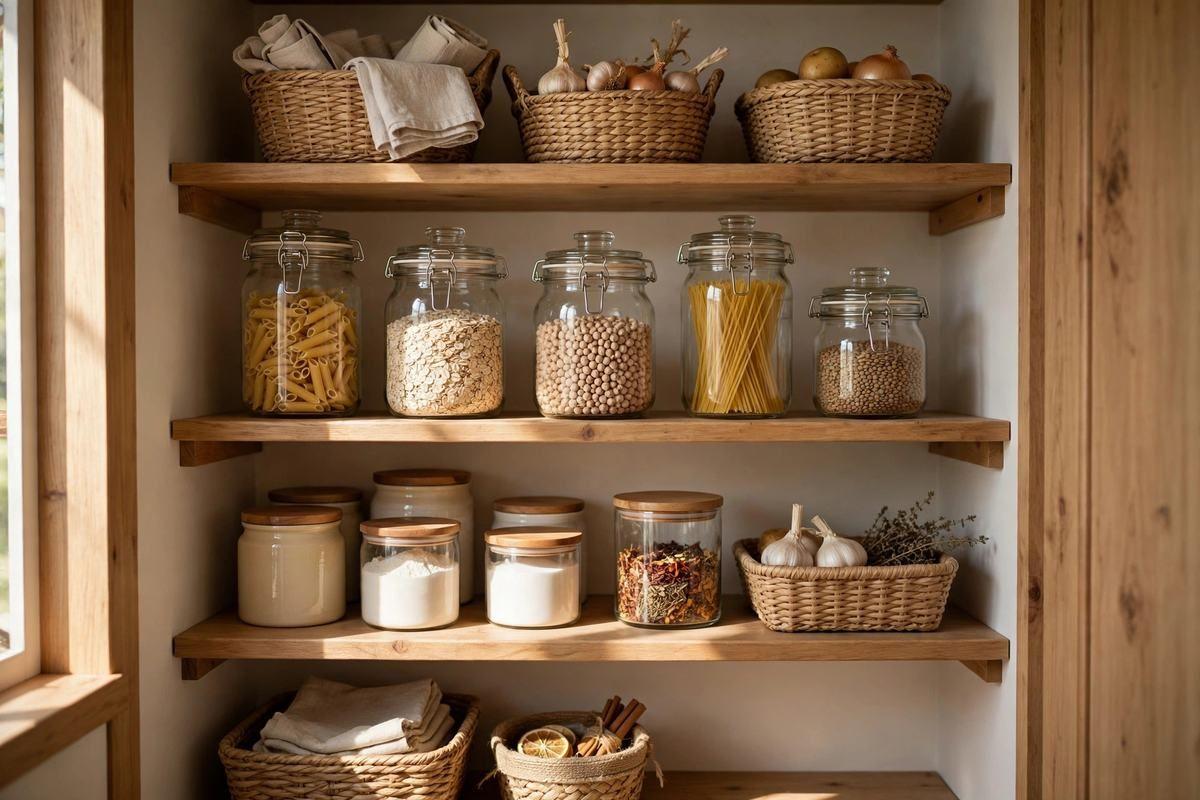
Kitchen cabinets with shelf risers, glass jars and task-based zones
Empty exactly one cabinet — one, not the whole kitchen. Group what comes out by task: cooking, baking, prep, daily dishes. Give each group a spot near where it gets used, add a shelf riser or turntable wherever you see empty air above the items, and keep the things you touch daily between hip and shoulder height. That is the whole method behind these kitchen cabinet organization hacks. If you have been wondering how to organize kitchen cabinets without a renovation, the rest of this guide is the detail that makes it stick.
Why your cabinets feel full but hold nothing
The problem is rarely too many dishes. A standard wall cabinet is about 12 inches deep with one adjustable shelf, which leaves 8 to 10 inches of empty air above a row of mugs — dead space you pay rent for. Stacking bowls hides the big ones at the bottom, and loose packets multiply at the back until the cabinet becomes a lucky dip. Fix it in this order: empty, group by task, measure the empty air, then choose the organizer that fits it. Organizer first is backwards.
The zone system: store by task, not by shape
Most cabinets fail because they store by shape — 'cans together because they're cans' — while your cooking oil lives three cabinets from the stove. Assign zones instead: a cooking zone within arm's reach of the stove (oils, spices, wooden spoons, the pan you grab most); a baking zone near the oven or a stretch of counter (flour, sugar, baking powder, mixing bowls, measuring cups); a prep zone near your main work surface (cutting boards, knives, colander); and daily dishes in the cabinet closest to the dishwasher or sink, so unloading is a single step. Everything else — holiday platters, the fondue pot — goes high and far. Touching it twice a year is fine. Small kitchen cabinet organization follows the same logic — the zones just get narrower and the rules get stricter.
Shelf risers vs. drilling in extra shelves
A freestanding shelf riser, usually 4 to 6 inches tall, turns one tall gap into two usable layers: short glasses and mugs below, more of the same on top. My honest take: for renters, risers win outright. No landlord approval, no tools, and you can rearrange when your cookware changes. Drilling in a permanent shelf only makes sense if you own the place and have lived with the kitchen long enough to know nothing will move — and even then, measure twice, because a fixed shelf at the wrong height is worse than no shelf at all. The rental-safe bonus: under-shelf baskets that hook over the shelf edge with no screws, perfect for tea packets, lids and wraps under a mug shelf.
Turntables beat stacking for bottles — every time
Oils, sauces and spices get worse when lined up in rows: to reach bottle seven you move bottles one through six, and you will not put them back. A 10- to 12-inch turntable — also sold as a lazy Susan — fits a standard 12-inch-deep wall cabinet and ends that game with one spin. For deep kitchen cabinets and corner cabinets — the ones where things go to die — a turntable or a pull-out bin is not optional; it is the only setup that keeps the back half of the cabinet in circulation. Stacking still wins for same-size bowls and nested pots. Bottles and jars always go on a spinner.
Kitchen cabinet organization hacks for rentals, galley kitchens and odd sizes
Every hack here is rental-safe: freestanding risers, turntables, under-shelf baskets, stackable bins and door-mounted racks that hook over the cabinet door instead of screwing into it. Everything travels with you when you move. In a narrow galley kitchen, run the zones along one side in cooking order — prep near the sink, cooking near the stove — so your feet do less work. For odd-size cabinets, measure the inside width, depth and clear shelf height and buy to the smallest number; a riser one inch too tall wedges under the shelf above, a turntable one inch too wide scrapes the door. Cut-to-fit shelf liners make awkward cabinets look intentional.
Three mistakes everyone makes
1. Buying organizers before measuring. The returns pile is where most cabinet projects die. Tape measure first, shopping second.
2. Storing by shape, not by task. Cans together because they are cans, while dinner prep still sends you across three cabinets.
3. Overfilling zones. A zone packed to 100 percent means reaching anything requires unstacking everything. A zone at 80 percent full is a working zone; at 100 percent it is a storage unit. Leave the air.
Frequently asked questions
- Will this work in a rental where I can't drill anything?
- Yes — nothing in this guide needs a drill. Freestanding shelf risers, turntables, under-shelf baskets that hook over the shelf edge, and stackable bins all work in rental cabinets, and they move with you when you move.
- What if my cabinets are odd sizes?
- Measure the inside width, depth and clear shelf height first, then buy to the smallest number. Adjustable risers, cut-to-fit liners and 10-inch turntables fit most awkward cabinets.
- How do I organize a deep corner cabinet where things disappear?
- Put a turntable or a labeled bin where your arm barely reaches. Never store loose items in the back half — if it isn't in a bin or on a spinner, it effectively doesn't exist.