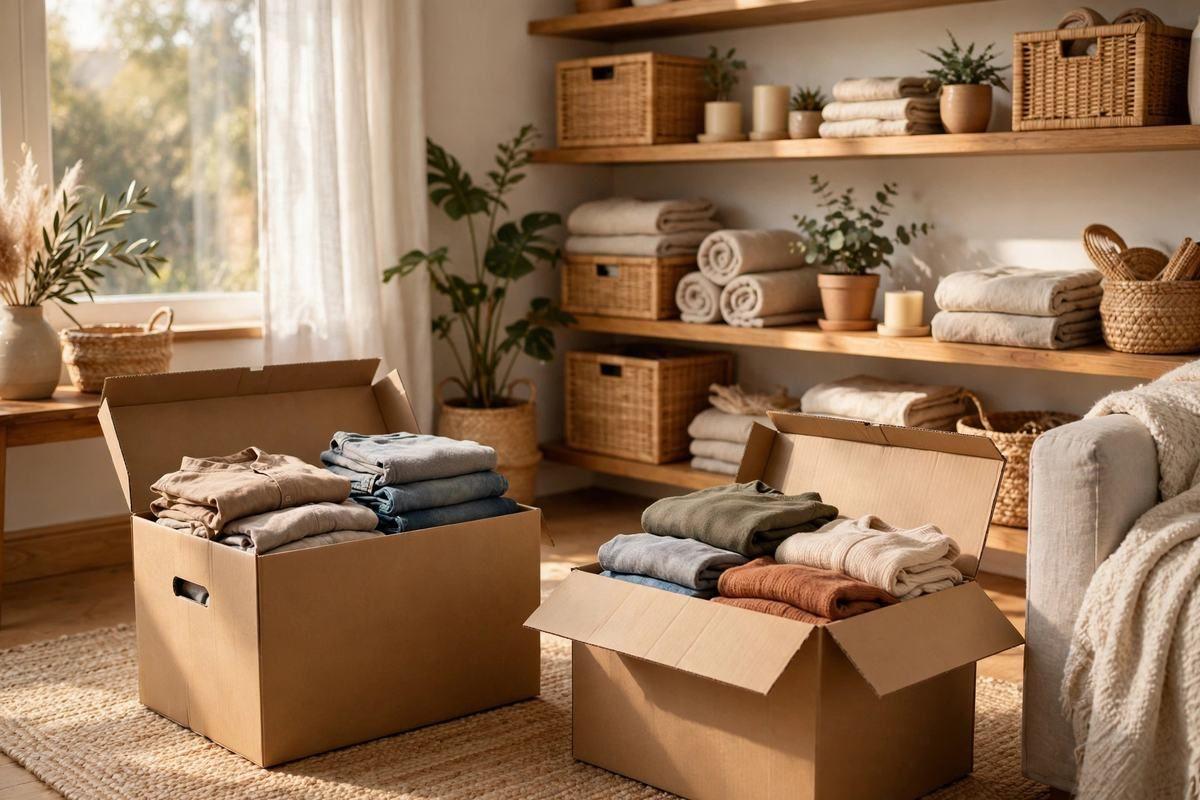
How to Fold Clothes to Save Space: File-Folding for Drawers, Suitcases and Small Closets
How to fold clothes to save space with the file-fold method: t-shirts, knitwear and jeans folded to stand upright, so drawers show everything and closets breathe.
- The file-fold in 4 moves makes clothes stand upright so drawers show everything.
- T-shirts, jeans, and sweaters each fold slightly differently — follow the item-by-item guide.
- Rolling wins for suitcases; file-folding wins for drawers.
- Hang anything that wrinkles badly — folding has limits.
T-shirts file-folded into upright packets, stored edge-up in a dresser drawer so every garment is visible
File-folding is how to fold clothes to save space: garments are folded into compact rectangles and stood upright, side by side, like files in a cabinet. One deep drawer holds roughly a third more t-shirts this way than stacked, and — more importantly — every garment stays visible, so you stop wearing the same five tops while the rest rot at the bottom of a pile.
How to fold clothes to save space: the file-fold in 4 moves
The whole method rests on one rule: the finished packet must stand on its own edge and match the height of your drawer. Measure your drawer depth first, then aim for a packet about 2 cm shorter — tall enough to use the space, short enough to grab without scraping knuckles.
- Move 1 — flatten. Lay the garment face-down and smooth it flat. Every wrinkle you leave here is a wrinkle you wear later; ten seconds of smoothing now replaces ironing later.
- Move 2 — make the rectangle. Fold the sides (and sleeves) in so the garment becomes a long, straight rectangle. The rectangle's width should end up close to your drawer depth — this is the dimension most people get wrong.
- Move 3 — fold to height. Fold the long rectangle into thirds (or halves for bulky items) until the packet's height equals drawer depth minus about 2 cm. Too tall and it jams the drawer shut; too short and the row leans and collapses.
- Move 4 — stand it up. Stand the packet on its folded edge, printed or decorated side facing you if you want a quick visual scan. Rows go left to right, front to back — never stacked.
Practice on a t-shirt. It takes about three tries before your hands learn the folds, and then it is permanent.
T-shirts, jeans, sweaters: item-by-item
T-shirts: learning how to fold shirts to save space starts here — fold the shirt into thirds lengthwise first (one side in, other side in), then fold the long strip in halves or thirds to drawer height. Thin tees make slim packets — alternate print-side-forward for easy scanning.
Jeans: fold in half lengthwise, leg over leg, then fold the long strip into thirds. Denim packets are heavy and excellent bookends for lighter rows — put a stack of folded jeans at the end of a t-shirt row to hold it upright.
Sweaters and knitwear: fold a wider rectangle than you would for a tee — narrow folds put hard crease lines into knit that take hours to relax. Two folds to drawer height is usually enough. And never hang knitwear: hangers stretch the shoulders of anything knitted, sometimes permanently.
Socks: fold, don't ball. Balling stretches the elastic and eats drawer space; lay one sock flat on the other, fold the pair into thirds, and file them upright in a small box. Pairs stay together without the ball.
Underwear: fold into simple thirds. No fancy technique needed — the goal is a uniform packet that files upright and lets you see every pair at a glance.
File-fold vs rolling — which wins where
Rolling is the main rival method, and it has real strengths: a rolled tee fits soft duffel bags beautifully and wedges into the odd corners of a suitcase where a rigid packet won't. But for drawers, file-folding wins outright. Rolls lean, topple and hide each other in a drawer; file-folded packets stand in neat rows where every item is visible, and visibility is what stops you rebuying clothes you already own. The honest answer is to use both — file-fold for every drawer and shelf at home, roll for the flexible bags and gap-filling on a trip.
The mistakes that make file-folding fail
Mistake 1 — folding wider than the drawer. Packets taller than the drawer depth jam the drawer shut or get crushed flat when you force it. Measure once, fold to drawer depth minus 2 cm, always.
Mistake 2 — mixing categories in one row. Tees, jeans and pajamas in one row turn back into archaeology within a week. One category per drawer, or at minimum one category per clearly divided row.
Mistake 3 — overstuffing. A row packed so tight that pulling one tee out drags three neighbours along it. Leave a finger's width of give in every row — the space you 'lose' is what keeps the system alive.
Mistake 4 — folding knitwear too narrow. The same fold that works for cotton tees puts sharp crease lines into a cashmere sweater. Wide rectangles for knit, always.
Setting up the drawer so it stays
Start with the tape measure, not the clothes: measure the depth of each drawer and write it down. Folding clothes to save space in drawers starts with this number, because every packet must be shorter than the drawer depth. Deep drawers (over 25 cm) work best with a divider across the middle and packets filed front-to-back on one level — stacking a second layer on top destroys the whole point, because the top layer hides the bottom one again.
Assign one category per drawer or row, then file packets in a light-to-dark colour order. It sounds fussy, but colour order is what makes outfit-choosing a ten-second scan instead of a five-minute dig — your eye finds 'the white tee' instantly when the whites all sit together.
Suitcases use the same skill
File-folded rows pack into a suitcase flatter and arrive less creased than stacked piles, because nothing shifts sideways in transit. Lay rows front-to-back across the case, heaviest items (jeans, shoes in bags) along the wheel end. Keep the rolls for the gaps: a rolled tee wedged beside the handle column uses space a packet can't. The home system and the travel system are one system — when folding clothes for travel packing, use the same file-fold as your space saving folding method and let rolling handle only the awkward gaps.
What not to fold (hang these instead)
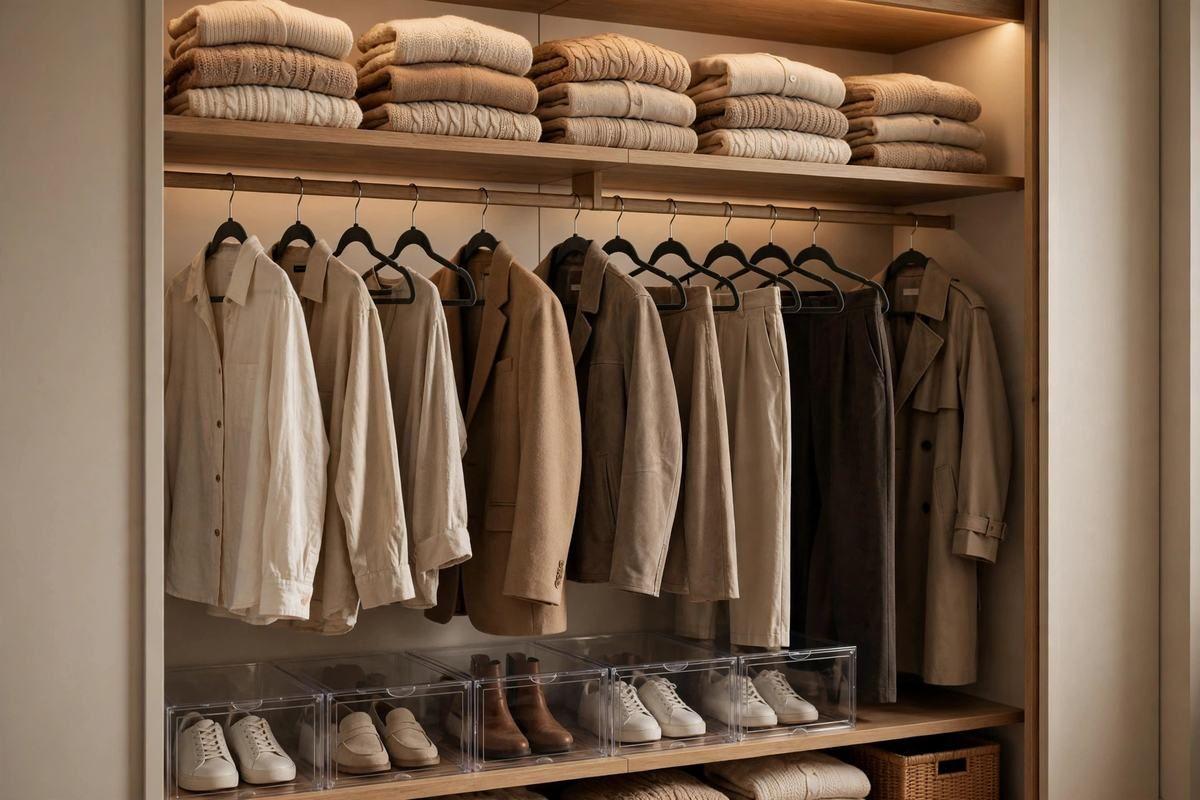
File-folding is for soft, unstructured clothes. Structured blazers, tailored coats, delicate dresses and silk blouses should hang — folding crushes their shape, and a blazer's shoulder construction never recovers from being folded in thirds. Activewear and pajamas, on the other hand, fold beautifully. The rule of thumb: if it has structure or drapes, hang it; if it's soft and casual, file-fold it.
Frequently asked questions
- Does file-folding really save space?
- Yes — in drawers, mostly. Standing garments upright uses the full drawer depth, and because every item is visible you stop keeping duplicates and overstuffing. On flat shelves the space gain is smaller, but the visibility gain is the same.
- File-folding vs rolling — which is better?
- File-folding wins for drawers, where rows of upright packets stay put and everything stays visible. Rolling wins for soft duffel bags and filling odd-shaped gaps in a suitcase. Skilled organizers use both, choosing by container.
- What should not be file-folded?
- Structured blazers, tailored coats, delicate dresses and silk blouses should hang — folding crushes their structure. Knitwear goes the other way: always fold it, never hang it, because hangers stretch knit shoulders out of shape.
- How do I keep the rows from toppling?
- Three fixes: make packets the same height as the drawer depth minus about 2 cm, keep every row full (a half-empty row has nothing to lean on), and bookend rows with a drawer divider or a small box.
- Does it work for deep drawers?
- Yes, with one change: stand the packets in rows front-to-back and add a divider mid-drawer. In drawers deeper than 25 cm, a second layer stacked on top wastes the visibility advantage — keep everything on one level you can see.