
Christmas Home Decor: One Plan for Every Room, the Porch, and a Rented Home
One palette, one strong idea, and one order of work, repeated room by room, porch included. The plan that makes a small rented home read as one decorated home instead of five separate purchases.
By the end, you will know which palette fits your home, which tree fits your floor, how to build a mantel in layers with no fireplace needed, how to size the porch, which pieces are safe with kids and pets, what to buy at each budget tier, and how to take it all down in January.
As an Amazon Associate, StyleBloom earns from qualifying purchases. This guide contains affiliate links — it costs you nothing extra and keeps our content free.
Every rival guide for this query teaches one room well and leaves the rest of the home to guesswork. The small-apartment guides stop at the living room. The porch guides never mention the mantel. The tree guides never size the wreath. A reader following any single one ends up with a decorated corner and an undecorated home, or with pieces that clash room to room because no palette was ever chosen. This page closes those gaps by teaching the whole home in one order, room by room and porch included, with the renter and owner fixings named at every step.
It sits beside the decorating and gift guides, not inside them. The home decoration ideas guide holds the handmade and room-by-room decorating angle; the Christmas gift finder by budget holds the gift side of the same tiers. This page holds the whole-home Christmas plan only. Read the palette section first if you read nothing else — ten minutes choosing three colours and one metal decides every purchase that follows.
Pick the look first: one palette, one strong idea, then every room

Start with the palette, not the shopping list. Every strong Christmas home in the guides read for this article follows the same order: choose three main colours plus one metal or wood tone, repeat them in every room, and let one strong idea lead the tree. Rooms that share deep green, cream, and brass read as one home.
Three palettes cover almost every home. Classic red, deep green, and warm cream is the timeless core: deep green garland, warm red in small doses, cream textiles keeping a small room bright. Earth tones, terracotta, rust, chocolate brown, sage, and warm cream, give the calm 2026 look, but only when edited hard to three earth tones and repeated.
Pick one ribbon colour and repeat it on the tree, the wreath, the candles, and the gifts. Velvet ribbon in red, rust, or burgundy makes separate pieces feel like one plan, and it comes off in January in minutes with no marks. Before hanging anything, lay every pillow cover, throw, and ribbon on the sofa and judge from about six feet away. If one piece clashes at that distance, move it to another room before a single hook goes up.
The one-look rule matters just as much. Pick one strong look, bows, colour, texture, or sparkle, and let it lead. A tree with velvet bows, jewel tones, tinsel, dried oranges, and a story collection all at once is not maximalist, it is undecided. A tree with one lead and two supporting details looks designed. The same rule works for the mantel and the porch. Choose the lead, repeat it three times, and stop adding.
Renters get the same plan with different fixings, and that split runs through every section. Adhesive hooks rated well above the weight, tension rods in window frames and doorways, over-door hangers for wreaths, weighted stocking holders on a console, and washi tape for flat designs cover almost every hanging job with no holes. Test every adhesive on a hidden patch of paint first, press each strip firmly for thirty seconds, and remove by pulling the tab straight down, never outward. No method is guaranteed deposit-safe.
Choose the tree by floor space: pencil, tabletop, flat wall, or second small trees
The tree decision is a floor-space decision, not a taste decision. Measure the corner before shopping, and leave at least thirty inches of clear walkway past the widest branch point. A slim pencil tree with an eighteen to twenty-two inch base usually fits a corner that a full tree would block completely, and it gives full height with a tiny footprint. A tabletop tree, about twenty-four to thirty inches tall, sits on a side table or console on a felt pad and still anchors the room when floor space is gone.
For the tightest rooms, build the tree shape on the wall itself with garland swags or string lights in a triangle outline. It reads festive, holds small ornaments, uses no floor at all, and each swag point fixes with a clear removable hook, spaced evenly, after testing one hook before loading it. Two smaller trees instead of one big tree is the other 2026 pattern the tree guides keep naming: one tree in the living room, a second small tree in a bedroom, an entry, or a dining room carrying the same palette in miniature. Group two or three heights together so the grouping looks intentional rather than leftover. Search for slim pre-lit pencil Christmas tree when the corner is narrow but the height matters.
| Room situation | Tree to choose | Footprint and fixing |
|---|---|---|
| Corner free, walkway clear | Slim pencil tree, full height | Base under twenty inches, stable stand, no fixing |
| No floor space at all | Tabletop tree, twenty-four to thirty inches | On a surface you own, felt pad under the pot |
| Tightest room or hallway | Flat wall tree, garland or lights outline | Zero floor, removable hooks at each swag point |
| Second room or entry | Small tree or grouped tabletop trees | Two or three heights together, no wall contact |
| Calm modern room | Sparse bare-branch tree, few ornaments | Branch shape is the decoration, fifteen to twenty-five ornaments |
Test the lights before a single ornament comes out of its box. Test each strand on the floor first, then light the tree, then decorate. A dead strand found after the ornaments are hung costs the whole decorating session. Warm white light, around 2700K, is the consensus across the living-room, porch, and tree guides read for this article.
Style the tree: lights deep, ribbon second, ornaments last, in that order

Lights first, ribbon second, ornaments last. That order is the one piece of tree advice every guide in this research agrees on, and reversing it is why so many trees look flat. Push the lights deep into the branches so the glow comes from inside the tree, not from bulbs sitting on the surface.
Ribbon is the trend to start with because it does so much for so little. One spool of wide wired velvet ribbon, looped between ornaments and warm lights, makes a whole tree look full and finished. Tie eight to twelve large velvet bows in burgundy, blush, or forest green, wire each one so the loops hold, and space them evenly from top to bottom. For the ribbon waterfall look, cut wired ribbon into one to one-and-a-half metre lengths, tuck the top into the tree near the crown, and let each length twist gently down, pinned in two or three spots.
Ornaments last, and the 2026 looks give a clear menu. Pick one lead and let the rest support it. Oversized velvet bows lead a classic living-room tree. Jewel-tone maximalism, three jewel tones only, emerald anchoring with sapphire, ruby, or plum, mixed matte, shiny, and glitter finishes with gold accents, leads a bold formal tree. Dried citrus and natural botanicals, dried orange slices, cinnamon sticks, pinecones, and wooden ornaments, lead a rustic tree, and most of it comes from the kitchen and the garden. Vintage glass ornaments, mismatched shapes and a few clip-on birds, lead the heirloom look, found at thrift stores and estate sales. Tinsel is back as thin strands hung slowly over branch tips, paired with glass baubles and warm lights, with champagne-gold tinsel tucked deep into the branches for warm vintage sparkle.
Two supporting rules keep any look from tipping into clutter. Hang the imperfect, handmade, and childhood ornaments at eye level at the front, and fill gaps behind with plain baubles in the palette. Clip heavier pieces to strong inner branches, and keep fragile ones high, away from sofa arms and passing bags. Stop before the tree feels full. The Scandinavian calm look, a slim realistic tree with wooden bead garlands, paper stars, cream linen bows, and a few matte white ornaments, works because it stops early. If the tree still looks bare after the ornaments, add light or ribbon, not more ornaments. Ornaments fill gaps. Light and ribbon create the glow. What to buy follows the same order: search for warm white Christmas string lights first, then velvet ribbon for the Christmas tree, wide and wired, then vintage-style glass Christmas ornaments in the palette, mixed finishes rather than one matched set.
The mantel method: garland, stockings, candles, in layers, never all at once

Build the mantel in layers, in this order, and do not start the next layer until the last one sits right. Greenery first, stockings second, candles and light third, ornaments and balance last. The mantels that look cluttered are almost always mantels where everything went up at once.
Drape the garland so it swags gently across the front of the mantel and cascades a little longer on one end, rather than hanging in a stiff symmetrical line. Real depth comes from mixing textures: a soft-touch faux pine as the base, then a few stems of eucalyptus, cedar, or berry tucked in to break up the green. Layer two or three greenery types so the base has depth instead of reading flat, and if a fuller look is wanted, weave a second thinner garland through the first. A coordinating wreath hung above or leaned against the wall behind gives the vignette a vertical anchor. Secure the garland out of sight with removable hooks or floral wire so nothing slides during a party. Search for faux pre-lit Christmas garland when the base layer needs to carry its own light, and weave separate warm white fairy lights through an unlit garland when control over where the glow appears matters more.
Stockings turn a decorated mantel into a holiday mantel, and they are also where mantels go lopsided fastest. Space stockings evenly and let them hang below the garland line so the greenery reads as the top layer. If the mantel is narrow or there are more stockings than room, cluster them slightly off-centre and balance the other end with a stack of books, a lantern, or a taller candle holder. Coordinate, do not perfectly match: a set that shares a palette, cream knits with red cuffs or a mix of velvet and woven textures in the same warm tones, looks far more intentional than identical stockings in a row. Use sturdy stocking holders or hidden hooks rated for the weight once filled, and keep filled stockings light, with heavy gifts beside the mantel. Search for knit Christmas stockings in one fabric family, mixing palette colours rather than matching exactly.
Candles and light are their own layer. Cluster candles in odd numbers and vary the heights, a couple of tall tapers, a mid pillar, a low votive or two, so the light plays across the mantel instead of marching in a straight line. Weave a few small strings of warm white fairy lights through the garland for a glow that shows up in daylight, and lean toward flameless pillars or LED candles anywhere greenery and ribbon sit close to a flame. Keep decor a safe distance from an active flame and never let ribbon or greenery sit where it can catch heat. Finish with ornaments, height, and balance, following the rule of thirds: one tall element above, medium and small pieces below, a handful of ornaments nestled into the garland, and a few open gaps so abundance does not tip into clutter.
No fireplace, no problem: the console, the TV wall, and the sofa wall as focal points
Most rented homes and many small homes have no fireplace, and the mantel method still works, because the method is about a focal point, not about a chimney. Treat the console or the TV stand as the mantel. Garland across the top, stockings along the front, candles at the ends, with stockings hung from weighted holders that sit on the surface and garland ends secured with clear removable hooks hidden behind the greenery. The console-as-mantel gives the room the same hearth feeling without a single hole, and it packs away in minutes in January.
The TV is the mantel in many apartments, so frame it lightly. Drape a slim garland across the top of the TV stand or along the console below the screen, keeping vents clear, and secure the ends with clear removable hooks on the stand, never on the screen itself. A garland that blocks vents or drapes over a hot screen is a fire and damage risk. Keep the garland slim on a TV wall, keep the stockings on the console front, and let the screen stay visible. When there is no mantel and no console worth dressing, make the wall above the sofa the focal point with one large wreath or one leaning framed winter print, hung with a large removable hook rated well above its weight.
Living-room surfaces: one tray, breathing shelves, textiles, and scent
Style the surfaces zone by zone, and give every surface one job. The coffee table gets one tray as its anchor: a flameless candle, a small bowl of ornaments, and one sprig of greenery, corralled so the tray lifts away in seconds and the table surface stays fully protected underneath. A tray around sixteen by twelve inches styles beautifully on a small table and still leaves at least twelve inches of clear surface beside it for cups and remotes.
Group mini trees in threes on the console, in about six, nine, and twelve inch heights, on one side only, and leave the other side calm. Style shelves with breathing room: one festive moment per shelf, a small wreath, a stack of books with ribbon, or a tiny village house, leaving at least a third of every shelf empty so the room feels calm.
Textiles do more decorating work per pound spent than any other layer, and they are the easiest renter swap in the whole article. Zip festive covers over the inserts already owned, in palette colours with one plaid or knit texture, and the whole sofa changes in ten minutes. Layer texture so the small room feels rich: a chunky knit throw, one velvet pillow, and a soft faux fur accent over the sofa arm, keeping colours inside the palette so texture, not colour, does the work. Two throws and three pillow covers are enough for a standard three-seat sofa. Choose throws around fifty by sixty inches, which cover a lap and legs fully without dragging on the floor.
Finish with scent, the invisible layer. A stovetop simmer pot with citrus, cinnamon, and cloves, or a small bowl of scented pinecones tucked near the tree, makes the room feel festive before anyone looks around. Keep pinecones in an open bowl on a tray, away from candle flames. Add one warm lamp behind or beside the sofa so the room edges do not fall into darkness, because a single lamp makes tree light feel richer and the room feel bigger. Search for flameless pillar candles for the tray, the console, and anywhere real flame cannot go, grouped in three heights with timers so the glow starts at dusk by itself.
Bedroom, kitchen, and bathroom: small touches, no extra furniture
Carry the palette into the bedroom, the kitchen, and the bathroom with small touches that need no extra furniture and no wall contact. A small tree on the dresser, in the palette, at about two feet tall, makes the bedroom feel dressed without taking floor space. Swap the bedspread or add a festive throw in the same fabric family as the living room, keeping the palette consistent room to room.
In the kitchen, style the island or the countertop with one centerpiece and stop: a tray with a small tree, one bowl of ornaments, and a candle cluster. Use the garland line across a window or a shelf edge, secured with removable hooks, and keep it clear of the stove and any heat source. A festive table runner, in the palette, down the center of a small dining table turns an everyday table into the Christmas table without a full place setting change. The bathroom gets the same treatment at a smaller scale: a small scented candle on a tray, a sprig of greenery in a jar on the shelf, and a festive hand towel in the palette. Nothing on the floor, nothing near water, nothing that blocks the mirror.
Porch sizing rules: the door, the wreath, the garland, and the planters
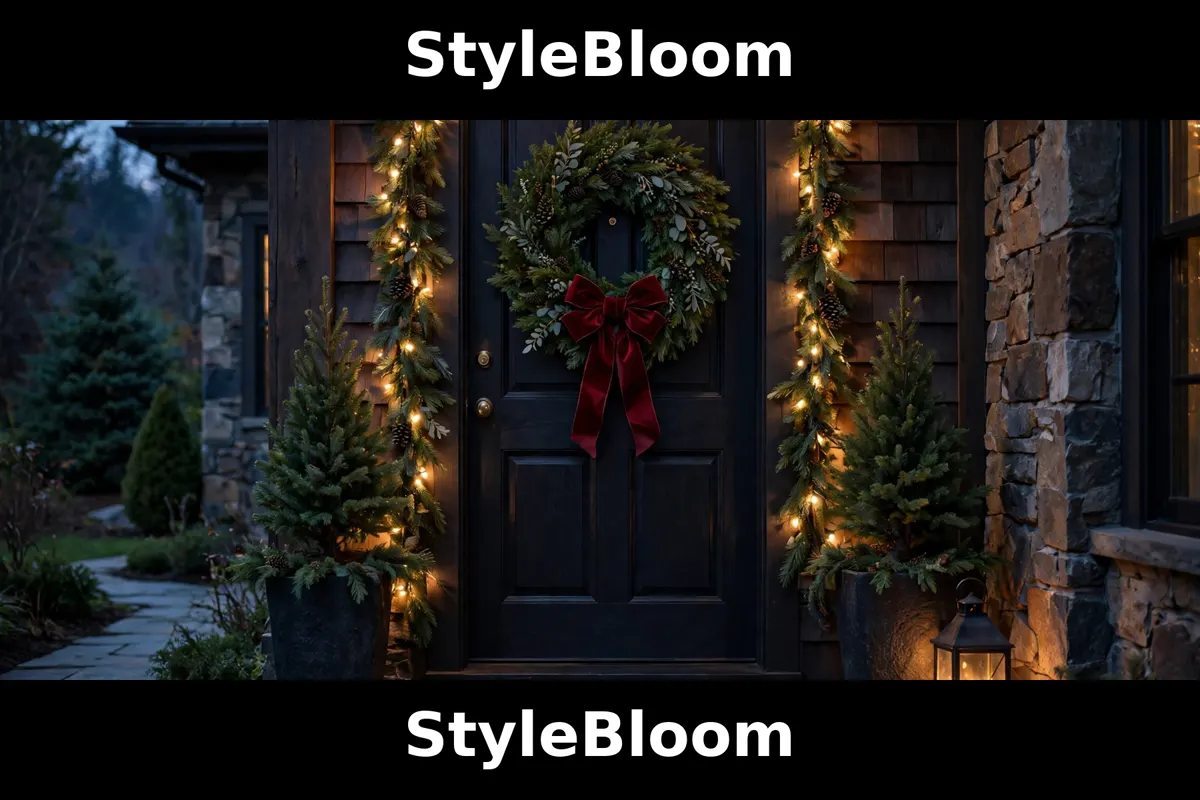
Porch decor fails on size more often than on taste. A wreath that is too small for the door looks apologetic from the street, and a garland that is too short for the doorframe looks unfinished. Size the pieces to the door and the porch, not to the price tag. A standard front door is thirty-six inches wide and about eighty inches tall. Size everything from those two numbers.
| Piece | Rule | For a standard 36-inch door |
|---|---|---|
| Wreath | About two-thirds of the door width, centre 58 to 64 inches high | 24-inch wreath, centre at about 60 inches |
| Doorframe garland | Twice the height plus the width, plus 6 to 12 inches of swag slack | About 16 to 17 feet of garland, 2 to 4 inches thick |
| Railing garland | About twenty percent extra length for the drape | Add a fifth to the measured railing run |
| Planter trees | 16 to 24 inches each, pair totalling 4 to 5 feet | Two planters flanking the door, symmetrical |
| Walkway clearance | At least 36 inches of clear path | Nothing narrowing the path below 36 inches |
Hang the wreath with an over-door hanger, an adhesive wreath hook rated well above the wreath weight, or a tension-rod wreath mount, and check that the hanger clears the door seal so the door closes fully. A 30-inch cedar wreath suits a taller door or a porch with high ceilings, where a 24-inch wreath would look lost. For a double door, hang two identical wreaths, one centred on each panel, rather than one large wreath spanning the seam. For an apartment door, the same 24-inch rule holds, and the over-door hanger keeps the corridor side clean and the fire corridor clear.
Planters frame the door and carry the porch through January. Two tall planters flanking the door, each sixteen to twenty-four inches, filled with faux or fresh greenery, berry stems, and one warm white light strand each, give symmetry that reads from the street. Weight the planters with stones in the base so wind cannot topple them, and keep the arrangement under five feet total so it frames the door without crowding it. Search for 24-inch outdoor Christmas wreath sized to the door width before buying, and measure the door width with a tape measure, not by eye. Layer the porch in the same order as the mantel: greenery first, then light, then accents.
Porch lights and safety: outdoor-rated only, GFCI, timers, and clear paths
Outdoor lights are a different product from indoor lights, and using indoor lights outside is the single most common porch safety mistake. Outdoor-rated strands carry thicker insulation and sealed connections, and they are the only strands that belong on a porch, a railing, or a yard.
Plug every outdoor strand into a GFCI-protected outlet, the outlet with the test and reset buttons, usually found on an exterior wall or in a garage, and keep the plug and the first connection out of standing water. Use outdoor-rated extension cords, rated for the load and laid flat along the porch edge, and secure cords with cord clips rated for outdoor use, never with nails or staples through the cord. Keep every cord out of the walkway. Run a timer so the display comes on at dusk and off at a set hour.
Choose warm white, around 2700K, for the porch as for the tree, and keep the colour temperature consistent across every strand on the house. Mixed whites read as a mistake from the street even when each strand looks fine up close. Keep the path clear at all times: at least thirty-six inches of clear width, no cords across the walkway, no lanterns in the step zone, and no planter narrowing the path where a visitor steps in the dark. Secure every lightweight piece against wind, weight planters, anchor garland at multiple points, and bring in unsecured light pieces when a storm is forecast. Search for waterproof outdoor Christmas lights and LED outdoor Christmas lanterns in warm white, outdoor-rated, with a timer or a dusk sensor, and test the whole display at dusk before the first guest arrives, because daylight hides dead sections and mixed whites alike.
Yard statements: one big piece, weighted, and visible from the street
The yard needs one statement piece, not a scattered collection. One large, well-lit piece visible from the street beats five small pieces spread across a lawn, because the eye reads the yard from a distance. A large lighted deer, a giant ornament sphere, a wooden sleigh, or a lighted arch over the walkway gives the yard its anchor.
Weight and anchor every yard piece. Wind topples unweighted deer and spheres, and a piece that moves in a storm becomes a hazard for the walkway and the street. Anchor inflatables and large pieces with the stakes and tethers they ship with, weight planters and lanterns with stones, and check the forecast before a storm. Keep the walkway and the driveway clear, keep pieces off the path where visitors step in the dark, and keep lighted pieces away from dry leaves and shrubs. Layer the yard the same way as the porch: statement piece first, then path lighting, then accents. Low path lights in warm white, spaced evenly along the walkway, guide visitors and frame the statement piece. Three to five yard pieces read as a finished yard.
Budget tiers: spend first on lights and the wreath, then the rest
Budget by tier, not by room, and spend the first money on the two pieces that do the most work: warm white lights and the door wreath. Lights and the wreath are seen from the street, from the sofa, and in every photograph. Everything else is a supporting detail.
| Tier | Buy first | Buy next | Skip for now |
|---|---|---|---|
| Under $25 or £25 | Warm white light strand, one spool of velvet ribbon | Pinecones and berries from the garden, paper stars | New ornaments, new tree |
| Under $50 or £50 | Lights, ribbon, and a 24-inch wreath | Garland for the mantel or doorframe | Second tree, large yard piece |
| Under $100 | Lights, wreath, garland, and stockings | Flameless candle set, one statement porch piece | Full ornament set, real tree delivery |
At the smallest tier, the plan is lights, ribbon, and what the home already owns: one warm white strand woven deep into the tree, one spool of velvet ribbon looped and bowed, pinecones and berries gathered and dried, and paper stars cut and hung on thread. At the middle tier, add the wreath sized to the door and a garland for the mantel or the doorframe, both in the palette. At the top tier, add stockings in one fabric family, a flameless candle set in three heights, and one statement porch piece, weighted and warm white. Each tier builds on the last, so nothing bought at the smallest tier becomes redundant. Buy lights and ribbon new, because light colour and ribbon wire quality decide the result. Buy ornaments, baskets, and candle holders second-hand or from sale shelves, because finish and shape matter more than the label. For homes with kids and pets, the shatterproof Christmas tree ornaments search is the durable choice, and the Christmas gift finder by budget holds the gift side of the same tiers.
Five DIY projects: one afternoon, one low-cost shop run, no specialist tools

Five projects, each completable in one afternoon with materials from one low-cost shop run or from the home itself, each using the palette and each honest about its skill level. No specialist tools, no sewing machine, no hot glue gun required for the first three, and the last two need only a glue gun and scissors.
One, hurricane vase centrepiece. Materials: one tall glass hurricane vase or large jar, one pillar flameless candle, a few sprigs of fresh or faux greenery, a handful of pinecones or ornaments, and a ribbon scrap. Steps: place the candle in the centre, ring greenery around the base inside the vase, nestle pinecones and two ornaments around the candle, tie the ribbon around the vase neck. Time: fifteen minutes. Two, bow garland from hair clips. Materials: wide wired velvet ribbon, small hair clips or ornament hooks, and scissors.
Three, snowy jar lanterns. Materials: clean glass jars, white glue thinned with water, Epsom salt or coarse sugar, a brush, and a flameless tea light per jar. Steps: brush the outside of each jar with thinned glue, roll in Epsom salt, let dry fully, place a flameless tea light inside. Time: twenty minutes plus drying. Four, village houses from cardboard. Materials: cardboard, a craft knife, white paint, and flameless tea lights. Steps: cut simple house shapes with window openings, paint white, place a tea light behind each window opening. Time: one hour for three houses. Five, bottle-brush centrepiece. Materials: three bottle-brush trees in two heights, one wooden tray or board, a felt pad, and a few pinecones. Steps: arrange the trees on the tray tallest at the back, ring pinecones around the bases, place the tray on the console or the table. Time: ten minutes. The home decoration ideas guide holds the handmade angle in full, including the felt and fabric projects this plan skips.
Real or faux: the decision table for tree, wreath, and garland
Real or faux is three separate decisions, not one, and the right answer differs by piece. A real tree with a faux wreath is a sensible combination. A faux tree with fresh garland is another. Decide each piece on smell, lifespan, storage, and the room it sits in. No combination is wrong.
| Piece | Real wins when | Faux wins when | Storage and lifespan |
|---|---|---|---|
| Tree | Smell matters, one season, no storage space | Pre-lit, reused for years, allergies in the home | Faux stores in its bag, real is recycled after the season |
| Wreath | Fresh scent at the door, mild December weather | Windy porch, long season, no watering | Faux keeps its shape, fresh lasts 3 to 5 weeks cold |
| Garland | Mantel scent, short display, cool room | Warm room, long display, shedding risk | Faux reuses for years, fresh dries and sheds |
Fresh greenery goes up in the first week of December, not in November, because three to five weeks of cold-weather life ends in early January if it starts in early December, and a heated living room shortens that life further. Mist fresh garland lightly and keep it away from heat vents and fireplaces. Faux greenery should be soft-touch and realistic, with varied needle lengths and a few berry stems mixed in, because flat shiny faux greenery is what makes a mantel look artificial from across the room. Mix real and faux deliberately: a faux garland base with a few fresh cedar stems tucked in gives scent and texture with the lifespan of faux, and the fresh stems are replaced once, mid-season, for a few minutes of work.
Kids and pets: tinsel, fragile ornaments, cords, flames, and stable stands
Christmas decor and small children and pets share a room for a month, and the safety rules are simple, specific, and worth following exactly. Tinsel is the piece the pet guides name first. Cats and dogs swallow tinsel strands, and swallowed tinsel injures the gut. Keep tinsel high on the tree, strand by strand over branch tips where a pet cannot reach, or skip tinsel entirely in a home with a cat that climbs.
Hang fragile ornaments high and sturdy ornaments low. Shatterproof ornaments, felt ornaments, and wooden ornaments go on the lower branches where small hands and paws reach. Glass ornaments, heirloom pieces, and anything with small detachable parts go above reach, clipped to strong inner branches with ornament hooks. Keep the tree stand stable and weighted, with the tree secured to the wall with a discreet cord or hook in a home with a climbing toddler or a large dog. Keep cords and light strands behind the tree and clipped to the wall, never trailing across the floor where a child trips or a pet chews.
Three more rules complete the safety section. Keep poinsettias and other festive plants out of reach, and check every plant against a pet-safety list before it enters the home. Keep small ornaments, ornament hooks, and batteries out of reach of children under three, because hooks are sharp and button batteries are a swallowing emergency. Keep the walkway clear and the step zone free of lanterns and planters, because a guest or a child stepping around decor in the dark is a fall risk. A decorated home that a child or a pet cannot safely move through is not a finished home.
When to put it up, when to buy, and when to take it down
Timing has three parts: setup, buying, and takedown. Setup starts in mild November weather for the outdoor work: hang the doorframe garland, the wreath, and the porch lights while the weather is mild and the ladder is safe, then switch the lights on after Thanksgiving or on the first weekend of December. Indoor setup follows the same order as the article: palette and sofa test first, tree and lights second, mantel and surfaces third, porch last.
Buying follows the sales calendar, not the decorating calendar. Lights, ribbon, and garland are cheapest in the post-Christmas sales, when the pieces for next year cost a fraction of the November price and store in one labelled box. Buy the wreath and the tree in November only if the size or shape is specific, because specific sizes sell out. Buy ornaments and candle holders second-hand or on sale all year, because finish matters more than novelty. The budget tiers in this article are planning bands for exactly this reason: a tier is a plan for the season, and the live price on the day decides which tier a piece lands in.
Takedown is January, in the reverse order of setup, and it deserves the same care as setup. Take down the tree ornaments first, then the ribbon, then the lights, coiling each strand and labelling it by room. Photograph the mantel and the porch before dismantling, so next year starts from a picture instead of a memory. Pack ornaments by room in labelled boxes, with fragile pieces wrapped and stored upright. Remove adhesive hooks last, pulling each tab straight down slowly, and check the paint in daylight before calling the job done. Store everything in one labelled box per room where space allows, with the lights on top so they are found first next November.
Seven mistakes that undo a good Christmas home
One, a wreath too small for the door. Measure the door, buy the wreath to the rule, and hang its centre between fifty-eight and sixty-four inches. Two, indoor lights outside. Indoor strands fail in wet weather. Outdoor-rated strands, GFCI outlets, and outdoor cords are the only safe combination, and the rating is on the box and the tag. Three, mixed white lights. Warm white and cool white clash obviously from the street and in photographs. Pick warm white once, around 2700K, and repeat it everywhere.
Four, a blocked walkway. A lantern in the step zone, a planter narrowing the path below thirty-six inches, or a cord across the walkway turns an entrance into an obstacle. Five, fresh greenery too early. Fresh greenery bought in November is dry by mid-December. First week of December for fresh pieces, and mist lightly away from heat. Six, overcrowding the mantel and the shelves. A mantel with no gaps and a shelf with no breathing room reads as clutter, not abundance. Leave gaps, leave a third of every shelf empty, and stop adding when the palette repeats three times. Seven, forgetting the wind. Unweighted planters, unanchored yard pieces, and garland secured at one point all move in the first storm. Weight, anchor, and secure at multiple points, and bring in light pieces when a storm is forecast.
The bottom line: one plan, one palette, and a home that holds all season
The whole-home Christmas plan is one palette, one strong idea, and one order of work, repeated room by room. Palette first, tree by floor space, mantel in layers, surfaces with breathing room, porch sized to the door, lights outdoor-rated and warm white, budget by tier, DIY where it is easy, real or faux decided piece by piece, safety for kids and pets built in, and takedown in January in reverse order. No room needs a matching set. No room needs a hole in the wall. Every room needs the palette repeated three times and the lead idea repeated once.
Start this weekend with the sofa test and the door measurement, because those two checks decide every purchase that follows. Buy lights and ribbon first, the wreath second, and the rest in tier order. Hang the porch in mild weather, the tree lights deep before the ornaments, and the mantel in layers. Photograph the result before the first guest arrives, and photograph the mantel and the porch again before takedown, so next year starts from pictures instead of guesses. A Christmas home that holds all season is not the home with the most pieces. It is the home with one plan, followed in order, in every room.
What to try first: Lay the palette on the sofa, measure the door, and test the lights on the floor. Good looks like: three colours repeating in every room, a wreath sized to the door, and warm white light from inside the tree. If it fails: remove one colour, resize the wreath, or swap the light strand — never add more pieces. Learn next: Home Decoration Ideas — the handmade angle behind the plan.
Frequently asked questions
- What colors are in for Christmas 2026?
- Deep green, burgundy, brown, and cream lead, with brass and champagne-gold accents, plus velvet ribbon, realistic greenery, and vintage ornaments. Pick three colours plus one metal or wood tone, repeat them in every room, and let one strong idea lead the tree.
- How do I decorate a small apartment for Christmas without damage?
- Use adhesive hooks rated above the weight, tension rods, over-door hangers, weighted stocking holders, and washi tape, testing every adhesive on a hidden paint patch first. Decorate the furniture, not the walls, when the lease is strict, and read the decorating clause before hanging anything heavy.
- What size wreath fits a 36-inch door?
- A 24-inch wreath, about two-thirds of the door width, with its centre between 58 and 64 inches high. For a double door, hang two identical wreaths, one centred on each panel, rather than one wreath spanning the seam.
- How do I decorate a mantel when I have no fireplace?
- Treat a console or TV stand as the mantel: garland across the top, stockings along the front on weighted holders, candles at the ends, all in the palette. Keep vents clear on a TV wall, and use a large wreath on the sofa wall when there is no console to dress.
- Should Christmas lights be warm white or cool white?
- Warm white, around 2700K, is the consensus across the guides read for this article. It keeps skin tones and cream fabrics soft, and mixed warm and cool white clashes obviously from the street, so pick warm white once and repeat it everywhere.
- How long does fresh greenery last outside?
- Three to five weeks in cold weather, less in a heated room. Put fresh greenery up in the first week of December, mist it lightly, keep it away from heat vents, and replace the fresh stems once mid-season when mixing real stems into a faux base.
- Real or faux tree, which is better?
- Neither is better in general. Real wins for smell and the yearly ritual with recycling nearby. Faux wins for pre-lit reuse, allergies, pets that chew needles, and homes with no storage corner. Decide each piece separately: tree, wreath, and garland can each go a different way.
- How do I keep a Christmas tree safe with kids and pets?
- Hang fragile ornaments high and shatterproof ornaments low, keep tinsel high or skip it in a home with a climbing cat, secure the stand and the tree to the wall, clip cords behind the tree, and use flameless candles everywhere a child or pet can reach.
- Can I use indoor Christmas lights outside?
- No. Outdoor-rated strands only, plugged into a GFCI outlet, with outdoor-rated extension cords laid flat and clipped to the edge, never nailed through. Check the rating on the box and the strand tag, and retire any strand with cracked insulation or a loose plug.
- When should I put Christmas decorations up?
- Hang outdoor garland, wreaths, and lights in mild November weather, switch them on after Thanksgiving or on the first weekend of December, and add fresh greenery in the first week of December. Indoor setup follows the article order: palette, tree, mantel, surfaces, porch.
- How do I store Christmas decor in a small home?
- One labelled box per room where space allows, or one labelled box per home where space is tight, with lights on top and fragile ornaments wrapped and upright. Photograph the mantel and porch before dismantling, and remove adhesive hooks last by pulling each tab straight down.
- What is the cheapest way to decorate for Christmas?
- One warm white light strand, one spool of velvet ribbon, and pieces already owned: pinecones, berries, paper stars, and a tray centrepiece. Lights and ribbon do the most work, so buy those first and add the wreath and garland only when the budget tier allows.
- How do I decorate a porch with no porch, just an apartment door?
- Hang a 24-inch wreath on an over-door hanger, place one small planter or lantern beside the door without narrowing the walkway, and keep the corridor side clean and the fire corridor clear. Three items, in the palette, are a complete apartment-door display.
- Do I need a theme for my Christmas tree?
- One strong look is enough: bows, colour, texture, or sparkle leading, with two supporting details. A tree with one lead and two supports looks designed. A tree with five competing ideas looks undecided, even with expensive ornaments.
- How do I take Christmas decor down without damage?
- Work in reverse order: ornaments, ribbon, lights, then garland and hooks last. Coil and label each light strand by room, pack fragile pieces upright, photograph before dismantling, and remove adhesive tabs slowly straight down, checking the paint in daylight before finishing.