
Best Scalp Serum for Hair Growth (2026): Honest Guide
A scalp serum is a leave-in treatment for the skin of your scalp, not for your hair. This guide separates what cosmetic serums can honestly do from what only minoxidil can do, and compares ten serums on evidence, not promises.
By the end, you will tell a medicine from a cosmetic at a glance, match a serum to the cause of your shedding, and use it correctly for 12 weeks.
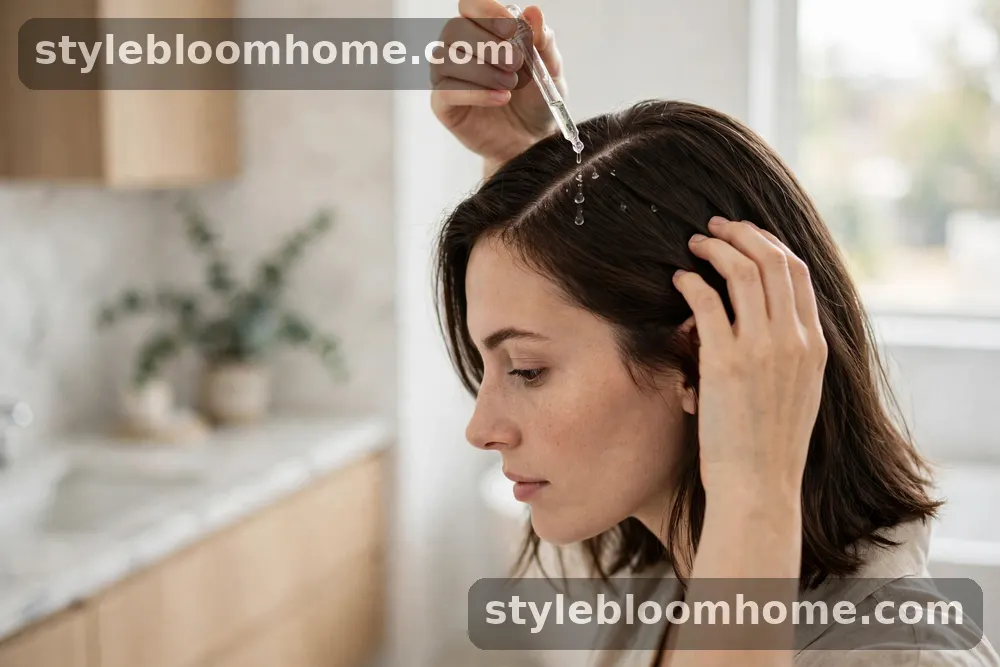
Illustration: serum applied directly to the scalp in partings — never to the hair lengths.
As an Amazon Associate I earn from qualifying purchases. This guide contains affiliate links to Amazon search results, so you see live prices and stock before you buy. It costs you nothing extra, and it keeps StyleBloom free.
No cosmetic scalp serum regrows hair. A serum can calm a dry or flaky scalp, reduce the shedding that comes from breakage, and make the hair you already have look fuller — but the only over-the-counter ingredient approved by the FDA to regrow hair is minoxidil. If your goal is regrowth for pattern thinning, minoxidil is the standard everything else is measured against, and a cosmetic serum is a supporting player, not a substitute.
This is general information, not medical advice. Hair loss has medical causes no serum can address. If anything in the "when to see a clinician" section describes you, see a clinician before you spend a dollar on a bottle.
First win: Tonight, part your hair in four places and look at your scalp in a bright mirror. Flakes, redness, tenderness, or visible widening at the part tell you more in sixty seconds than any product page will.
How we chose what counts
We searched fresh on October 31, 2026, then opened and read the live pages behind this guide: the 2025 expert consensus summary on topical minoxidil, the Panahi rosemary trial reporting, dermatologist roundups, and the brand and retailer pages for every price below.
Evidence first, texture second. A serum earns its place by the strength of the evidence for its active ingredient, not by how luxurious it feels. Texture matters — it decides whether you will still use it in week eight — but never outranks evidence. One job per pick. Every serum below carries a "Best for" label naming the one situation it serves best. US prices, US stockists. Every price is a US price at a US stockist, read on October 31, 2026. Check the live price before you buy. What we did not do. We did not lab-test these serums.
What a scalp serum can and cannot do
A scalp serum works on the skin of your scalp. Hair is dead fibre; the scalp is living skin, and the follicle — the tiny factory that makes each hair — sits inside it. A serum's honest jobs all happen at that skin level, and its dishonest claims all pretend otherwise.
What a scalp serum can do. It can moisturise a dry scalp, reducing the itching and flaking that make shedding look worse than it is. It can calm irritation from harsh shampoos, colour, or over-washing, loosen flakes when it contains a gentle exfoliant such as salicylic acid, and reduce breakage — the shedding you see in the shower that was never a lost follicle, but hair snapping along the shaft. It can make existing hair look denser by coating the shaft and improving the scalp environment it grows through.
What a scalp serum cannot do. It cannot create a new follicle or reverse an established bald patch, change your hair's genetically set growth rate (about half an inch a month), replace minoxidil for pattern hair loss, or diagnose why your hair is shedding. The honest summary: serums improve appearance and comfort; they do not create follicles.
Why the hair cycle sets the timeline. Each follicle runs its own schedule: growth of two to seven years, then a resting phase of two to three months. Expect the first judgement point at eight to twelve weeks, and a fair verdict at four to six months.
Minoxidil vs a cosmetic serum: the honest comparison
Minoxidil is a drug. Everything else in this guide is a cosmetic. That single fact explains the difference in evidence, in rules, and in what you are allowed to expect.
Minoxidil: the proven standard. Topical minoxidil is FDA-approved to treat pattern hair loss, with decades of randomised trials behind it. The 2025 expert consensus guidelines in the Journal of the American Academy of Dermatology confirm it prolongs the growth phase, switches resting hairs back into growth, and converts fine, miniaturised hairs into thicker terminal hairs. Results typically appear at two to four months with twice-daily application, and roughly 40 to 60 percent of users of the 5% strength achieve a clinically significant response. A 2004 randomised trial of 381 women found 5% superior to placebo on hair count, patient assessment, and investigator assessment.
The price of the proof. Minoxidil must be used indefinitely: stop, and the regrown hair is typically lost within three to four months. It can irritate the scalp — the foam is usually better tolerated than the solution, which contains propylene glycol. It must not be used during pregnancy or breastfeeding, under age 18, or when hair loss is patchy, caused by medication, thyroid problems, nutritional deficiency, chemotherapy, or scarring. Apply 1 ml twice daily to the scalp, and read the drug label first.
Cosmetic serums: the supporting cast. A cosmetic peptide, caffeine, or botanical serum is not FDA-approved to regrow hair, and no honest guide should let it borrow minoxidil's evidence. What the better ones do is support the conditions hair grows in: a calmer scalp, less flaking, less breakage, better hydration. For mild, recent shedding, that support is often the whole job. For established pattern thinning, a cosmetic serum used alone is a delay, not a treatment — and six months of delay costs hair, because follicles that miniaturise further are harder to recover.
Can you use both? Yes, at different times of day. Apply minoxidil to a clean, dry scalp exactly as its label directs, let it dry fully, and use the cosmetic serum at the other end of the day. If you can only buy one, buy the one that matches the diagnosis.
At a glance: comparison table
Prices are US prices read on October 31, 2026 — re-check before you buy.
| Product | Best for | Key actives | Size | Price checked |
|---|---|---|---|---|
| Women's Rogaine 5% Minoxidil Foam | Proven regrowth, pattern thinning | 5% minoxidil (medicine) | 2-month supply | 4-month supply $49.99 at CVS |
| The Ordinary Multi-Peptide Serum | Budget cosmetic, early thinning | Redensyl, Procapil, Capixyl, caffeine | 60 ml | $24.00 |
| Vegamour GRO Hair Serum | Thinning hair, lightweight feel | Red clover, mung bean, curcumin, peptides | Full-size bottle | $64.00 |
| Briogeo Scalp Revival Treatment | Dry, flaky, itchy scalp | Binchotan charcoal, tea tree, witch hazel | 1 oz | $32.00 |
| Nécessaire Rosemary Serum | Rosemary-led routine, daily use | 70% rosemary blend, 5% Capixyl | 1 fl oz | $48.00 |
| Cécred Restoring Hair & Edge Drops | Edges and sparse areas | Biopeptide-5, keratin ferment | 1.7 oz | $56.00 |
| Divi Scalp Serum | Oily scalp, buildup | Caffeine, peptides, tea tree, amino acids | 30 ml | $48.00 |
| OUAI Scalp Serum | Dry scalp, skincare-style routine | Red clover, adaptogens, hyaluronic acid | 2 fl oz | $54.00 |
| Kérastase Genesis Serum | Breakage-related shedding | 1.5% Aminexil, caffeine, ginger root | 90 ml | $66.00 |
| Marc Anthony Grow Long Serum | Budget anti-breakage | Rosemary, caffeine, ginseng, biotin | 2 fl oz | $9.99 list |
The ten serums, reviewed
Every review follows the same shape: who it is for, what the evidence actually says, and what to watch out for. Prices were read on live US pages on October 31, 2026 — check the current price and the size before you buy.
1. Women's Rogaine 5% Minoxidil Foam — Best for proven regrowth in pattern thinning
The only medicine on the list, listed first because for pattern thinning it is the only honest first buy. The foam is 5% minoxidil, the best-evidenced strength in women, and the format sensitive scalps tolerate best. The 2025 guidelines confirm the mechanism and timeline; the 2004 trial of 381 women found 5% superior to placebo on hair count and both assessments. Roughly 40 to 60 percent of users achieve a clinically significant response — a substantial minority do not, and no seller may honestly tell you in advance which group you are in.
CVS listed the 4-month supply at $49.99 on October 31, 2026; roundups place the 2-month canister roughly in the $30 to $45 range. What it demands: twice-daily application, about 1 ml, directly on the scalp, indefinitely — never in pregnancy or breastfeeding, under 18, or for patchy or medically caused loss. Check the current price of Women's Rogaine 5% Minoxidil Foam on Amazon.
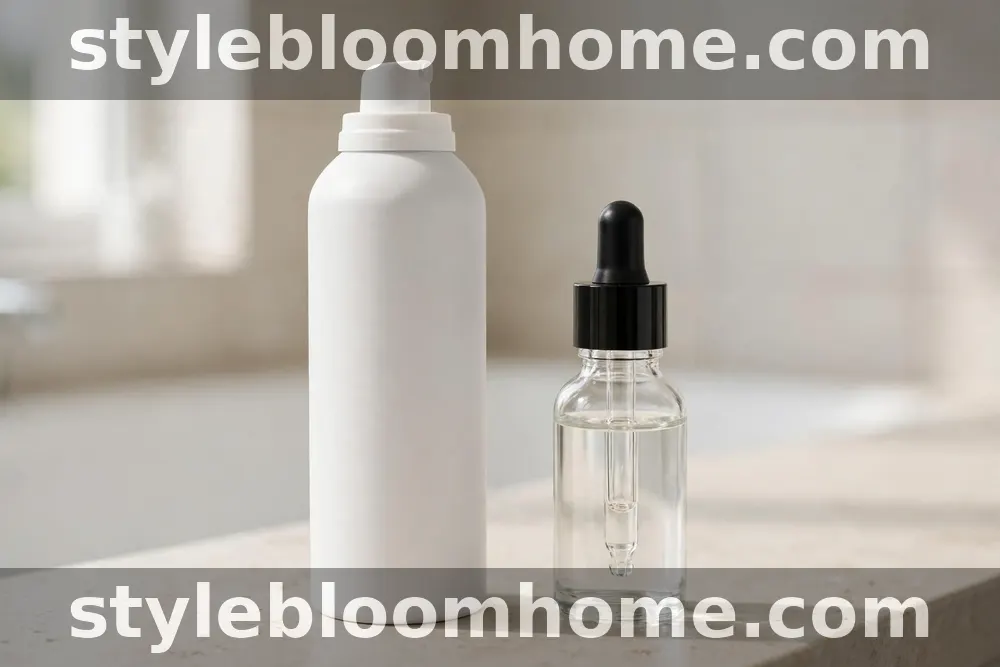
Illustration: a minoxidil foam canister beside a cosmetic peptide serum. One is a medicine with a drug label; the other is a cosmetic. Different jobs, different rules, different evidence.
2. The Ordinary Multi-Peptide Serum for Hair Density — Best budget cosmetic for early thinning
The cheapest way to buy the three named peptide complexes — Redensyl, Procapil, and Capixyl — plus caffeine, in one bottle. At $24.00 for 60 ml on the brand's US listing, it is roughly a third of the price of most competitors. The evidence is small and often manufacturer-linked; no large independent trial exists. It is not FDA-approved to regrow hair, and The Ordinary does not claim that it is. It can honestly support the scalp environment and reduce the appearance of thinning — a reasonable first step for early, mild thinning.
It feels light and watery and dries without grease. Use it on a dry or towel-dried scalp, a few drops in partings, once daily. Do not expect it to do minoxidil's job. Check the current price of The Ordinary Multi-Peptide Serum on Amazon.
3. Vegamour GRO Hair Serum — Best for thinning hair with a lightweight feel
The most written-about cosmetic serum in this category, and the most often confused with a medicine. It is a vegan cosmetic of red clover, mung bean, curcumin, and peptides, light and fast-absorbing — suited to people who hate heavy, oily scalp products, and to fine hair, which notices every gram of residue. The brand's own clinical study is small and brand-reported, and independent evidence is thin. Vegamour's own reporting says most users see fuller-looking hair after about four months.
The $64.00 full-size single bottle (checked on vegamour.com, October 31, 2026; a smaller size starts at $49) buys that four-month experiment at a premium price. If the texture is what will keep you applying it daily, the premium is defensible. If you are buying it because you believe it regrows hair, the premium is a misunderstanding — buy the Rogaine foam instead, and watch out for the subscription pricing. Check the current price of Vegamour GRO Hair Serum on Amazon.
4. Briogeo Scalp Revival Charcoal + Tea Tree Scalp Treatment — Best for a dry, flaky, itchy scalp
The pick for the scalp that itches, flakes, or feels tight — the scalp problem, not the hair-loss problem. Binchotan charcoal, tea tree oil, witch hazel, and peppermint make it a treatment for discomfort first and appearance second. Neither it nor charcoal is a regrowth treatment, and Briogeo does not pretend otherwise. It calms the scalp and reduces scratching, itself a cause of breakage.
At $32.00 for the 1 oz bottle (list price, confirmed across several US stockists on October 31, 2026), it is a focused buy: use it as a targeted treatment, not a daily leave-in. Tea tree oil is a sensitiser for some people, and peppermint can sting on broken skin — patch-test behind one ear first, and stop if the sting outlasts the first minute. Check the current price of Briogeo Scalp Revival Treatment on Amazon.
5. Nécessaire Rosemary Serum — Best rosemary-led serum for a daily routine
The single rosemary product the fresh search returned with a real formula behind it: a 70% rosemary water, oil, and extract blend with 5% Capixyl, in a 1 fl oz bottle positioned as a 30-day supply. At $48.00 (checked at Bluemercury and the brand's own shop, October 31, 2026), it is the most expensive rosemary option in this guide — and the only one whose rosemary content is stated as a percentage rather than implied by the name. The evidence is one small trial against 2% minoxidil — the Panahi study, read properly below.
What the serum can honestly offer is a pleasant, daily, rosemary-led scalp routine with a peptide complex alongside it. Buy it for the rosemary routine, not because a search result said rosemary beats minoxidil. Rosemary oil can irritate very sensitive scalps: patch-test first, and keep it off broken skin. Check the current price of Nécessaire Rosemary Serum on Amazon.

Illustration: a water-based leave-in serum in a glass dropper bottle. A few drops in partings, massaged in, is the whole application — more is not better.
6. Cécred Restoring Hair & Edge Drops — Best for edges and sparse areas
Built for one specific worry: the hairline and edges, where thinning is most visible and most distressing. The formula centres on Biopeptide-5 and a keratin ferment, in a 1.7 oz dropper bottle positioned as a 30-day supply. At $56.00 (checked on cecred.com, October 31, 2026), it is priced as a premium targeted treatment. It can honestly condition and protect fragile hairline hairs, where tight styles and heat do much damage.
If your edges are thinning from traction — tight braids, ponytails, wigs glued at the hairline — the first treatment is not a serum at all, it is releasing the tension. A serum helps edges only after the pulling stops. If the hairline loss is patterned or scarring, that is a clinician conversation, and no edge drop will answer it. Check the current price of Cécred Restoring Hair & Edge Drops on Amazon.
7. Divi Scalp Serum — Best for an oily scalp with buildup
The pick for the scalp that gets greasy by midday, flakes at the hairline, and feels coated no matter how often you wash. Caffeine, peptides, tea tree, and amino acids in a light, non-greasy formula, for the scalp that over-produces oil and traps buildup at the root. Caffeine's evidence is laboratory-stage and weak as a leave-in. Tea tree and amino acids address comfort and buildup — the side this serum solves.
At $48.00 for 30 ml (checked on diviofficial.com, October 31, 2026; the 100 ml bottle is $136), it is priced at the premium end, and the small bottle is the honest first purchase. Watch out for the oily-scalp trap: an oily scalp is often over-washed, and over-washing is often what drives the oil. If you wash daily and your scalp still feels coated, the answer is usually a gentler wash routine and a lighter product — this serum — not a stronger shampoo. Check the current price of Divi Scalp Serum on Amazon.
8. OUAI Scalp Serum — Best for a dry scalp in a skincare-style routine
OUAI's serum treats the scalp the way skincare treats the face: red clover extract, adaptogens, and hyaluronic acid, in a 2 fl oz bottle. At $54.00 (checked at Ulta and Target, October 31, 2026), it suits anyone whose scalp step should feel like skincare. Hyaluronic acid hydrates scalp skin, which flakes and itches less. This serum's honest job is comfort and hydration — a dry, tight scalp that feels better within a week — and it does that job well.
It is not a thinning treatment, and OUAI's marketing does not make it one. For dryness, a strong buy; for a widening part, a distraction — buy the Rogaine foam. Watch out for fragrance: if your scalp is reactive, a fragranced serum is a risk. The unscented or low-fragrance options here — The Ordinary, Divi — are the safer first try. Check the current price of OUAI Scalp Serum on Amazon.
9. Kérastase Genesis Strengthening Serum — Best for breakage-related shedding
Aimed at the most common misdiagnosed problem in this category: hair that is not falling out from the root, but breaking along the shaft. The formula carries 1.5% Aminexil — L'Oréal's anti-breakage molecule — with caffeine and ginger root, in a 90 ml bottle. At $66.00 at Sephora US (checked October 31, 2026; some stockists list $62), it is the most expensive serum in this guide. Aminexil has company research for anchoring hair and reducing breakage. The brand states plainly that this is not a medical hair-loss treatment.
The way to tell whether breakage is your problem is simple: look at the hairs you shed. A hair with a tiny bulb at the root fell from the follicle; a hair with no bulb, a frayed end, or a short, snapped length broke. If most shed hairs have no bulb, a breakage serum plus gentler handling beats any growth serum — and our satin bonnet guide for curly hair explains the night-time half. Confirm the diagnosis before you buy the premium bottle. Check the current price of Kérastase Genesis Serum on Amazon.
10. Marc Anthony Grow Long Scalp & Hair Serum — Best budget anti-breakage serum
The honest budget pick, and the most honestly labelled bottle in this guide: its pack wording states plainly that it does not grow new hair. At $9.99 list price for 2 fl oz (seen at $8.67 on Amazon, checked October 31, 2026), it is a fifth of the price of most of the list. It conditions scalp and shaft, reduces breakage, and costs almost nothing to try. None of its ingredients is a proven regrowth treatment, and the brand does not claim otherwise.
For a first experiment, it is the sanest ten dollars in this category. It is fragranced and lighter on named complexes than the premium bottles. Buy it to learn the habit, not to buy a result. And watch the name: "Grow Long" is a length-appearance promise, not a growth claim, and the pack says so. Check the current price of Marc Anthony Grow Long Serum on Amazon.
Ingredient evidence, honestly graded
"Strong" means randomised trials in people. "Limited" means small, early, or manufacturer-linked studies. "Weak" means laboratory or animal work, or tradition, without a human trial worth citing.
| Ingredient | What it can do | Evidence | Watch out for |
|---|---|---|---|
| Minoxidil 5% | Regrow hair in pattern thinning; prolong growth phase | Strong — decades of trials, FDA-approved | Must be used indefinitely; irritation; not in pregnancy |
| Redensyl | Support the scalp environment; appearance of density | Limited — small, manufacturer-linked studies | Not FDA-approved for regrowth; often overstated |
| Capixyl | Support the scalp environment; reduce irritation | Limited — small, manufacturer-linked studies | Often paired with rosemary in marketing claims |
| Procapil | Support the scalp environment; appearance of density | Limited — small, manufacturer-linked studies | Evidence is mostly in vitro and small trials |
| AnaGain (pea sprout) | Support growth-phase signalling in lab studies | Weak to limited — small human data | Marketing often outruns the evidence |
| Caffeine | Support hair-shaft growth in lab studies; mild scalp stimulation | Weak as a leave-in product | Needs long contact time; rinse-off use is weaker still |
| Rosemary oil | Calm the scalp; one small trial vs 2% minoxidil | Limited — one small single-site trial | Irritant for sensitive scalps; never ingest undiluted |
| Salicylic acid | Lift flakes; clear follicle openings; calm flaking scalps | Strong for flaking, not for regrowth | Overuse dries and irritates the scalp |
| Niacinamide | Support the skin barrier; calm redness | Moderate for skin; weak for hair growth | High strengths can flush sensitive skin |
| Tea tree oil | Reduce flaking and itch in seborrhoeic dermatitis | Moderate for flaking, not for regrowth | Sensitiser for some; patch-test first |
| Biotin | Help only when you are deficient | Strong for deficiency; weak otherwise | No evidence for supplementation without deficiency |
| Saw palmetto | Weak DHT-related support, by tradition | Weak — limited human evidence | Check with a doctor first if pregnant or breastfeeding |
| Aminexil | Help anchor hair; reduce breakage | Limited — mostly company research | Not a medical hair-loss treatment |
| Copper peptides | Support skin repair and scalp health | Weak to limited for hair | Stains fabric; evidence is early |
| Hyaluronic acid | Hydrate scalp skin; reduce dryness and flaking | Strong for hydration, not for regrowth | Needs a sealed routine to hold moisture in |
Three readings matter more than any single row. First, the only row whose evidence is "strong" for regrowth is minoxidil. Second, the rows strong for something are strong for scalp comfort, not growth. Third, the peptide complexes that dominate cosmetic serum marketing — Redensyl, Capixyl, Procapil — are all "limited", all small, and all manufacturer-linked.
Scalp serum vs hair serum vs hair oil
Three products, three jobs, one shelf, and endless confusion. A scalp serum goes on the skin of the scalp, in partings, and stays there — a leave-in treatment for the scalp, usually water-based, light, and fast-absorbing. A hair serum goes on the hair shaft, mid-length to ends, and its job is the look and feel of the hair you already have: smoother, shinier, less frizz. Applying it to the scalp coats the roots. A hair oil is heavier and slower to absorb, aimed at the shaft and ends for shine and breakage protection. An oil can be a pre-wash scalp treatment, rinsed out — but a daily leave-in oil traps buildup.
Mielle's Rosemary Mint Scalp & Hair Strengthening Oil — the oil most often mistaken for a serum here — is $9.99 for 2 oz at the brand's own store, and it is an oil, not a serum. It has its place: a pre-wash scalp massage, once or twice a week, rinsed out. Our rosemary and rice water guide walks through the home routine honestly, and our hair wash routine guide covers the wash-day half.
Rosemary: the one study, read properly
Rosemary is the most searched ingredient in this category, and the most misquoted. Nearly every rosemary serum page says the same sentence: a study found rosemary oil worked as well as minoxidil.
What the study actually was. Panahi and colleagues published a randomised comparative trial in 2015 in the journal Skinmed, in 100 people with androgenetic alopecia. One group applied rosemary essential oil, the other applied minoxidil 2%, twice daily for six months, and hair counts were measured. Both groups saw a significant increase in hair count, with no statistically significant difference between them. The rosemary group reported less scalp itching. Nothing significant showed at three months — the effect took six.
What the study does not say. It does not say rosemary oil works as well as the 5% minoxidil standard — it compared against 2%, and the 2004 trial found 5% superior to 2% in patient-reported benefit. It does not say rosemary oil is FDA-approved as a hair-growth medication — it is not. It does not say a retail rosemary serum, oil, or water carries the trial's result — the trial used rosemary essential oil in a controlled protocol, not a blended cosmetic. What that means for your purchase: a rosemary serum is a reasonable, pleasant experiment for an otherwise healthy scalp — and the Nécessaire serum above is the most honestly specified option we found, because it states its rosemary percentage. But choosing it instead of minoxidil means choosing a one-trial cosmetic over a decades-of-trials medicine. Our rosemary water routine covers the home version.
How to use a scalp serum
Most serum bottles are wasted by application, not by formula. A serum poured onto the hair does nothing for the scalp. Four habits decide whether the bottle works.
Part, then apply. Make four or five partings across the scalp and place a few drops directly on the skin in each parting. For minoxidil foam, the same rule applies with the label's dose: about 1 ml, twice daily, on the scalp — more than the label's dose does not work better, and increases irritation risk for no gain. Massage with fingertips, not nails. Two minutes of gentle fingertip massage spreads the serum and increases blood flow to the skin. Keep the pressure pleasant, never painful.
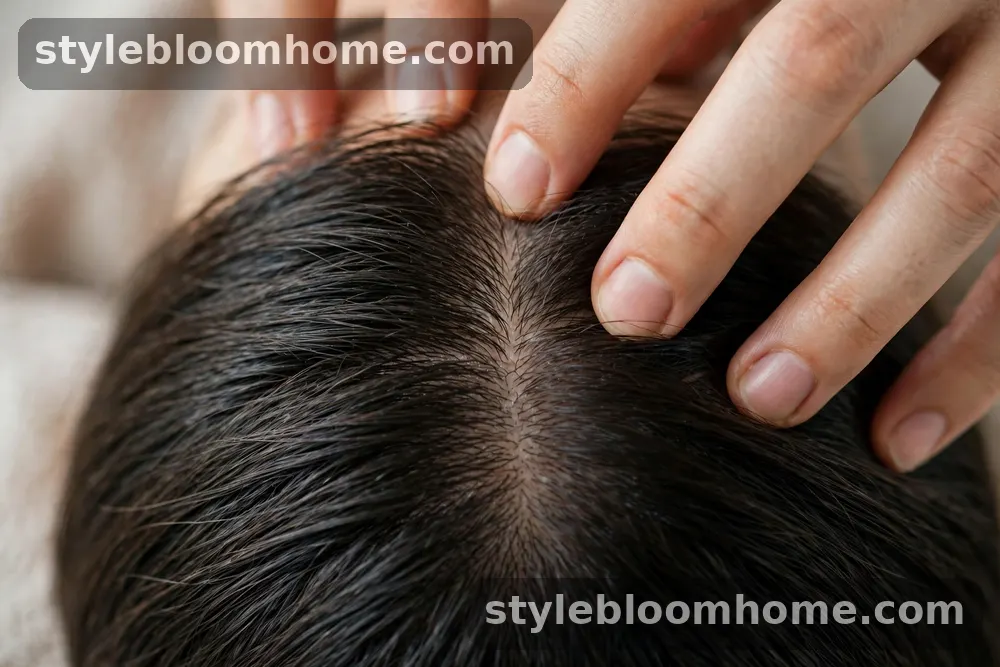
Illustration: fingertips, not nails, for two minutes. The massage spreads the serum and brings blood to the skin — the pressure should feel pleasant, never painful.
How often, and how long? Daily — once daily for most cosmetic serums, twice daily for minoxidil — for at least eight to twelve weeks before you judge it. Tie the routine to a moment you already have, and let the habit carry the treatment.
Choose by your situation
Buy for the scalp you have, not the hair you wish for. Match your situation to one row, and buy that row's pick first. If two rows describe you, treat the medical one first and the cosmetic one second.
Pattern thinning with a widening part or a receding hairline. Buy the Rogaine 5% foam, and book a clinician visit to confirm the diagnosis. Shedding two to three months after illness, surgery, childbirth, or severe stress. This is the classic telogen effluvium pattern: a shock pushes many follicles into the resting phase at once, and the shedding shows up months later. It usually resolves on its own over six to nine months. A gentle serum can support the scalp while you wait. Do not start minoxidil for this pattern without a clinician's advice.
Flaky, itchy, tight scalp with normal density. Buy the Briogeo treatment, use it as directed, and simplify your wash routine — the hair wash routine guide covers the wash-day half. Thick, yellowish flakes or red, scaly patches mean a dermatologist, not a serum.
Postpartum shedding. Shedding that starts two to four months after giving birth is expected — the high oestrogen of pregnancy held hairs in the growth phase, and the drop after birth releases them together. It usually settles within a year. A cosmetic serum is fine for scalp comfort, but do not use minoxidil while pregnant or breastfeeding. If shedding is still heavy after a year, or comes with other symptoms, that is a clinician visit. Thinning at the edges from tight styles. Release the tension first — looser braids, no glue at the hairline, no tight daily ponytail — and then use a conditioning edge product such as the Cécred drops. If the hairline has smooth, shiny patches where follicles look lost, see a dermatologist promptly: scarring can make it permanent.
Breakage, not shedding. Do the bulb test from the Kérastase review: no bulb means breakage, a handling problem. Buy the Kérastase or Marc Anthony serum, sleep on silk or satin — our satin bonnet night routine covers that half — and cut the heat styling for eight weeks.
Objections, and who should skip serums
"I tried a serum and nothing happened." The three usual reasons, in order: it was the wrong job (a cosmetic bought for pattern thinning), it was applied to the hair instead of the scalp, or it was judged at three weeks instead of twelve. If all three were right and nothing changed, the answer is probably a diagnosis, not a better bottle. "Serums are just expensive water." Some are: a serum of water and glycerin with its named complex far down the list is a moisturiser with a marketing budget. The table above is the filter.
Who should skip serums entirely, for now. Anyone with sudden, patchy, painful, or scarring hair loss; shedding with scaling, sores, pus, or a burning scalp; anyone pregnant or breastfeeding and considering minoxidil — never without a clinician; anyone whose hair loss followed a new medication; and anyone without basic blood work for new shedding: thyroid, iron, medication review. A serum can wait. Those cannot.
What not to buy
"Regrows hair" on a cosmetic label. A cosmetic that claims to regrow hair is making a drug claim without a drug's evidence Before-and-after photographs. Lighting, part width, hair length, wet versus dry hair, and a different camera angle can manufacture a full head of hair from the same head. The only before-and-after worth trusting is your own, taken in the same mirror, the same light, the same part, twelve weeks apart.
"DHT blocker" shampoos and serums. Saw palmetto and similar botanicals are sold as natural DHT blockers, and the human evidence for that mechanism from a leave-in cosmetic is weak. The cosmetic version borrows the word, not the effect. Proprietary blends with no concentrations. A "proprietary growth complex" that lists no ingredient and no percentage is a label, not a formula. High-alcohol formulas on a sensitive scalp. High alcohol on a sensitive scalp will make you stop using the product. Miracle timelines. Two weeks, thirty days, "results in one wash" — every one is a claim the hair cycle forbids.
When to see a clinician
See a clinician — a primary-care doctor first, a dermatologist for anything below — if any of these describe you. The conditions below are the ones a serum will waste time on.
Sudden or rapid shedding. Losing large amounts of hair over days or weeks is a medical event until proven otherwise. The causes are diagnosable with basic blood work, and treatable in ways a serum is not. Patchy loss. Round, smooth patches, or loss in a pattern that does not match the usual widening part or receding hairline, can be alopecia areata or a scarring condition. Both need prompt diagnosis.
Pain, scaling, sores, or burning. A painful scalp, thick scaling, crusting, pus, or burning is a skin condition, not a serum deficiency — psoriasis, seborrhoeic dermatitis, folliculitis, and fungal infection all present this way, and all need a clinician's eye and usually a prescription treatment. Shedding with other symptoms. Hair loss with fatigue, weight change, feeling cold, heavy periods, acne, or excess facial hair is a hormone or thyroid story until proven otherwise. Children and teenagers. Hair loss in a child or teenager is always a clinician visit, never a serum purchase. The visit is the one purchase here that can change the outcome.
After you buy: the first twelve weeks
The bottle is the easy half. Most people quit in week four, when nothing looks different.
Weeks one to two: the habit. Tie the application to a moment you already have — after the evening shower, beside the toothbrush, before the bonnet goes on. Photograph your part in the same mirror and light — your baseline. A mild tingle that fades is common; worsening burning or flaking means stop. Weeks three to six: the flat middle. Nothing visible will happen, and that is normal. Take one photograph a fortnight — daily mirror-checking manufactures disappointment. With minoxidil, hold steady through two weeks of increased shedding; talk to a clinician if it continues.
Weeks seven to twelve: the first judgement. Compare the week-twelve photograph with the baseline, in the same conditions. Look at the part width, not at the hair in general. A narrowing part, new fine hairs at the hairline, or a visible reduction in shower shedding are real signals. "My hair feels better" is a real signal for a comfort serum, not a regrowth signal. After week twelve: decide, once, on evidence. If the serum worked for the job you bought it for, keep it and the routine that made it work. If it did not, buy the clinician visit — or, for pattern thinning, the medicine you skipped.

Illustration: a serum bottle among wash-day products on a bathroom shelf. The serum is one step in a routine, not the routine itself — the wash, the handling, and the night protection matter as much.
Scalp serum by budget
Under $15: learn the habit. The Marc Anthony Grow Long serum at $9.99 list price is the whole budget tier, and it is enough. It teaches you whether you will apply a serum daily, whether your scalp tolerates a fragranced formula, and whether breakage is your problem. $15 to $35: the honest middle. The Ordinary at $24.00 and the Briogeo treatment at $32.00 are the two best buys in this tier, for opposite problems — early thinning support and flaky-scalp comfort. Most buyers should stop here.
$35 to $65: the premium experiment. Nécessaire at $48.00, Divi at $48.00, OUAI at $54.00, Cécred at $56.00, and Vegamour at $64.00 are premium experiments in a specific job — rosemary routine, oily scalp, dry scalp, edges, lightweight thinning support. Buy one when you know the job precisely and the middle tier has not served it. $65 and above: stop and ask what you are buying. The Kérastase at $66.00 is the only serum here at that price, and it is there because breakage is a real, common problem and the formula is honestly specified. Above that price you are buying packaging, fragrance, and advertising. Subscriptions: buy the first bottle at full price; subscribe only after week twelve.

Illustration: a serum bottle on a nightstand. The nightly routine is the treatment — the bottle only works on the nights it is used.
Frequently asked questions
- Does scalp serum work for hair growth?
- No cosmetic scalp serum regrows hair. A serum can improve the scalp environment, making existing hair look fuller. Regrowth is minoxidil's job: the only FDA-approved OTC ingredient, used twice daily.
- What is the #1 hair regrowth product?
- By evidence, 5% minoxidil foam — Women's Rogaine is the best-known version — with decades of trials behind it and roughly 40 to 60 percent of users responding significantly. It is a medicine: indefinite use, possible irritation, and never in pregnancy, under 18, or for patchy or medically caused loss.
- What are the big 3 for thinning hair?
- There is no official "big 3". The honest version: minoxidil, a clinician's assessment of prescription options, and scalp care that keeps the scalp calm.
- How often should you use a scalp serum?
- Daily: once daily for most cosmetic serums, twice daily for minoxidil, applied directly to the scalp in partings. Judge it at eight to twelve weeks, not at three.
- How long does a scalp serum take to work?
- For scalp comfort, one to three weeks. For the appearance of fuller hair, eight to twelve weeks of daily use. For regrowth with minoxidil, two to four months for the first change, four to six for a fair verdict.
- What is the best serum for your scalp?
- It depends on the scalp you have. For pattern thinning, 5% minoxidil foam. For a dry, flaky, itchy scalp, the Briogeo treatment. For an oily, coated scalp, the Divi serum. For early, mild thinning on a budget, The Ordinary serum.
- Does rosemary serum work as well as minoxidil?
- No — not on the evidence we have. One small 2015 trial of 100 people found rosemary oil comparable to minoxidil 2% over six months. It never faced the 5% standard or replication, and rosemary oil is not FDA-approved for growth. A reasonable experiment for a healthy scalp; a poor substitute for minoxidil in pattern thinning.
- Can I use a scalp serum every day?
- Yes — daily use is how these products are designed to be used, and how their timelines are measured. Exception: targeted treatments, used as directed, and any product that irritates — stop it rather than pushing through.
- Should I apply scalp serum to wet or dry hair?
- To a dry or towel-dried scalp, in partings — never to soaking-wet hair, which dilutes the product and sends it down the shaft. Minoxidil's label is stricter: a dry scalp, left to dry fully for two to four hours, with no blow-drying immediately after.
- Can a scalp serum help postpartum shedding?
- A cosmetic serum can help scalp comfort while postpartum shedding runs its course, usually within a year. It cannot stop the shedding, a hormone-driven cycle event. Do not use minoxidil while pregnant or breastfeeding. If shedding is still heavy after a year, see a clinician.
- What is the difference between a scalp serum and a hair serum?
- A scalp serum goes on the skin of the scalp, in partings, and stays there — a leave-in treatment for the scalp environment. A hair serum goes on the shaft, mid-length to ends, for the look and feel of existing hair. An oil is a third thing: heavier, for the shaft and ends or pre-wash.
- Can scalp serum help a receding hairline?
- Only minoxidil has evidence for regrowth at a receding hairline, and only when follicles are still alive — a smooth, shiny, scarred hairline will not respond to any topical. Releasing tension is the first treatment for traction-related edge loss. A progressing receding hairline is a clinician conversation, not a serum purchase.
- Is minoxidil safe, and who should not use it?
- Its common effects are local irritation, usually from the solution's propylene glycol; the foam is better tolerated. Never in pregnancy or breastfeeding, under 18, or for patchy or medically caused loss. Increased shedding for up to two weeks after starting can be normal; shedding that continues beyond that is a reason to talk to a clinician.
- My hair started shedding heavily three months after surgery. Will a serum help?
- Probably not directly, and the timing is the clue: shedding two to three months after surgery, illness, childbirth, or severe stress is usually telogen effluvium — many follicles resting and shedding together. It usually resolves on its own over six to nine months. A gentle serum can keep the scalp comfortable; minoxidil is not the answer to a cycle event.
- I have a flaky, itchy scalp and thinning at the crown. Which serum do I buy first?
- Buy the flaky-scalp treatment first — the Briogeo treatment — and use it for three weeks, because it is the fastest problem to solve. Then reassess the crown: a widening part with a family history of pattern loss means the Rogaine 5% foam plus a clinician visit. If the crown thinning is new, rapid, or comes with pain or scaling, skip both purchases and book the clinician first.