
Best Jewelry Box Organizer for Women (2026): Boxes vs Organisers vs Armoires
The best jewelry box organizer is the one that matches the jewelry you actually own: a dresser-top box for everyday pieces, a stackable organiser for a growing collection, a standing armoire for a large collection, and a travel case for the pieces that leave the house.
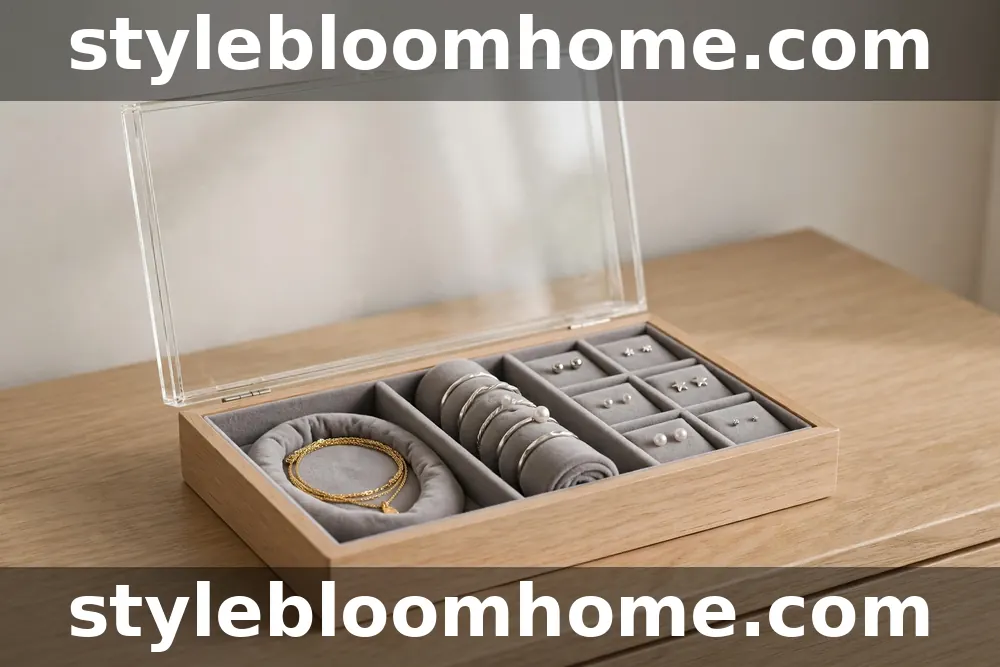
Illustration: an open glass-lid box with velvet compartments — the dresser-top form this guide starts with.
As an Amazon Associate I earn from qualifying purchases. This guide contains affiliate links to Amazon search results, so you see live prices and stock before you buy. It costs you nothing extra, and it keeps StyleBloom free.
The best jewelry box organizer for most women is a lidded box on the dresser that keeps every piece in its own compartment and closes against dust and air. That rules out most of what is sold as a jewelry organizer: open stands that tarnish everything, shallow trays that tangle within a week, and giant armoires bought for twelve pieces. Storage is protection first, finding things second, and looking good third — in that order, every time.
No tested editorial comparison of box versus organiser versus armoire existed when we checked on October 31, 2026 — only two tested lists, retailer category pages, and sponsored products. This guide answers it, with dimensions and hook counts read from live product pages.
Every size, drawer count, hook count, and named-retailer price below was read on a live brand or retailer page on October 31, 2026.
First win: Count your necklaces before you read another word. More than ten necklaces? Skip to the armoire and hanging organiser sections — a dresser-top box will not fix tangling, however pretty it is.
How we chose what counts
No sponsored placements, no guessing from thumbnails. Here is the actual process, so you can judge the picks for yourself.
Live pages first. We searched fresh on October 31, 2026, then opened and read the live pages at writing time: WOLF's storage guidance, Blue Nile's tarnish care guide, The Container Store's Stackers listing, SONGMICS specifications, Pottery Barn's organization guide, and armoire and travel-case specifications. Snippet-only prices were never published as verified.
Form before brand. The most common mistake is brand-first shopping: picking a beautiful box, then discovering it has nowhere to hang necklaces, no room for watches, or drawers too shallow for bangles.
Measured, not vibes. Every pick below carries at least one measured fact: footprint, height, drawer count, hook count, or compartment count, read from the live specification. Two boxes that look identical in a photo can differ by two inches in height — the difference between fitting under a shelf and not fitting at all.
Protection is a feature, not a vibe. Velvet lining is not automatically anti-tarnish. A lining that absorbs tarnish-causing gases, a lid that closes, and storage away from bathrooms and sunlight are what slow tarnish, according to both WOLF and Blue Nile.
What we did not do. We did not lab-test boxes, and this guide does not pretend otherwise. Where assembly or sturdiness matters — standing armoires especially — we report what the manufacturer states, including anti-tip kits and weight.
Box vs organiser vs armoire: the chooser
Sellers use the words box, organiser, and armoire interchangeably, which is why so many buyers end up with the wrong shape. They are three different answers to three different problems, and the differences are physical, not marketing.
A jewelry box is a lidded container on a dresser or vanity, usually one to three layers, with a top tray under a hinged or glass lid and one or two drawers below. It holds a small to medium collection — roughly a two-week rotation — and protects it by closing. Buy a box when your collection is modest and you want to see the top layer at a glance.
A jewelry organiser is a system, not a single container. The clearest example is the stackable layer system: a lid plus individual layers for rings, watches, charms, earrings, or necklaces, bought separately and stacked to match what you own. Organisers win on growth — add a layer instead of replacing the box — and lose on access: to reach the bottom layer, you lift the layers above it.
A jewelry armoire is furniture. Standing armoires are roughly five feet tall, with a full-length mirror on the door, hooks and slots inside, drawers at the base, and shelves behind. Armoires win on necklace capacity and on seeing everything at once, and lose on footprint, weight, assembly, and price. Buy one when you own fifty pieces or more, or when necklaces are your main problem.
Two more forms complete the picture. A travel case is a small, zippered, padded case with necklace clips and ring rolls, sized for a carry-on. A hanging organiser is a double-sided fabric panel with hooks and clear pockets that hangs in a closet or on a door. The travel case is for pieces that leave the house; the hanging organiser is for necklace-heavy collections with closet space and no dresser space.
- Best for a first jewelry box: a 2-layer glass-lid box — see it, close it, done.
- Best for a growing collection: a stackable organiser — add layers, never replace the box.
- Best for necklace tangles: a hanging organiser or an armoire — hooks beat trays for chains.
- Best for fine and silver jewelry: a box with a named anti-tarnish lining and a lid that closes.
- Best for travel: a zippered travel case with necklace clips — never pack jewelry loose.

Illustration: the three forms side by side — a glass-lid dresser-top box, a stackable tray system, and a tall mirror-front cabinet.
At a glance: comparison table
Read this table against your own collection, not against an ideal collection. The right row is the one whose "fails when" column does not describe you.
| Form | Best for | Typical footprint | Biggest strength | Fails when |
|---|---|---|---|---|
| Dresser-top box | Under 30 pieces, everyday rotation | About 8 x 9 in, 4 to 7 in tall | See it, grab it, close it | You own many long necklaces |
| Stackable organiser | Growing collections, one dominant type | About 7 x 10 in, grows taller per layer | Add a layer, never replace it | You hate lifting layers to reach the bottom |
| Drawer organiser trays | Hidden storage, existing dresser drawers | Fits inside your drawer | Invisible, dust-free, no dresser space used | Your drawers are shallow or already full |
| Standing armoire | 50+ pieces, necklace-heavy collections | About 14 x 16 in floor, about 58 to 63 in tall | Hooks, mirror, and storage in one | You rent, move often, or lack a free wall |
| Wall or door armoire | Small bedrooms, mirror needed | About 15 x 4 in, about 43 in tall | Full storage with almost no floor space | Your door or wall cannot take the weight |
| Travel case | Trips, weekends, destination weddings | About 10 x 6 x 2 in | Tangle-free packing, hard protection | You try to use it as your only storage |
| Hanging organiser | Necklace-heavy, closet space available | About 17 x 32 in hanging | Up to 39 necklaces visible at once | You have no closet rod or door to hang it on |
Measure first: three numbers before you buy
Three measurements prevent almost every return in this category. Take them with a tape measure, not by eye, and write them down before you open a single product page.
1. Dresser depth and free width. Measure the depth of the dresser top and the clear width that is actually free after lamps and perfume — not the width of the whole dresser. Most dresser-top boxes here are about 8 inches deep and 9 inches wide. A lid that opens backward needs clearance behind it, and side drawers need clearance on the sides.
2. Your longest necklace, laid flat. Lay it flat and measure it clasp to clasp. Then check the interior: does the box hang it, fold it once, or force it into a coil? Necklaces tangle because they are stored folded against other chains. Long lariat or pendant chains need hooks — an armoire, a hanging organiser, or a stand — not a deeper box.
3. Your tallest and widest pieces. Measure your chunkiest bangle standing up and your widest cuff flat. Drawers in dresser-top boxes are often only 1 to 2 inches tall inside, which swallows rings and studs and rejects chunky bangles entirely. One bangle that does not fit is the piece you leave on the dresser — and the piece left on the dresser is the piece that gets lost.
While you measure, count. Count necklaces, rings, stud pairs, drop earrings, bracelets, watches, and brooches separately. A collection of 40 stud pairs and 5 necklaces needs compartments; 30 necklaces and 5 rings needs hooks. The count takes five minutes and it is the most useful thing you can do before buying.
The same measure-first habit pays off in the kitchen too — our spice rack organizer guide starts from three numbers as well.
Best dresser-top jewelry boxes
Dresser-top boxes are the default for a reason: the fastest storage to use. You open the lid, see the top layer, choose, and close. The best ones share three traits: a glass lid or a lid that stays open, a genuinely soft velvet lining, and drawers that pull smoothly when loaded.
SONGMICS glass-lid boxes: the measured standard. The SONGMICS GISELLA collection gives you the clearest like-for-like choice in the whole category, because the same footprint comes in three heights with verified specifications. The 2-layer box (model UJBC174) measures 8 inches deep by 9.1 inches wide by 4.1 inches high, weighs 2.6 pounds, and has one drawer under a glass lid. The 3-layer box (UJBC239) measures 8 by 9.1 by 5.3 inches, weighs 3 pounds, and has two drawers. The 4-layer box (UJBC173) measures 8 by 9.1 by 6.5 inches, weighs 3.7 pounds, and has three drawers. All three use MDF with polyurethane, a velvet lining, and a glass lid. Choose the 2-layer if your dresser sits under a low shelf or mirror. Choose the 3-layer for the standard everyday collection.
The honest limit of the glass-lid box is necklaces. The top layer holds rings, studs, and short chains beautifully. Long necklaces fold into the drawers, and folded chains tangle. If necklaces are more than a third of your collection, pair a glass-lid box with a hanging organiser or a necklace stand, rather than buying a taller box and hoping the problem goes away. Search SONGMICS glass-lid jewelry boxes on Amazon to see live prices for the 2, 3, and 4-layer sizes, and check the height against your shelf clearance before you order.
Tall narrow boxes for small dressers. If your dresser top is narrow but shelf height is generous, look at the tall narrow form: the SONGMICS 5-layer box with side drawers (UJBC172) measures 5.1 inches deep by 7.9 inches wide by 9.7 inches high, with three side drawers and a big mirror. It takes under 8 inches of dresser width and can stand in for a vanity mirror for earrings. Our small bedroom storage ideas guide covers the wider room, not just the dresser top. Search large-drawer jewelry box organizers on Amazon and compare the tall form against the wide form on your own measurements, not on the product photo.
Wood and leather boxes: buy the lining, not the outside. Wooden and leather boxes dominate the premium dresser-top market, and they are beautiful objects. But the outside is not what protects your jewelry — the lining is. Before you pay a premium, ask: is the lining soft velvet or a named anti-tarnish fabric? Does the lid close fully? Can dividers move? A beautiful wooden box with hard compartments and a gapping lid will scratch and tarnish jewelry faster than a plain box with a good lining and a tight lid. Search wooden jewelry boxes for women on Amazon and read the lining description before the wood description, every time.
Best stackable jewelry organisers
Stackable organisers are the only form here that grows without being replaced. You buy a lid and one or two layers, learn what you own, and add the layer you are missing. That is the difference between a box you keep for ten years and a box you replace in eighteen months.
Stackers Classic: the system to beat. The Stackers Classic system is built from a lid plus individual layers: rings and bracelets, watches and accessories, charms, earrings, necklaces, and deep layers for larger pieces, each sold separately so you build the stack your collection needs. The exterior is faux leather with a grey velvet interior, and the layers are designed to stack snugly without toppling. The US starter set at The Container Store — the Classic Lidded Box, a 25-section tray, and a deep tray — was listed at $79.99 and in stock when we checked on October 31, 2026, measuring 7-1/4 inches long by 9-7/8 inches wide by 5-5/8 inches high. The starter set is the right starting point for most buyers, because the 25-section tray handles the small pieces that cause most of the mess, and the deep tray handles the pieces that do not fit anywhere else. Search Stackers jewelry box sets on Amazon to compare live prices against The Container Store listing, and confirm the layer combination before you order, because sets vary by retailer.
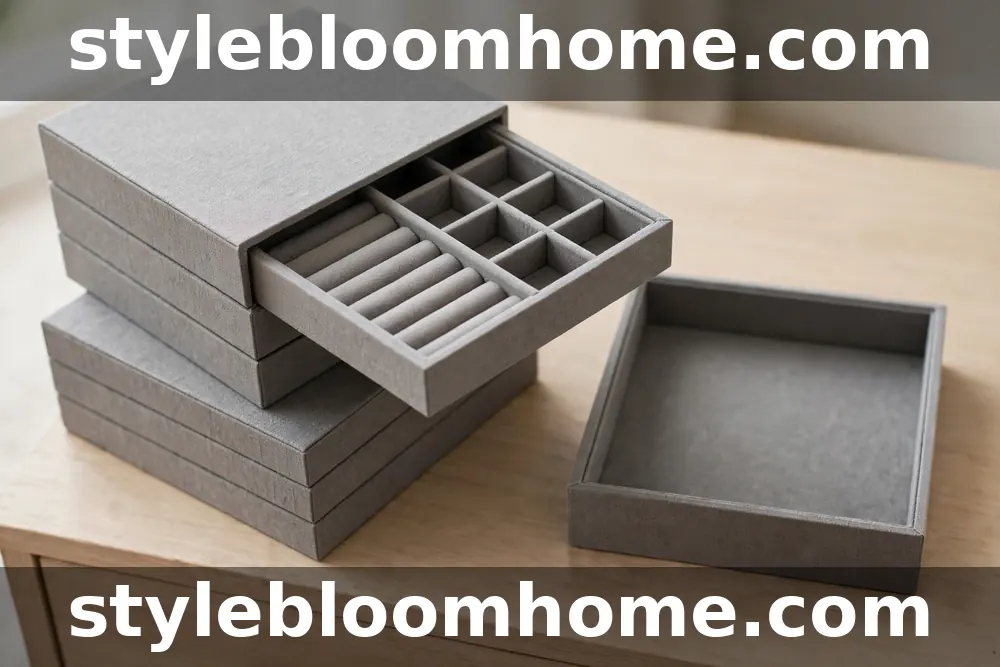
Illustration: stackable trays with ring rolls and divided compartments, plus a deep tray for larger pieces.
The honest limit of every stackable system is access to the bottom. To reach the bottom layer, you lift the layers above it and set them down somewhere. That is fine once a day and annoying four times a day. The fix is ordering: daily pieces in the top layer, weekly in the middle, monthly at the bottom. If you wear everything equally, a stackable system will frustrate you, and a drawer box or armoire with everything visible will serve you better.
Drawer organiser trays: the invisible option. If you own a dresser with a spare drawer, velvet trays are the cheapest serious storage here — and the easiest to get wrong. Measure the drawer interior, not the drawer front, and measure depth: a tray that is too tall stops the drawer closing. Buy trays by compartment size, not compartment count: large compartments for bracelets and watches, small ones for rings and studs, and a separate solution for necklaces. Search velvet jewelry drawer organizer trays on Amazon and measure your drawer interior first, because a tray that almost fits is a tray you will return.
Best jewelry armoires: standing and wall-mounted
An armoire is the right answer to a specific problem: too many necklaces, too many pieces, and nowhere to see them. It is the wrong answer to every other problem, because it is the most expensive, heaviest, and hardest-to-move form here.
Standing mirror armoires: the full-length solution. A standing armoire is a tall cabinet with a full-length mirror on the front, hooks and slots inside, drawers at the base, and shelves behind the door. The SONGMICS LED mirror cabinet (UJJC023) measures 16.2 inches deep by 14.4 inches wide by 60.6 inches high, weighs 31.9 pounds, and includes a lock, two drawers, an inner mirror measuring 13.6 by 8.3 inches, and a wall anti-tip kit. The CHARMAID standing armoire measures 15 by 15 by 62 inches, weighs 33.5 pounds, and is specified with 191 compartments, including 100 earring slots, 91 ring slots, and 30 necklace hooks. The differences that matter are hook count, drawer depth, and whether the mirror is full-length on the outside, not the compartment count, which counts slots of very different sizes as if they were equal. Search standing mirror jewelry armoires on Amazon and compare hook counts and weights, not compartment counts, because hooks are what fix tangling and weight is what decides whether you can move it.
Before you buy any standing armoire, answer three safety questions. Can you anchor it to the wall? The anti-tip kit is included for a reason, and a tall loaded cabinet a child climbs is a tip-over risk. Can you assemble it, or will you pay someone? Armoires arrive flat-packed and need a second pair of hands for the mirror door. Will you move within two years? If yes, do not buy one — buy a hanging organiser and a dresser-top box, which move in a car. Search jewelry box organizers for women on Amazon if those answers point you back to a box.

Illustration: a tall standing mirror-front armoire in a bedroom corner — closed until you need a necklace, which is the point of the form.
Wall-mounted and door-mounted armoires: the small-bedroom answer. A wall-mounted armoire is a shallow cabinet, roughly 15 inches wide, 4 inches deep, and 43 inches tall, that hangs on a wall or over a door and opens to reveal hooks, trays, and a mirror. It gives armoire-style hook storage with almost no floor space — the best armoire form for small bedrooms and rented rooms. The limits are weight and mounting: it must be fixed into studs or with proper anchors, not hung on a hollow door with one hook. Renters should check the lease before drilling.
Wooden furniture armoires: heirloom or furniture? Solid-wood armoires with dovetailed drawers are furniture first and jewelry storage second: heavier, more expensive, and longer-lived than MDF mirror cabinets. Buy one if you want furniture that outlasts the jewelry inside it. Do not expect better tarnish protection by magic — the lining, the door seal, and the room do that work, whatever the cabinet is made of.
Best travel jewelry organizers
Travel is where jewelry gets damaged, lost, and tangled, and where the cheapest protection pays off fastest. A travel case costs less than a single lost earring, and it is the one purchase here with no real downside.
Zippered travel cases: the carry-on standard. The BAGSMART travel jewelry case measures 9.8 inches long by 6.1 inches wide by 1.9 inches high, weighs 0.55 pounds, and is specified with 4 necklace clips, 4 ring holders, a PU leather earring plate for up to 12 pairs of earrings, and 3 transparent pockets. The necklace clips are the feature that matters: clip each necklace separately, and it arrives untangled. The earring plate matters second: studs pushed through a plate arrive as pairs, not as singles at the bottom of a bag. Buy the case in a colour you can spot inside a dark suitcase, pack it in the centre of the case surrounded by soft clothes, and never pack jewelry in checked luggage if you can avoid it. Search travel jewelry organizer cases on Amazon and check the closed dimensions against your carry-on pocket, not just the open layout in the photograph.
Travel rolls: for the light packer. A foldable jewelry roll is a flat panel that folds into a pouch, with compartments, straps, and pockets for a handful of pieces. The BAGSMART roll unfolds to about 18 by 9 inches, folds to about 7 by 9 inches, weighs under half a pound, and has six compartments and an earring board for up to 20 pairs. Rolls suit the traveller who packs five pieces, not fifty. If you travel with a watch, a cuff, and wedding jewelry, buy the zippered case with a hard structure and keep the roll for weekends.
Hanging organisers: closet storage that travels badly, stores brilliantly. The BAGSMART hanging organiser measures 17.16 inches deep by 0.08 inches wide by 32.37 inches high, with 39 necklace hooks on one side and 42 transparent pockets plus 20 PVC anti-tarnish plastic bags on the other, on a rotating hanger. That is the highest necklace capacity in this guide, in the thinnest footprint — and it hangs in a closet, not on a dresser. Folded for travel it compresses into a pouch, but it is not a travel case: open hooks and soft pockets in a suitcase are a tangle waiting to happen. Use it at home; pack a case for the trip. Search hanging jewelry organizers with necklace hooks on Amazon and count your necklaces first — under 15, a hanging organiser is overkill and a box will serve you better.
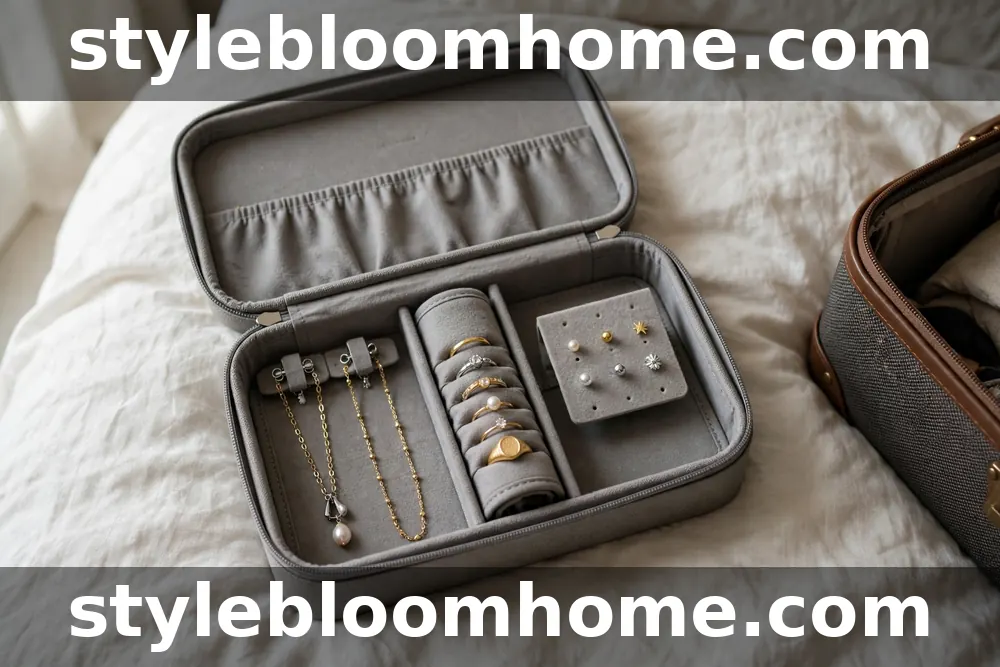
Illustration: an open zippered travel case with separate necklace clips, a ring roll, and an earring plate.
The travel packing rule. Clean each piece, clip necklaces separately, push studs through the plate, roll rings onto the roll, zip the case, and place it in the centre of your bag. Photograph the open case before you zip it — that photograph is your packing list and your insurance record in one image. On arrival, unpack the case first and put pieces straight into the hotel safe or the case itself, never loose on the hotel dresser.
Choose by what you own
Buy for the jewelry you own, not for the jewelry you wish you owned. These five splits cover almost every real collection.
Mostly necklaces. You need hooks, not trays: a hanging organiser for home, an armoire if you want the mirror and furniture, and a travel case with necklace clips for trips. Store each necklace clasped, hung separately, or coiled once in its own compartment. Never store two chains in one compartment.
Mostly rings and studs. You need small compartments, many of them, with soft rolls for rings and a plate or slots for studs. A glass-lid box or a Stackers starter set with a 25-section tray serves you perfectly. Count stud pairs, not pieces — a pair needs one compartment.
Mostly bracelets, bangles, and cuffs. You need height and rods, not shallow trays: a deep layer, a drawer box with deep drawers, or an armoire with bracelet rods and shelves. Check drawer interior height, not exterior height — a drawer 2 inches tall outside may be 1.5 inches inside.
Watches and statement pieces. Watches need pillows or rolls that hold the case without pressing the crown, and compartments wide enough for the case diameter. Statement necklaces and cuffs need large, flat compartments or a deep drawer.
A little of everything, worn in rotation. You need visibility above all: a glass-lid box for the top layer, a hanging organiser or armoire for necklaces, and a travel case for trips. Buy the glass-lid box first, live with it for a month, and note which pieces never fit. Then buy the second form for exactly those pieces.
Materials, linings, and tarnish: what actually works
Tarnish is chemistry, not bad luck. It happens when certain metals react with air, humidity, sulfur compounds, skin oils, and product buildup. Sterling silver is the most sensitive, because silver reacts with sulfur gases to form silver sulfide. Brass and copper oxidize readily. Plated jewelry is vulnerable because its thin layer can wear and expose a more reactive base metal. Solid gold and platinum resist tarnish but still scratch and collect oils. Storage slows tarnish. Nothing in a normal home stops it forever.
Anti-tarnish linings: what the claim means. WOLF's LusterLoc lining is the best-documented anti-tarnish lining in this category, and WOLF states it plainly: the patented lining absorbs the gases within the box to protect pieces and preserve their brilliance and shine for up to 35 years. That claim is about the lining's protective life under typical storage conditions, and it applies most to sterling silver and silver-plated jewelry, plus some brass and copper alloys. It means the box actively slows the reaction, while a plain velvet lining only prevents scratches. When you compare boxes, ask which lining is named. "Velvet lining" means soft and scratch-safe. "Anti-tarnish lining" or a named system like LusterLoc means gas-absorbing and tarnish-slowing. Both are valuable. They are not the same, and a seller who calls plain velvet "anti-tarnish" without naming a system is selling you softness under a stronger name.
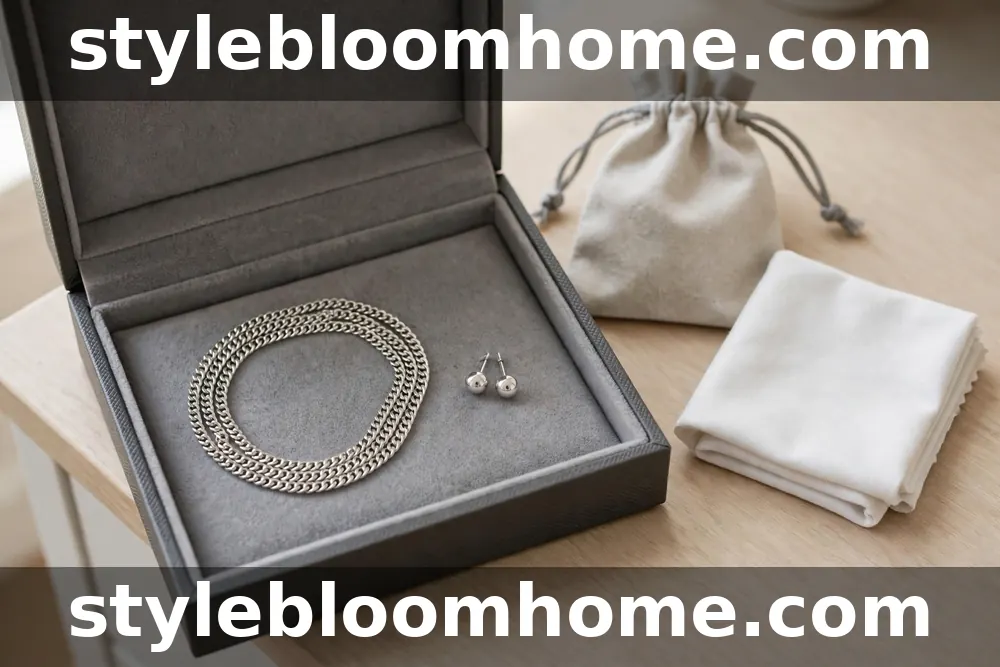
Illustration: silver pieces stored separately in a lined box, with a drawstring pouch and a polishing cloth beside it.
The rest of the tarnish system. A lining alone is not a system. Blue Nile's guidance, read live on October 31, 2026: store pieces separately in a lined box, soft pouch, or zip-seal bag; add anti-tarnish strips inside boxes and drawers for silver; wipe each piece with a polishing cloth before storing; keep jewelry dry; put jewelry on last, after perfume and lotion have dried; and store away from bathrooms, windows, and shifting temperatures. Search anti-tarnish strips for jewelry on Amazon and replace strips when the manufacturer says to.
Materials, honestly ranked by job. Solid wood is durable and beautiful, but bare wood is hard and dry, so wood boxes need a soft lining — the lining does the protective work. Leather and vegan leather are durable and wipeable, but the exterior tells you nothing about the lining, so check it separately. MDF with polyurethane and velvet, the SONGMICS construction, is the mid-market workhorse: stable and affordable when the lining is soft and the lid closes. Glass lids reduce air exposure because you see without opening, but glass breaks — keep glass-lid boxes on a stable dresser.
What about silver that already tarnished? Tarnish is usually a surface reaction, not permanent damage. Light tarnish on solid sterling silver can often be improved with a silver polishing cloth or a gentle wash in warm water with mild soap, dried completely before storage. Go gently with plated, antique, gemstone-set, or delicate pieces, and ask a jeweler before chemical dips or ultrasonic cleaners, which can loosen stones and strip plating. Wear solid sterling silver often: gentle friction buffs away light oxidation.
Locks, mirrors, and security
A lock on a jewelry box is a small thing buyers overvalue and undervalue at the same time. Overvalue, because no jewelry box lock stops a determined thief — a small key lock deters a curious child and a snooping guest, and that is all. Undervalue, because that deterrence is genuinely useful: it keeps small hands away from sharp posts and gives you privacy in a shared bedroom. Buy a lock for privacy and children, not security.
Mirrors follow the same logic. A mirror lid is genuinely useful for earrings and clasps. A full-length mirror on an armoire door is genuinely useful for a whole outfit. A warped or cloudy mirror is worse than no mirror, because you will trust it. Check mirror size in the specification — the SONGMICS armoire's inner mirror is 13.6 by 8.3 inches, a makeup mirror, not a full-length mirror. Search jewelry boxes with a lock on Amazon and treat the lock as a privacy feature, checking the key is real with a spare, not a decorative clasp.
Who is it for? Recipient splits
A jewelry box is a gift that only works if it matches the recipient's collection, not the giver's taste.
For a bride or a new graduate. Buy the glass-lid dresser-top box in a neutral colour, with a travel case to go with it. Give the box with the first piece inside it — the wedding earrings, the graduation gift — because a box given empty is a promise, and a box given with something inside is a memory. Our Christmas gifts for mom guide covers the wider December picture if the box is a holiday gift.
For a teenager. Buy small, sturdy, and lockable, in a colour she chose. Her collection is mostly fashion jewelry, studs, and a few necklaces, in a bedroom cleaned by someone else. A small 2-layer box with a lock survives that life. A large armoire does not fit the room, the budget, or the collection. Never buy a box for jewelry she does not own yet in the hope she grows into it.
For a frequent traveller. Buy the travel case first and the home box second, or the travel case alone. A traveller with a beautiful home box and no case will pack jewelry loose, because that is what travellers do without a case. Buy the zippered hard-structured case in a colour visible inside a dark bag. Search wall-mounted mirror jewelry armoires on Amazon only if she also needs home storage and has wall space — otherwise the travel case alone is the complete gift.
For a collector with fifty pieces or more. Buy the armoire or the hanging organiser, after measuring, not before. She knows her count and her necklace problem, and she will spot a generic box instantly. The best gift is the form she does not yet own: if she has boxes, buy hooks; if she has hooks, buy a stackable system for small pieces. Ask one question first: "Do your necklaces tangle?" Her answer tells you the form.
For a mom, for Mother's Day or Christmas. Buy the stackable system in her colour, starting with the starter set, and give it with a piece of jewelry inside. A mom who has everything already owns a box, and a second generic box is clutter. For the wider gift search, our birthday gifts for mom who has everything guide starts from the same principle: buy for the life she lives, not the shelf she owns.
Jewelry box organizer by budget
Budget bands below use verified retailer prices where they exist and live Amazon search prices everywhere else. Treat every price as a check on the day, not a promise for next month.
Under $25: the travel case and the drawer tray. This band buys the two most useful cheap storage: a zippered travel case and velvet drawer trays, if your drawer measures right. Do not expect a locking, glass-lid, multi-drawer box here, and do not buy one claiming all three — at this price, one claim is false, usually the lock.
$25 to $75: the glass-lid box and the small stack. The sweet spot for most buyers. It holds the SONGMICS 2-layer and 3-layer glass-lid boxes at live Amazon prices, small stackable sets, and good hanging organisers. Buy one good form in this band, done well, rather than two cheap forms.
$75 to $150: the full stack and the wall armoire. This band buys the Stackers starter set plus an extra layer, a 4-layer glass-lid box with room to spare, and smaller wall-mounted armoires. The right band for a gift that should last a decade.
$150 and up: standing armoires and fine boxes. Above $150, buy furniture or fine storage, not more of the same box: a standing mirror armoire, a solid-wood box with a named anti-tarnish lining, or a WOLF box for fine and silver jewelry. The question is no longer "does it hold jewelry?" but "does it protect fine jewelry for decades, and earn its floor space?"
What not to buy, and when not to buy
Most bad jewelry storage purchases were bought for a collection that does not exist, in a room that was never measured.
Do not buy an open stand as your only storage. Necklace trees, bracelet T-bars, and earring stands look beautiful and protect nothing: open air, sunlight, dust, faster tarnish, and visible loss risk. Use a stand for the two pieces you wear this week and store the rest closed.
Do not buy a box with no lid, no lining, and no compartments. A pretty open tray is a catchall, not a box — perfect for rings you remove to wash your hands, useless as your only storage, because it does not close, separate, or protect.
Do not buy for a future collection. Do not buy a 50-piece armoire for 12 pieces, or a watch box for watches you do not own. Storage bought for a future collection sits empty, gathers dust, and pressures you to fill it.
Do not buy the cheapest lockable box you can find. At the bottom of the market, "lockable" often means a tiny clasp a child can open and a hinge that fails within months. A lock that does not lock is worse than no lock, because you will trust it.
When not to buy at all. Do not buy the week you move house, redecorate the bedroom, or leave on a trip — unless the purchase is the travel case. Storage bought in a move gets damaged before it is used, and storage bought before a redecoration gets measured for a room that no longer exists. Wait, measure the new room, and buy once.
After you buy: the first-week setup and care
The first week decides whether the box becomes a habit or a decoration. Set it up properly once, and it stays set up.
Day one: clean, sort, and assign. Clean every piece with a soft cloth before it goes in — oils and lotions stored with jewelry accelerate tarnish from the inside. Sort by type, then by wear frequency: daily pieces on top, weekly in the middle, monthly at the bottom. Assign every piece a named home before you close the lid, and photograph the open, assigned box.
The weekly five minutes. Once a week: return catchall tray contents to the box, re-pair singles, re-hang slipped necklaces, and wipe the top layer with a dry cloth. Once a month: wipe each piece you wore, check anti-tarnish strips and replace them when the manufacturer says to, and check silica packets if you use them.
Post-use: the habits that protect. Put jewelry on last, after perfume, lotion, and hairspray have dried, and take it off first when you get home. Remove it before swimming, showering, exercising, gardening, and cleaning with harsh chemicals. Never store jewelry damp — dry it completely first. Keep the box in the bedroom, closed, away from the bathroom and sunny windowsills.
When to upgrade, and when to stop. Upgrade when a form fails you three times: lifting the stack to reach the bottom three times in a week, untangling the same necklace three times, leaving the same bangle on the dresser three times. Stop when every piece has a home, you can find any piece in under thirty seconds, and nothing lives on the dresser overnight.
Frequently asked questions
- What is the best box for storing jewelry?
- A lidded dresser-top box with a glass lid and a soft velvet lining is the best box for most women, because you can see the top layer without opening it.
- What is the best way to organize a lot of jewelry?
- Split the collection by form: a stackable organiser or dresser-top box for rings, studs, and small pieces, hooks in an armoire or hanging organiser for necklaces, and a separate travel case for trips.
- What is the best organizer for jewelry and accessories?
- A stackable layer system is the best organizer for jewelry plus accessories, because you buy layers for rings, watches, earrings, charms, and necklaces separately and stack only what you own.
- Is it better to store jewelry in a box or outside?
- It is better to store jewelry in a closed box. Open storage on stands and trays leaves jewelry in open air, sunlight, and dust, which speeds tarnish and risks loss.
- What is the best quality jewellery box available?
- Quality means a tight-closing lid, a genuinely soft lining, smooth drawers, and compartments sized for your pieces.
- What is the best safe box for jewelry?
- No jewelry box is a safe. A lockable jewelry box deters curious children and casual snooping, and that is all it should be trusted to do.
- Are WOLF jewelry boxes worth it?
- WOLF boxes are worth it if you own fine jewelry, especially sterling silver. The LusterLoc lining absorbs tarnish-causing gases and is stated to protect pieces for up to 35 years under typical storage conditions.
- Where can I get nice jewelry boxes?
- Buy dresser-top and stackable boxes from Amazon search results for live prices, from The Container Store for the Stackers system, and from the brands themselves for WOLF and SONGMICS specifications.
- How do I stop my necklaces from tangling?
- Hang each necklace separately on its own hook, clasp it before you store it, and never put two chains in one compartment.
- How do I keep silver jewelry from tarnishing in a box?
- Store each silver piece separately in a lined box or an anti-tarnish pouch, add anti-tarnish strips inside the box, wipe pieces with a polishing cloth before storing, keep the box closed in a cool, dry bedroom away from the bathroom, and wear solid sterling silver often.
- Should a jewelry box have a lock?
- A lock is worth having if children live in or visit the house, if the bedroom is shared, or if you want privacy. Buy a box with a real key lock and a spare key.
- What size jewelry box do I need?
- Measure three things: the free width and depth of your dresser top, your longest necklace laid flat, and your tallest bangle standing up. Most dresser-top boxes are about 8 inches deep and 9 inches wide, standing armoires are about 14 by 16 inches on the floor and 58 to 63 inches tall, and travel cases are about 10 by 6 by 2 inches.
- Is a jewelry armoire better than a jewelry box?
- An armoire is better only if you own fifty pieces or more, if necklaces are your main problem, or if you want a full-length mirror and storage in one piece of furniture. A box is better if your collection is modest, your space is limited, you rent or move often, or you want to see the top layer at a glance.
- What is the best travel jewelry organizer?
- A zippered travel case with separate necklace clips, a ring roll, and an earring plate is the best travel organizer for most trips. A foldable roll suits light packers with five pieces or fewer.
- How do I clean a jewelry box and the jewelry inside it?
- Empty the box, wipe the velvet lining gently with a dry, soft cloth, and never soak a lined box or use harsh chemicals on the lining.