Is It Normal to Not Keep Up With Housework as a Working Mom?
Yes — and the data proves it. Here is what the numbers say, why the guilt is lying to you, and a realistic system that actually fits your life.
- Yes, it is normal: working mothers average 16 hours of housework a week vs. 6 for husbands (Gallup) — on top of a full-time job.
- A "messy house" is usually a math problem, not a character flaw: two jobs' worth of labor cannot fit into one person's evenings.
- Letting go of all-or-nothing thinking is step one — a "good enough" standard you keep beats a perfect system you abandon.
- A short daily reset plus one focused weekly session (about 75 minutes) beats willpower every time — grab the free checklist to make it stick.
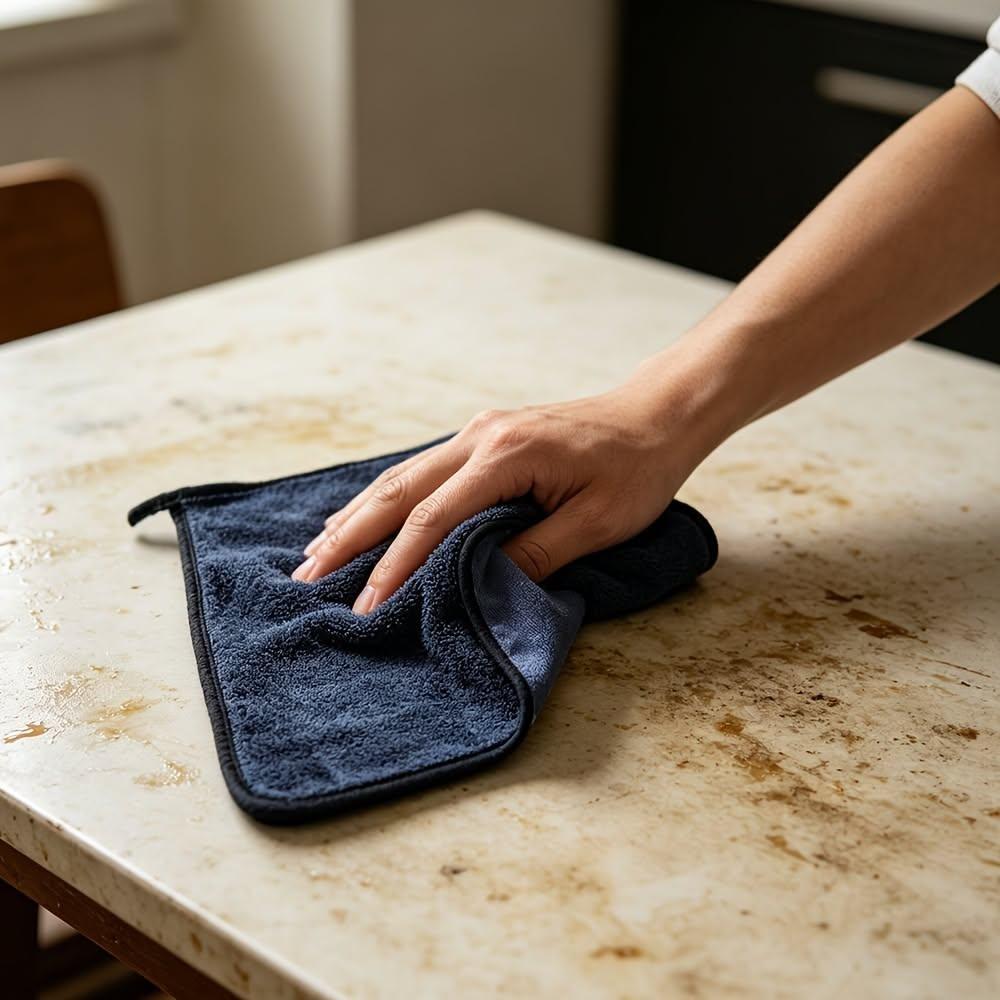
A lived-in home is not a failed home — it is a home with a working mom in it
Yes — it is completely normal not to keep up with housework as a working mom. Gallup research found working mothers average 16 hours of housework a week compared to 6 for their husbands, while carrying roughly 70% of all domestic labor. If your house is not spotless, you are not failing. You are doing the math of an impossible workload — and the math was never going to work.
What the data actually says
Let us start with numbers, because numbers do not do guilt trips. Sociologist Arlie Hochschild coined the term "the second shift" back in 1989 to describe exactly this: women working a full day at a job, then coming home to a second full workload of cooking, cleaning, and caregiving. Nearly four decades later, the data says the second shift is alive and well.
| Measure | Working mothers | Husbands / partners |
|---|---|---|
| Housework per week (Gallup) | ~16 hours | ~6 hours |
| Share of total domestic labor | ~70% | ~30% |
| Paid work | Full-time job | Full-time job |
Sixteen hours of housework on top of a forty-hour work week is not a scheduling problem. It is a second part-time job — roughly 64 extra hours a month — layered on top of the first one. When moms in online forums ask "is it normal to not keep up with housework," the most honest answer ever given might be the one from an old MetaFilter thread: there is no normal. You get to make up your own normal.
Why "not keeping up" feels like a personal failure (but is not)
If the numbers are so clear, why does the guilt persist? Three culprits:
1. The comparison trap. Your childhood memory of a spotless house was probably maintained by someone who did not also work full-time. Your social media feed shows the 4% of someone's home that photographs well, cleaned for the photo. Neither is your life.
2. All-or-nothing thinking. Many of us absorbed the idea that a home is either "clean" or "a mess" — no middle ground. So a sink with three dishes feels the same as a disaster zone, and once it feels like a disaster, why bother starting? This binary is the single biggest enemy of an actually tidy home.
3. The invisible labor list. Nobody sees the mental load: remembering the dentist appointment, noticing the milk is low, tracking whose turn it is for the school form. Invisible labor does not photograph, does not get thanked, and absolutely counts toward your exhaustion — even though the house "looks" like you did nothing.
Three moms, three real weeks
These are composites of the stories working moms share in forums, comment sections, and group chats every single day. See if you recognize yourself:
Mom A: the nurse. Twelve-hour shifts, three days a week. On work days the house runs on survival mode — paper plates, a toy-strewn living room, laundry multiplying in the hamper. On days off she "catches up," which means she spends her only free day cleaning instead of resting. She is not disorganized. She works 36 hours in three days.
Mom B: the work-from-home mom. She is "home all day," so everyone assumes the house should be immaculate. In reality she is in back-to-back video calls while a toddler dismantles whatever she tidied during the last break. The house looks lived-in by 10 a.m. every day. She is not failing at homemaking — she is working a job inside the mess factory.
Mom C: the single mom. One income, one adult, two kids, zero backup. There is no partner to split the 16 hours with — it is all her, or it does not happen. Her house has seasons: the week it is under control and the week it is not, alternating with her energy and the kids' schedules. She is not behind. She is a team of one doing a team's work.
The point is not that any of these situations is ideal. The point is that every one of them is normal — and none of them is solved by trying harder at 9 p.m. when you are already empty.
The reframe: your goal is not a clean house
Here is the mindset shift that actually changes things, borrowed from the smartest cleaning advice on the internet: your goal is not a clean house. Your goal is a house that does not get worse.
A "clean house" is a finish line you cross once and immediately lose. A "house that doesn't get worse" is a direction you walk every day — and it is achievable in the cracks of a working mom's schedule. Dishes done tonight means tomorrow starts neutral instead of behind. A ten-minute reset means Friday's mess is one laundry basket, not a landslide.
Pair that with an honest standard. Try this: my home needs to be healthy, functional, and mostly calm — not impressive. Healthy means no mold, no pests, no hazards. Functional means you can find things and move through rooms. Mostly calm means the main living areas get a regular reset. Everything beyond that — baseboards, color-coded closets, streak-free baseboards — is bonus content, not the baseline.
A realistic system for an unrealistic workload
Systems beat willpower because willpower is a battery and yours is already drained by 6 p.m. Here is the minimum viable system that hundreds of working moms actually stick to:
1. The 15-minute evening reset. Set a timer. Everyone in the house — kids included — puts things back where they live until it rings. Dishes in the dishwasher, shoes by the door, toys in the bin. You will be amazed what 15 focused minutes does; you will be more amazed at how it stops the slow landslide.
2. One focused weekly session: 75 minutes. Not a whole Saturday — one focused block. Bathrooms, floors, kitchen deep-wipe, one load of laundry start to finish. Our full working mom's cleaning schedule breaks those 75 minutes into a day-by-day plan so you never wonder "what should I clean today."
3. Put it on paper, not in your head. The mental load is half the exhaustion. A written checklist means you stop re-deciding what needs doing every single day. Our free weekly cleaning checklist printable is exactly this — print it, stick it on the fridge, and let the paper do the remembering.
4. Match tasks to energy, not just time. The 5 p.m. version of you has a fraction of the bandwidth of the Saturday-morning version. Save the brainless tasks (folding laundry while watching TV, wiping counters) for low-energy evenings and the annoying ones (bathrooms, floors) for when you actually have fuel.
5. Recruit the household. If other people live there, they can maintain there. Even small kids can do the evening reset; partners can own one zone (bathrooms, say) outright. "Helping mom clean" frames it as your job with assistants — reframe it as everyone maintains the home they live in.
Your permission slip: what to let go of
Consider this signed permission to stop caring about the following, effective immediately:
- Baseboards. Nobody's life was ever improved by dusted baseboards. They can wait for a seasonal deep clean.
- Folded underwear and socks. A drawer of rolled pairs works identically and takes a tenth of the time.
- Making beds "properly." Pull the duvet up. Done. Decorative pillows are a hobby, not a requirement.
- A spotless car. It is a transportation device full of children, not a showroom.
- Apologizing for the mess when someone visits. Try "come on in, we live here" instead. Watch how fast the tension leaves the room.
You are not lowering your standards. You are finally setting standards that match your actual life — a full-time job, 16 hours of housework already on your plate, and limited hours left over. That is not giving up. That is growing up.
Frequently asked questions
- Is it normal for a working mom to have a messy house?
- Yes, completely. Gallup research found working mothers average 16 hours of housework per week compared to 6 for their husbands, while carrying about 70% of all domestic labor. A home that is not spotless under that workload is the expected outcome, not a personal failure.
- How many hours of housework do working moms do per week?
- According to Gallup, working mothers average about 16 hours of housework per week — nearly triple the 6 hours their husbands average. That is on top of a full-time job, the equivalent of two full-time workloads carried by one person.
- How do working moms keep their house clean?
- The working moms who stay on top of it use systems, not willpower: a short daily reset (15 to 20 minutes), one focused weekly session (about 75 minutes), and a written checklist so nothing lives only in their head. Lowering the standard from "spotless" to "does not get worse" is the mindset shift that makes it sustainable.
- Why do I feel guilty about a messy house?
- Guilt comes from comparing your behind-the-scenes to everyone else's highlight reel — social media, childhood memories of a stay-at-home parent's house, and the old idea that a woman's worth shows in her home. None of those reflect your actual life: a full-time job plus the majority of domestic labor. The guilt is a faulty signal, not a fact.
- What is the minimum cleaning a busy working mom should do?
- The non-negotiable minimum: dishes handled daily, one load of laundry started and finished, a 10-minute evening reset of main living areas, and bathrooms and floors once a week. Everything beyond that — baseboards, organized closets, streak-free windows — is bonus, not baseline.