How to Keep Your House Clean With a Full-Time Job (The 20-Minute-a-Day System)
The realistic system for women who work all day: a 5-minute morning, a 15-minute evening closing shift, and weekends that belong to you again.
- The 20-minute system: 5-minute morning reset + 15-minute evening closing shift.
- Habit-stack cleaning onto things you already do (wipe the sink while the coffee brews).
- Automate the boring parts — robot vacuum, dishwasher routine, laundry rhythm.
- Kill the weekend marathon: daily maintenance makes weekends yours again.
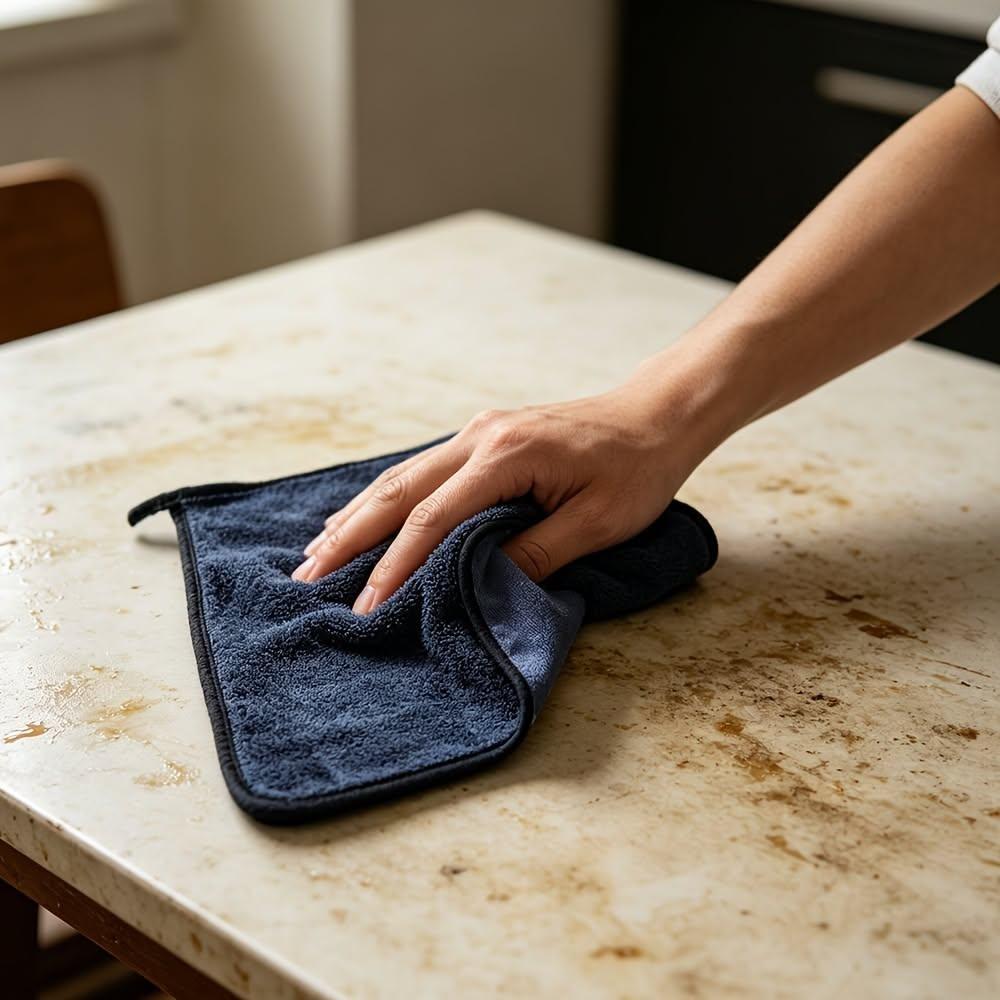
A five-minute wipe-down keeps the kitchen calm on busy workdays
Here is how to keep your house clean with a full-time job: clean a little every day instead of a lot on weekends: five minutes in the morning, a fifteen-minute evening 'closing shift,' and one small rotating task each week. This 20-minute-a-day system works because it matches your real energy — not the fantasy version of you who cheerfully deep-cleans for four hours on a Saturday.
Why does your house fall apart the moment you start working full time?
It is not laziness, and it is not a character flaw. It is an energy budget problem. A full-time job drains the exact resource cleaning requires: decision-making energy. Every cleaning task is secretly a hundred micro-decisions — where does this go, is this trash, should I wipe this now or later — and after eight hours of work decisions, your brain simply refuses to make more.
The classic plan — 'I will do it all on the weekend' — fails for a structural reason. Weekends are when your body and mind recover. Mess, meanwhile, accumulates at a fixed daily rate whether you are home or not. Dishes, laundry, dust, and clutter do not pause because you had a long week. So you start every Saturday already behind, spend half the weekend catching up, and begin Monday exhausted. That is the debt cycle, and no amount of willpower fixes it. Only a different system does. This guide shows how to keep your house clean with a full-time job — twenty focused minutes a day, no weekend marathons required.
How to keep your house clean with a full-time job: the 20-minute system
The math is simple and slightly magical: twenty minutes a day is 140 minutes a week — roughly the same time as a Saturday marathon. But spread across seven days, it does something a marathon cannot: it prevents mess from ever compounding. A crumb wiped today never becomes a sticky counter tomorrow. A basket of laundry moved along daily never becomes Mount Washmore.
The split is what makes it survivable on workdays:
Morning 5: make the bed, start the dishwasher or one load of laundry, wipe the bathroom sink while you brush your teeth. You leave the house with three things already handled, which changes how the whole day feels.
Evening 15: the 'closing shift' — a short reset routine that returns every room to its starting position before bed. (Full sequence below.)
Weekly 30: one rotating zone task — bathrooms one week, floors the next — done on whatever evening or weekend slot suits you. It never grows into a marathon because the daily maintenance has already done most of the work. That is the entire 20-minute cleaning routine: small enough to survive a bad week, consistent enough to replace the Saturday marathon for good.
What should you actually clean every day?
Not everything. The daily list is deliberately short — these are the tasks where skipping one day visibly compounds by day three:
Dishes and laundry in motion. Not finished — in motion. Start the dishwasher, move one load along. The goal is flow, not completion.
Kitchen counters and stovetop. A sixty-second wipe after dinner prevents the sticky build-up that later demands scrubbing.
High-traffic floors. A quick sweep or vacuum of the kitchen and entryway only. Whole-house floors are a weekly task.
Bathroom sink and toilet. A two-minute wipe keeps the bathroom guest-ready all week. Keep the supplies under the sink so there is no fetching.
Flat surfaces. The 'flat surface rule': clutter lands on counters, tables, and nightstands first. A nightly two-minute sweep of these keeps the whole house looking calm.
Notice what is not on the daily list: dusting, mopping, windows, baseboards, the oven. Daily cleaning is maintenance, not deep cleaning. Trying to do everything daily is exactly how systems die by Wednesday.
Habit stacking: attach cleaning to things you already do
The reason cleaning routines die is that they ask for new time slots you do not have. Habit stacking skips that problem entirely — you bolt a 2-minute cleaning task onto something you already do every day, so it fires on autopilot with zero new decisions:
- Brush teeth → wipe the bathroom sink. Keep a cloth by the tap; 90 seconds and the bathroom stays guest-ready all week.
- Coffee brews → start one load of laundry. Three minutes while the machine drips, and laundry moves itself through the day instead of piling up.
- Dinner heats → 2-minute toy and clutter sweep. One basket, one lap of the living room, done before the microwave beeps.
- Morning kettle boils → unload the dishwasher. Two idle minutes, and the kitchen starts the day empty and calm.
- Shower warms up → wipe the stovetop. That wasted minute of waiting handles yesterday's splatters before they bake on.
How to make it stick: pick just three pairings to start, write them on a sticky note on the fridge, and put the supply exactly where the trigger happens — the cloth by the sink, the basket by the couch. The honest caveat: habit stacking maintains a clean home; it will not rescue a messy one. Do your reset weekend first, then stack.
Automate the boring parts
Once the daily system is running, hand the repetitive middle to machines and schedules. Four automations that pay for themselves in reclaimed evenings:
- Robot vacuum on a mid-morning schedule. Set it to run while you are at work and come home to clean floors every day. The honest part: it misses corners and needs its bin emptied and brushes de-haired weekly — it replaces the daily sweep, not the weekly deep clean.
- Dishwasher on delay timer. Load it after dinner, set the delay so it runs overnight, and unload with the morning kettle. Clean dishes greet you daily — but only if loading it is already a closing-shift habit.
- Washing machine delay-start. Time the cycle to finish as you walk in the door, so laundry never sits damp and forgotten for hours. Work backwards from your arrival time; most machines let you set the finish time directly.
- Subscription deliveries for supplies. Put the basics — dishwasher tabs, laundry detergent, bin bags, toilet paper — on auto-delivery every 4–8 weeks so you never make a special trip or run out mid-week. One fewer errand is one fewer decision.
Automation does not replace the closing shift — it handles the boring middle so your twenty focused minutes stay twenty minutes. Set each one up once, then forget it exists; that is the entire point.
What about weekly and monthly tasks?
Think in three tiers — this is the house cleaning schedule for busy people in its simplest form. Daily keeps things from getting worse. Weekly keeps things genuinely clean. Monthly handles the slow-build grime nobody notices until a guest points it out.
Weekly (pick one zone per week, 30 minutes): bathrooms deep-wipe, full vacuum and mop, dusting all rooms, kitchen deep-wipe including microwave and appliance fronts, bedding and towels, entryway and wardrobe tidy. One zone, done properly, beats six zones done halfway.
Monthly (one hour, calendar it): baseboards, window interiors, fridge clean-out, washing machine maintenance cycle, showerhead descale, under-sink check for leaks, light fixtures and ceiling fans. Put it on the first Saturday of the month and it becomes background, not a project.
If this tiered rhythm appeals to you, our weekly cleaning schedule breaks it into a day-by-day checklist with twenty-minute daily anchors — it pairs perfectly with this system.
What is the 'closing shift' evening reset?
Borrowed from restaurants and retail, where nobody goes home until the store is reset for morning. Your home gets the same treatment. Fifteen minutes, same order every night, timer on:
Minutes 1–4: kitchen. Dishes into the dishwasher or sink soak, counters wiped, stovetop checked. Kitchen closed.
Minutes 5–8: living areas. Grab a laundry basket and walk each room collecting out-of-place items, then redistribute them in one trip. Cushions straightened, throw folded. Living room closed.
Minutes 9–11: bathroom. Quick sink and toilet wipe, towel straightened, tomorrow's products set out. Bathroom closed.
Minutes 12–15: launchpad. Keys, bag, and outfit for tomorrow by the door. This is not cleaning — it is a gift to your morning self, and it is the step that makes the whole system feel luxurious instead of chore-like.
The psychological trick is the sequence, not the speed. Waking up to a 'closed' home — bed made, kitchen clear, bag ready — creates a calm-start loop. Calm mornings make you more likely to do the evening shift. The system feeds itself.
How do you speed-clean without missing everything?
Speed comes from method, not hurrying. Four techniques do most of the work:
The timer. Twenty minutes with a visible timer beats an open-ended 'clean the house' every time. Parkinson's law applies to housework: it expands to fill the time you give it. Cap the time and your brain prioritizes automatically.
Top to bottom, left to right. Dust falls down; clean high surfaces first so you never re-clean. Moving systematically around a room means no spot gets visited twice and none gets missed.
The basket method. One basket per floor for everything out of place. Collect first, redistribute second. It turns a chaotic room into a sorted task in under five minutes and stops the aimless wandering that eats entire evenings.
The caddy. Keep all daily supplies in one portable caddy: all-purpose spray, two microfiber cloths, dish soap, a small brush. Every trip to fetch supplies is a chance to get distracted. Our microfiber guide's two-cloth method — damp cloth to clean, dry cloth to buff — lives in the caddy and makes wiping genuinely fast.
What cleaning supplies do you actually need?
Fewer than the cleaning aisle wants you to believe. The minimum viable kit for a working woman's home:
A stack of microfiber cloths (colour-coded if you like: one colour for kitchen, one for bathroom), one good all-purpose spray, dish soap, a toilet brush, a vacuum or quality broom, and a mop you will actually use. That is the whole list. One specialty product per persistent problem — limescale remover if your water is hard, for example — and nothing else.
Stop buying gadgets before the basics are habitual. A robot vacuum is wonderful, but it cannot replace the closing shift. Buy the system first with your hands; automate later once the routine is boring and reliable.
How do you finally stop the weekend marathon cleaning?
Understand what the marathon costs you. A four-hour Saturday clean does not just take four hours — it takes your recovery. You start Monday already tired, the mess rebuilds all week because there is no daily system, and by Saturday the backlog demands another marathon. It is a loan with terrible interest.
Breaking it takes one deliberate transition. Do a single reset — one full weekend, or three focused weeknights of ninety minutes — and get the house to a true baseline. Then start the 20-minute system the next morning and protect it like a work meeting for two weeks. By week three, the weekend marathon will feel absurd, because there will be nothing to marathon. Your Saturdays become yours again: one optional 30-minute zone task, or nothing at all.
What if you don't live alone?
A system only works if everyone in the house is in it. The trick is assigning zones, not tasks. 'Clean the bathroom' invites debate about standards; 'the bathroom is your zone on weeknights' creates ownership. Rotate zones monthly so nobody feels stuck with the worst one.
The golden rule: everyone closes their own shift. Each person resets their own spaces nightly — bedroom, desk, bathroom items. Kids get a five-minute tidy with music before bed; make it a game with a timer and it stops being a negotiation. Housemates split the closing shift by area and alternate weeks.
One honest note: if you live with someone who will not participate, stop trying to convert them and shrink your system instead. Close the kitchen and bathroom — the shared hygiene zones — and let their bedroom be their business. Protecting your energy matters more than winning the argument.
The family chore chart that actually works
Most chore charts fail for two fixable reasons: they assign vague tasks nobody owns, and everyone quietly disagrees about what 'done' looks like. Fix both and the chart runs itself:
- Assign zones, not tasks. 'The bathroom is your zone this week' creates ownership; 'clean the bathroom' invites debate about standards. Zones have visible owners; tasks get orphaned.
- Define 'done' once, in writing. For each zone, one sentence: 'Bathroom done = sink and toilet wiped, mirror spot-free, floor swept.' Post it on the fridge. Ninety percent of chore fights are really standard fights, and writing it down ends them.
- Rotate weekly, every Sunday. Nobody is stuck with the worst zone forever. A 5-minute Sunday swap — name moves to the next column — keeps it feeling fair without a family meeting.
- Toddlers: the toy bin. One clear, finishable job — everything soft and small goes in the bin.
- School-age kids: trash and dusting. Emptying small bins and a duster run through the living room are perfect starter responsibilities with visible results.
- Teens: bathroom wipe-down and their own laundry, start to finish. Real zones with real standards — and the skills they will need in their first apartment anyway.
- Everyone, together: one 10-minute family tidy with music before bed. Timer on, playlist on, whole house reset. It is faster than nagging and nobody dreads it.
The skip rule: decide in advance what happens when someone skips — the zone rolls to them next week, not to you. The moment you absorb someone else's skipped zone, the chart becomes your second job. Protect the system and it protects your evenings.
How do you stop feeling guilty about a messy house?
The guilt is the hardest part, and no checklist fixes it alone. So here is the reframe: the homes that make you feel guilty are staged. Photos are lit, styled, and shot between messes. Nobody's real Tuesday-night kitchen looks like that — including the person who posted it.
Adopt a 'clean enough' standard and write it down: hygienic (food areas and bathrooms), functional (you can find things, walk freely), and calm surfaces (the flat-surface rule). That is it. Baseboards can wait for the monthly hour. The 80/20 rule runs this whole system: twenty percent of the effort — the daily twenty minutes — produces eighty percent of the calm.
You work full time. You are already doing a lot. A home maintained with twenty honest minutes a day is not a failure of standards — it is a triumph of systems.
Does this work in a small apartment?
If your question is how to keep an apartment clean with a full-time job specifically, the answer is that it works even better in small spaces. Less square footage means the closing shift takes ten minutes instead of fifteen, and the basket method covers the whole flat in one trip. Small spaces punish clutter faster, though, so two adaptations matter more here.
First, an entryway drop zone — hooks, a small tray for keys, a shoe spot — prevents roughly half of all apartment mess, because most clutter is just 'arrival debris' with nowhere to land. Second, the one-in-one-out rule for stuff generally: small homes cannot absorb accumulation, so every new item should trigger an old one leaving. With those two guards in place, the 20-minute system keeps a small apartment effortlessly serene.
Frequently asked questions
- How do I keep my house clean when I work 40+ hours a week?
- Use a 20-minute-a-day system: five minutes in the morning and a fifteen-minute evening closing shift. Small daily maintenance stops mess from compounding, so you never need a weekend marathon again.
- Is 20 minutes a day really enough to keep a house clean?
- Yes, for maintenance. Pair it with one 30-minute weekly zone task and one monthly hour. About 140 focused minutes a week beats a three-hour Saturday marathon because dirt never gets a head start.
- How do I start if my house is already a mess?
- Do one reset weekend first — or three focused evenings — then start the system on Monday. A maintenance routine cannot fix a backlog; clear the debt, then maintain.
- Should I clean in the morning or evening?
- Evening does the heavy lifting: a 15-minute closing shift resets the whole home. Mornings are just five minutes — make the bed, start laundry or the dishwasher, wipe the bathroom sink.
- What is the fastest way to clean after a long workday?
- Set a timer for 15 minutes, grab a laundry basket for out-of-place items, and work top to bottom, left to right with a cleaning caddy. The basket method alone rescues most living rooms.
- How do I get my partner or kids to help with cleaning?
- Assign zones, not random tasks, and use the everyone closes their own shift rule: each person resets their own spaces nightly. A five-minute family tidy with music works better than nagging.
- How can I automate cleaning while working full time?
- Schedule a robot vacuum to run while you are at work, put your dishwasher and washing machine on delay timers so cycles finish when you get home, and set cleaning supplies on auto-delivery. Automation handles the repetitive middle of cleaning — but pair it with a short daily reset, because machines maintain clean; they do not create it.