Small Laundry Room Organization: Sorting, Folding and Storage in Two Square Metres
Laundry room organization ideas for tiny spaces and cupboard laundries: the three-basket sort, a folding surface that appears from nowhere, and supplies stored at arm's reach.
- Sort where clothes land with three baskets — not at the machine.
- A folding surface that appears and disappears (wall-mounted or over-machine) saves the system.
- One portable supply caddy beats a fixed shelf in tiny spaces.
- No drying space? Use retractable lines and heated airers sized for your setup.
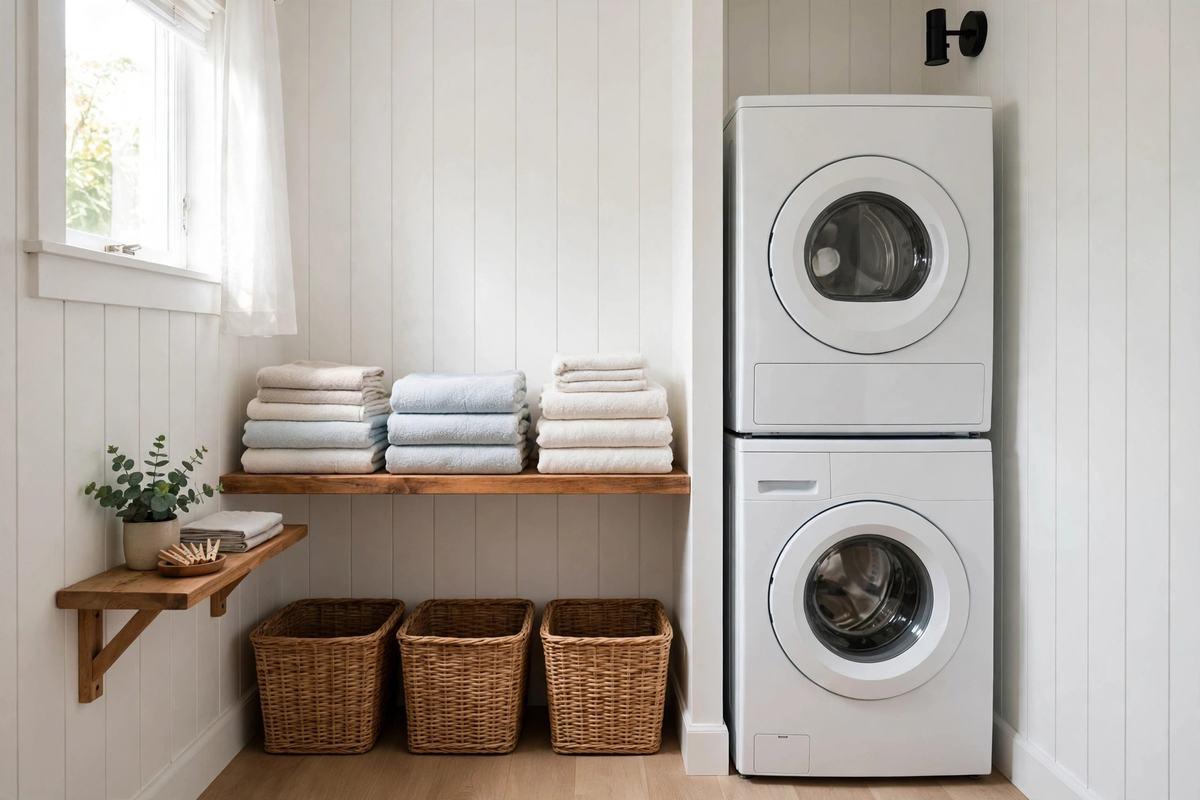
A tiny laundry corner with stacked sorting baskets, supplies within reach, and every step given its own address
Give your laundry three fixed addresses — a sorting station where clothes land, a folding surface you can clear in seconds, and one caddy holding every supply — and a cupboard, a bathroom corner or a shared basement works as well as a dedicated laundry room. That is small laundry room organization in one sentence: you do not need more square metres, you need every step of the process to have somewhere to happen.
Sort where the clothes land, not at the machine
The most expensive sorting mistake is the single big hamper. You end up standing at the machine, sorting while the water fills, rushing, mis-sorting, and adding ten wasted minutes to every load. The fix costs nothing: put the sort where dirty clothes actually accumulate — the bedroom or the bathroom.
Three stackable slim hampers or hanging sorter bags, labelled lights, darks, delicates. That is the whole system for most households. When a bag is full, the load is already decided — you carry it to the machine and start it. Add a fourth bag for hand-wash-only pieces only if you own more than a handful of them; otherwise delicates ride along in a mesh bag inside the darks load. No label-maker ceremony needed — a piece of tape and a marker works, and the system starts working tonight.
A folding surface that appears (and disappears)
Folding straight out of the dryer beats the laundry chair every single time. Here is the honest reason: the chair exists because clean clothes have no address. Clothes folded while they are still warm go into person-zoned baskets and then into drawers, and the chair never gets its first deposit.
The surface itself is easy even without a counter. Two front-loading machines take a board laid across the top — an instant folding station roughly 60×120 cm that vanishes when the machines are idle. For a single machine or top-loaders, a wall-mounted drop-down shelf folds flat against the wall when you are done. Laundry organization for small spaces is mostly about surfaces that appear and disappear. And the option nobody wants to admit works brilliantly: the bed as folding headquarters. One basket per person on the duvet, fold straight into them, carry each basket to its room. Same-day put-away is the rule that makes all three options work.
One portable caddy beats a fixed shelf
A shelf bolted above the machine is lovely if the machine is five steps away. It is useless if the machine is three floors down in a shared basement. That is why a portable caddy wins for most small-space laundry: detergent, stain stick, a couple of mesh bags, a lint roller and a small brush, all in one handle-top carrier that lives near the hamper station and travels with you.
This is also the answer to shared machines. The go-bag routine: pre-sorted bags plus the caddy go down together, the load runs, and folding happens back upstairs at the bed or kitchen table — never on the damp edge of a basement laundry room. Mistake number two, and it is everywhere: detergent in the kitchen, stain spray under the sink, lint roller wherever it landed. Supplies scattered across the house mean the routine stalls between steps, and stalled laundry becomes the pile.
Drying when there is nowhere to hang
Delicates cannot go in the dryer, and air-drying is where tiny laundries usually give up. A wall-mounted accordion drying rack folds flat against the wall and holds a full load of delicates in about a 60 cm strip — ideal above a cupboard laundry or on a bathroom wall, and one of the simplest tiny laundry room ideas that actually holds a full load. Over-door racks use the inside of a cupboard door for hang-drying blouses and knitwear. In a bathroom-corner setup, a tension rod across the bathtub handles drip-drying for a day, then comes down.
The rule for all three: delicates go up the moment the washer stops. Wet silk and lace left sitting in the drum is how things stretch, smell musty and need re-washing — a second full cycle for one forgotten load.
Small laundry room organization: the four hard setups, solved
Cupboard laundry. Stack the machines, hang sorter bags on the inside of the cupboard door or slide a slim rolling cart beside the machines for the caddy. The accordion rack goes on the wall opposite.
Shared basement machines. Nothing lives downstairs except nothing. The hamper station, caddy and folding setup all live in your flat; the go-bag routine covers the trip down. A laundry basket with a lid doubles as your transport box.
Bathroom corner. Washer tucked under a counter or beside the vanity, hamper stack behind the door, accordion rack on the wall above, caddy on the tank or in a narrow pull-out beside the machine.
No machine at all — the laundromat. The sorting system is identical, which is the point: sorted bags plus the caddy (add your card or coins) go in one trip, and folding happens at the laundromat's tables before you leave. Never bring unfolded laundry home; the chair is waiting.
Three mistakes that kill any system
These three mistakes undo even good small laundry room organization — and every one of them is a missing address, not a character flaw.
1. Sorting at the machine instead of where clothes land. Covered above — it wastes time and it mis-sorts. The sort belongs in the bedroom or bathroom, full stop.
2. Storing detergent across the house. Every step that requires a trip to another room is a step that gets skipped. One caddy, everything inside, parked next to the hamper station.
3. Letting the folding pile become furniture. Unfolded clean laundry has a half-life of about one evening before it merges with the chair. Fold straight from the dryer, into person-zoned baskets, put away the same day — the whole routine from washer to drawer fits inside a single evening if nothing waits overnight.
Frequently asked questions
- How do I organize laundry without a laundry room?
- Recreate the three zones anywhere: sorted hamper bags where clothes land, a portable caddy that travels with you, and a folding surface with a clear address. Shared machines get a go-bag routine; laundromats get fold-at-the-table.
- What is the best folding routine?
- Fold straight out of the dryer or off the line, into baskets zoned by person, and put everything away the same day. Folding while clothes are warm means no laundry chair.
- How do I stop the laundry chair?
- The chair is a missing zone, not a discipline problem. Give clean clothes a basket address and a same-day deadline — unfolded clothes should never sleep outside their basket.