Makeup & Skincare Expiry Calculator: Is That Product Still Good?
Pick the product, tell us the month you opened it, and get an honest toss-by window — built from FDA and dermatologist guidance, with your own label's jar symbol always winning over any general rule.
- The little open-jar symbol (6M, 12M, 24M) is your product's own clock — it starts the day you open it, and it beats every general guide, including this one.
- Mascara and sunscreen play by stricter rules: mascara goes at two to four months, and expired sunscreen cannot be trusted to protect you.
- Smell, texture, color or performance changes mean toss it today, whatever the calendar says.
- This calculator runs entirely in your browser — nothing you type is sent anywhere or stored.
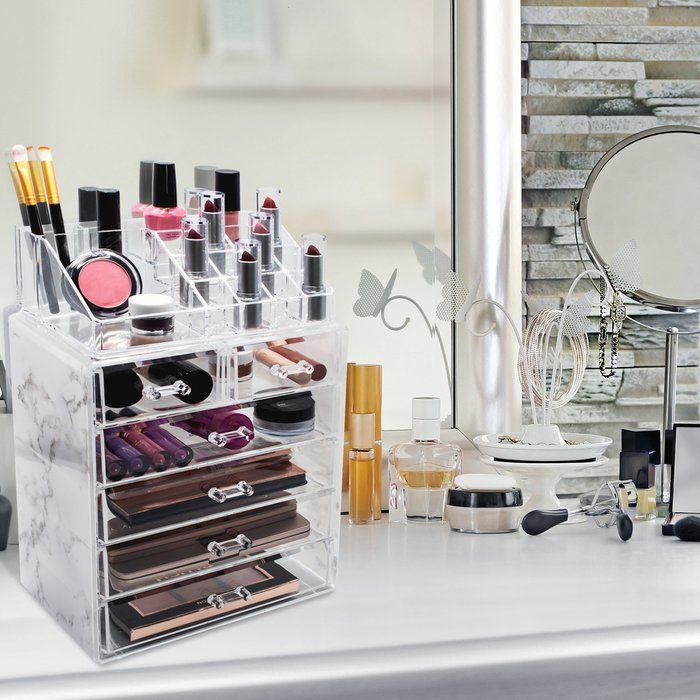
Every product on this vanity is quietly running a clock that started the day it was opened
The calculator: pick your product, get your toss-by window
Choose the product type and the month you opened it — that is all this tool needs. If your packaging shows the little open-jar symbol, type its number in too, because your own label always wins over general guidance. Nothing you enter leaves this page: the maths happens in your browser, and we store nothing.
One promise about how this tool thinks: it will never give you a made-up exact day. Real shelf life is a window, not a moment — it depends on the formula, your fingers, and your bathroom. Any calculator that multiplies your answer by a secret "humidity factor" and hands you a precise date is inventing that precision. We would rather show you the honest window, tell you which end of it is careful, and let your label and your nose make the final call.
How this calculator decides: your label first, guidance second
Every product carries up to three different clocks, and the honest answer is always the earliest one. First, a printed expiry date — where it exists, it covers the unopened product stored properly. Second, the PAO jar symbol, which counts from the day you opened it. Third, when there is neither, the typical window for that product type from dermatologist guidance. This tool checks all three, in that order, and shows you its working.
Here is the part most expiry charts leave out: the US FDA does not require ordinary cosmetics to carry an expiration date at all. Shelf life is the manufacturer's responsibility, which is why two foundations from two brands can honestly carry different clocks. That is also why the table below gives ranges with the source named beside each one — where dermatologists and labels disagree, we show you the disagreement instead of quietly picking a number that sounds precise.
| Product | Typical window after opening | Why — and who says so |
|---|---|---|
| Mascara | 2–4 months | The strictest clock in the bag. The FDA notes manufacturers usually recommend discarding mascara two to four months after purchase — every use carries bacteria and fungi back into the tube. |
| Liquid or gel eyeliner | 3–6 months | A wet product used at the eye line. Cleveland Clinic's dermatologist guidance puts liquid liner at six months; most labels sit between three and six. |
| Pencil eyeliner or lip liner | 1–2 years | Sharpening shaves off a fresh surface each time, which is why pencils outlast liquids (Cleveland Clinic). |
| Liquid foundation | 6–12 months | Cleveland Clinic says six months for liquid foundation; jar symbols commonly say 6M–12M. Your label wins. |
| Liquid concealer | 6–12 months | Same family as foundation: six months on the careful end (Cleveland Clinic), up to a year by label. |
| Cream blush or cream eyeshadow | 6–12 months | Creams hold moisture, and moisture feeds growth. Cream blush is six months in Cleveland Clinic's guidance; cream shadows run six to twelve. |
| Powder products | 1–2 years | Dry powders are the marathon runners — little water for anything to grow in (Cleveland Clinic: powdered blush, foundation and shadow at one to two years). |
| Lipstick | 6–18 months — guides disagree | Cleveland Clinic says six months for lip products, because lips carry a lot of bacteria; many labels print 12M–18M. We show both and trust your label first. |
| Lip gloss or lip balm | 6–12 months | The wand goes from lips back into the tube, like mascara in slow motion — six months careful, twelve by label. |
| Moisturizer or cream in a jar | 6–12 months | Every fingertip dip is a small donation of bacteria. Six months if fingers go in daily; up to your label's 12M with clean hands or a spatula. |
| Serum or moisturizer in a pump | 6–12 months | A pump keeps fingers and air mostly out, so these hold up better than jars — but opened skincare still ages; most labels say 12M. |
| Sunscreen | Printed date — or 3 years from purchase | The special case. FDA: a sunscreen with no expiration date should be considered expired three years after purchase. AAD: toss it once it expires, because the protective ingredients break down. |
| Nail polish | 1–2 years | Polish thickens and separates with age rather than turning risky — once it will not mix back to smooth with a roll between your palms, it is done. |
| Natural or organic products | 3–6 months | Fewer or gentler preservatives means a shorter honest life — the FDA notes natural products can have shorter shelf lives. Shorter still in a warm bathroom. |
Read the table the way a mother would read a weather forecast: it tells you when to start paying attention, not the exact minute the rain starts. The careful end of each window is for products that live hard lives — daily use, warm rooms, shared bathrooms. The generous end is for the lipstick that comes out twice a year from a cool drawer.
The little jar symbol, decoded in plain words
Turn almost any product over and look at the back or the bottom crimp. Somewhere small you will find a drawing of a tiny open jar — a little pot with its lid tipped open — and inside or beside it, a number followed by the letter M: 3M, 6M, 12M, 24M. That is the PAO, the period after opening, and it simply means: this product is made to stay good for that many months after the day you first open it.
Picture it: an open jar, lid leaning back, and "12M" written on the jar — twelve months from opening day. A 6M jar is the same drawing with a shorter promise. On US shelves the symbol is voluntary (many brands print it because they also sell in Europe, where it is required), so a missing symbol does not mean a missing clock — it means the typical window in the table above is your guide.
Two habits make the symbol actually useful. First, the day you open something new, write the month and year on the bottom with a fine marker — the FDA itself suggests marking containers with the date you open them, because nobody honestly remembers whether the concealer is from March or from last spring. Second, when you are standing in a store deciding between two similar products, the one that prints its clock clearly is the one respecting you. Secrecy about dates is a brand choice, and you are allowed to price it into your decision.
The strictest two: mascara and sunscreen
Mascara earns the shortest clock in the bag for a simple reason: it is a wet product, used at the eye, and the wand makes a round trip — lashes, tube, lashes, tube — carrying bacteria and fungi home every time. The FDA's guidance is that manufacturers usually recommend throwing mascara away two to four months after purchase, and it deserves its own extra rules: if the tube has dried out, it is finished today, because adding water dilutes the preservative and adding saliva — please, never — adds mouth bacteria directly. And if you have had an eye infection, every eye product you were using when it started goes in the bin, however new it is. That one stings, and it is still cheaper than a second infection.
Sunscreen is strict for the opposite reason: nothing looks wrong when it fails. An old foundation announces itself with streaks and smell, but expired sunscreen can look, feel and smell perfect while its protective ingredients have quietly broken down. That is why sunscreen is regulated as an over-the-counter drug in the US, why the FDA requires it to hold its strength for at least three years, and why the rule is so plain: follow the printed date; if there is no date, three years from purchase is the limit; if you do not know how old the bottle is, the FDA says discard it. Write the purchase month on undated bottles, the way the American Academy of Dermatology suggests, and keep the beach bag out of the hot car between trips — heat is sunscreen's fastest enemy.
Throw it today, whatever the date says
Dates are the plan, but your senses are the referee. Any one of these five signs ends the discussion immediately, even in the middle of a product's good window — dermatologists at Cleveland Clinic name the same five: smell (sour, chemical, or just "off" compared with when it was new), texture (separated, lumpy, gritty, or a cream that has turned watery), color (foundation gone orange or darker is oxidizing in front of you), performance (mascara flaking, blush refusing to blend, polish that will not smooth out), and your skin (new breakouts, stinging or rashes from a product that used to suit you). Add three automatic tosses of their own: anything used during an eye infection, anything shared through a cold sore, and any mascara that has dried out. No product is expensive enough to argue with that list.
Storage rules that actually matter (and the bathroom myth)
Here is the gentle myth to retire: the prettiest place for makeup — lined up on the bathroom counter — is close to the worst place for it. Twice a day that room fills with steam, and heat plus moisture is exactly the combination that helps bacteria and mold grow and makes preservatives give up early. The FDA puts a number on the heat side: do not store cosmetics above 85°F, which is why the glove box and the sunny windowsill are shelves in name only. If your bathroom is your only option, a closed cabinet away from the shower beats the open counter, and our bathroom counter organization guide shows how to keep the daily few within reach without crowding the sink.
The kinder home is boring, and boring is good: a cool, dry bedroom drawer or shelf, lids clicked shut, out of direct sun. Pump bottles beat open jars because your fingers stay out of the product. Brushes and sponges are part of storage too — they touch your face and then sit in your powders, so wash them weekly with a gentle shampoo and let them dry completely, the way dermatologists advise. None of this needs a shopping trip; it is the same small-home logic as our spa bathroom on a renter budget: the right container in the right place, once, and the system runs itself.
The 20-minute vanity cleanout
Set a timer and work like you are helping a friend — kindly, but without negotiating with every tube. Step one: empty everything onto a towel and group by type: eye products, liquids, powders, lips, skincare. Step two: run each group through the calculator above, starting with mascara and sunscreen, the strictest two. Step three: anything with no memory attached — you cannot say when you opened it — gets the signs test, and face products that fail the memory test entirely are simply done. Step four: marker out: every keeper gets its opening month written on the bottom, so next time this takes five minutes. Step five: put back only the daily drivers at the front — our vanity makeup organizer rules sort them in the order your hands actually move — and give the survivors room to be seen, because a product you can see is a product you finish while it is still good.
Then protect the system you just built. A beginner routine does not need twelve products racing their clocks at once: our skincare routine for beginners builds on four calm steps, and the glass skin routine steps guide layers extras in slowly, one at a time — which also means fewer half-used bottles expiring in the back of the drawer. When you want the cleanout to stick, fold it into a ritual you already enjoy: the monthly version of our self-care Sunday routine pairs one small reset like this with the rest of your wind-down. And if a paper checklist on the inside of the cabinet door would help you keep the dates straight, our free printable library is where we keep the home checklists our readers asked for.
Sources and how we built this tool
Every window in this calculator traces to guidance we opened and read, and we have told you beside each figure who said it: the FDA's shelf-life and expiration guidance and its eye cosmetic safety page; the FDA's sunscreen guidance; the American Academy of Dermatology's sunscreen FAQs and its guide on when to toss makeup and sunscreen; and dermatologist guidance published by Cleveland Clinic. This page is general information, not medical advice — a product that irritates your skin or eyes deserves a conversation with your own clinician, not a calculator. And the honest limit of every tool like this, ours included: your label, the printed date, and your own senses, in that order, outrank any website.
Makeup expiry questions, answered plainly
- How long does mascara last after opening?
- Two to four months is the honest window. The FDA notes that manufacturers usually recommend discarding mascara two to four months after purchase, because the wand carries bacteria and fungi back into the tube every single time you use it. If your tube has dried out, it is done today, whatever the calendar says — never add water, and never, ever saliva, to revive it.
- What does the little jar symbol with 12M on my makeup mean?
- That open-jar symbol is the PAO — the period after opening. The number is how many months the maker says the product stays good once you first open it: 6M means six months, 12M means a year, 24M means two years. The clock starts the day you open it, not the day you bought it, which is why writing the opening month on the bottom in marker saves so much guessing.
- Does unopened makeup expire too?
- Much more slowly. A Cleveland Clinic dermatologist notes that unopened, well-formulated makeup stays stable for years at room temperature — the real countdown starts when you open it and air, fingers and applicators get in. Sunscreen is the exception: even unopened, treat it as expired three years after purchase if it carries no printed date.
- Can I use expired sunscreen if it still looks and smells fine?
- Please do not rely on it. Sunscreen is regulated as a drug in the US, and the FDA and the American Academy of Dermatology are unusually blunt here: the active ingredients break down over time, so an expired bottle may not deliver the SPF printed on it, even when it looks perfect. If the printed date has passed, or an undated bottle is more than three years old, replace it.
- My foundation has no date and no jar symbol. How do I decide?
- Use the typical window for liquid foundation — six to twelve months after opening — then run the signs test: smell it, look at the color, check whether it has separated or turned streaky. US law does not require most cosmetics to print a date, so your senses plus the calendar are the system. If you cannot remember when you opened it and it goes on your face daily, the kind answer is to let it go.
- Which wins: the printed expiry date or the PAO symbol?
- Whichever comes first. The printed date covers an unopened product stored properly; the PAO counts from the day you opened it. A foundation you opened fourteen months ago does not become safe because the printed date is next year — once it is open, the jar symbol is running your clock. This calculator always takes the earlier date.
- Does keeping makeup in the bathroom really shorten its life?
- It can. Heat and humidity help bacteria and mold grow faster, and a steamy bathroom is warm and wet twice a day. The FDA also warns against storing cosmetics above 85°F — a hot car is the worst shelf in your life. A bedroom drawer or a cool, dry shelf is genuinely kinder than the prettiest bathroom organizer.
- I had an eye infection. What do I need to throw away?
- Every eye-area product you were using when the infection started — mascara, liquid liner, cream shadows, and the brushes that touched them. The FDA is direct about this: stop using all eye cosmetics, talk with your health care provider, and discard the ones in use when it began, because they may now carry the infection back to you.
- Is it okay to share lipstick or mascara with my daughter or sister?
- It is loving, and it is still a no. Sharing makeup raises the risk of contamination — the FDA lists sharing as a habit that spreads bacteria between people, and lips and eyes carry plenty of their own. If she loves your shade, the safe gift is a fresh one of her own; if you both dipped into one tube after a cold sore, that tube is finished.
- Why do so many US products have no expiry date printed at all?
- Because no US law requires one for ordinary cosmetics — the FDA leaves shelf life to manufacturers, who are responsible for keeping their products safe. Many brands print the European-style jar symbol anyway because they sell in both markets. Sunscreen is the exception: as an over-the-counter drug it follows drug rules, which is why it so often carries a real printed date.