Beauty by Earth Self Tanner: Lotion, Mousse and Drops, Explained as a Gift
Three formats, one brand, one honest question underneath them all: which one tans without streaks, without orange, and without a sunburn warning nobody read?
- Lotion is the hydrating, gradual option; mousse is faster and tans a bit darker with fewer hydrating ingredients; drops mix into your own moisturizer for a buildable face glow.
- DHA tans only the top layer of skin and needs no sun at all — but it gives NO sun protection. This product contains no sunscreen and does not protect against sunburn.
- Streak-free comes from preparation, not luck: exfoliate, use a mitt (not a sock), go lightly over dry areas, and do hands last.
- The bundles decide the gift: the Lotion Ultimate Bundle, the Mousse Basics Bundle, and the Lotion + Drops Duo ("Glow Your Way").
- Shade comes first: Fair-Medium versus Medium-Dark. Picking the wrong depth is how most "orange" results happen.
As an Amazon Associate I earn from qualifying purchases. This gift guide links to products on Amazon; prices change, so check the listing before you buy. Read our affiliate disclosure.
Beauty by Earth is a small, ingredient-led self-tan brand, and its gift appeal is easy to see: instead of one bottle, it sells a small family of formats — a lotion, a mousse, and drops — plus bundles that turn those formats into a ready-made gift. That is also where buyers get confused, because the three formats are not three versions of the same thing. They differ in hydration, in speed, in darkness, and in how much control they give you, and picking the wrong one is the most common reason a self-tanner disappoints. This guide explains each format from the brand's own published information, how DHA tanning actually works, how to apply without streaks, what "safe" can and cannot mean here, and how the bundles compare with the rival tanners a buyer will also be considering.
A note on what this guide is and is not, because gift guides should say so plainly. This is a research-based guide, built from Beauty by Earth's own published product information, retailer label information, and the wider self-tanner field it competes in. It is not a hands-on lab test, and it does not invent review scores, ratings, or sales claims — you will find no star rating quoted here, because the figures we could verify do not support one, and a guide that prints a number it cannot stand behind is not a guide worth trusting. Brand claims are attributed to the brand; general self-tan logic is flagged as general logic, not as a property of this brand.
What Beauty by Earth self-tanner actually is
Beauty by Earth's self-tanner is a DHA-based sunless tanner sold in three formats. The lotion is the core product: a moisturizing tanning lotion built on DHA derived from sugar cane, with organic aloe vera leaf juice, shea butter, coconut oil, green tea, pomegranate, cranberry, jojoba, and argan among its ingredients. The brand describes the lotion as 81% water plus certified organic ingredients, with the rest naturally derived, and free of dyes, sulfates, and parabens. One distinction the brand states itself matters here: the product as a whole is NOT certified organic, even though many of its ingredients are certified organic. A guide that called it "certified organic" would be misquoting the brand, so this one does not.
The mousse is the same idea in a faster, lighter-feeling form. The brand says the mousse absorbs faster than the lotion, has FEWER hydrating ingredients — specifically no coconut oil, no aloe, and no shea — and tans a bit darker than the lotion. It is applied by pumping onto a mitt or brush and buffing into the skin, and it is described as quick-drying. Sizes seen on retailer listings include 7.5 fl oz and a smaller 3.3 oz size. The drops are the third format and the most controlled: a few drops mixed into your own moisturizer, so the glow is buildable — more drops, deeper glow — and the face is the natural place for them, since you already have a moisturizer you trust there.
Shopping anchor for the range itself: Beauty by Earth self tanner on Amazon — check the listing shows the format you want (lotion, mousse, or drops) before ordering, since the three formats look similar in thumbnails and do different jobs.
The bundles are where this becomes a gift rather than a single bottle. The brand sells a Self Tanner Lotion Ultimate Bundle, a Mousse Basics Bundle, and a Lotion + Drops Duo sold as the "Glow Your Way" bundle. The logic of each bundle is different, and the gifting section below matches each one to a recipient. For now, the point to hold is that a bundle is not automatically better value than a single: it is better only when the recipient will actually use everything in it. A lotion bundle for someone who hates lotion is a worse gift than a single mousse they will use.
Lotion vs mousse vs drops
The honest way to compare the three formats is by what each one trades away. The lotion trades speed for hydration: it is the most moisturizing of the three, with shea, coconut oil, and aloe in the formula, and it suits dry skin and beginners because it spreads slowly and forgives uneven application better than a fast-drying mousse. Its cost is time — it takes longer to absorb, and you must wait longer before dressing. If the recipient has dry skin, dislikes the feeling of a quick-dry foam, or is new to self-tanning, the lotion is the default recommendation in this guide.
The mousse trades hydration for speed and depth. With no coconut oil, aloe, or shea, it is lighter on moisture but absorbs faster and, by the brand's own account, tans a bit darker than the lotion. That makes it the pick for someone who already self-tans, wants a deeper result, and does not want to wait around in a robe. It is also the least forgiving format: fast-drying means fast-setting, so uneven buffing shows sooner. A first-timer who buys mousse for speed and then rushes the application is the classic streak story, and it is avoidable by choosing lotion instead.
The drops trade coverage for control. You mix a few into your own moisturizer, so you decide the depth by the number of drops, and you apply with a product your skin already tolerates. That is why drops suit the face: facial skin is pickier than body skin, and a dedicated face tan can react badly where a familiar moisturizer plus drops does not. Drops are not a whole-body solution — mixing enough for legs and arms every time is fiddly — but as the face part of a gift, or as a top-up for someone who already tans their body, they are the most precise tool in the range.
Shopping anchors for the two main formats: the Beauty by Earth self tanner lotion on Amazon and the Beauty by Earth self tanner mousse on Amazon — check the format and size on the listing, since lotion and mousse listings sit side by side and are easy to confuse.
How DHA works — and what it does not do
DHA, or dihydroxyacetone, is the active tanning ingredient in almost every sunless tanner, and its mechanism is refreshingly simple: it reacts with the amino acids in the very top layer of dead skin cells, and that reaction produces a brown color. No sun is involved, no melanin is involved, and the color is not a real tan — it is a surface color on dead skin, which is exactly why it fades as that skin sheds. Understanding that one fact explains nearly everything else in this guide: why preparation matters (dead skin must be even), why the color develops over hours rather than minutes (the reaction takes time), and why it lasts days rather than weeks (dead skin leaves).
What DHA does NOT do matters more than what it does, and this is the warning this guide will not bury: this product contains no sunscreen and does not protect against sunburn. That is label information, not opinion. A self-tan gives no UV protection at all, and the color it produces can make the danger worse, because tanned-looking skin invites longer sun exposure while offering no defense. Anyone who wears self-tanner outdoors must still use a real sunscreen, applied separately, at the usual amount and frequency. If the recipient is someone who will treat a tan as sun protection, this is a gift that needs that conversation attached to it — or a different gift entirely.
Two more things DHA does not do. It does not tan evenly over uneven skin: dry patches, rough elbows, knees, and ankles grab more color because they hold more dead skin, which is why the application section below treats those areas specially. And it does not stain the same way twice: the result depends on your skin's current state, the amount applied, and how long it develops, so the same bottle on the same person in winter and summer can read differently. That variability is normal, not a defect, and it is why this guide hedges every timing claim instead of printing fixed hours.
How to apply streak-free
Streaks are almost never a product failure. They are a preparation and application failure, and the fix is a short routine done in order. First, exfoliate the day before or the morning of — not immediately before, when skin is still reactive — so the dead-skin layer is as even as you can make it. Shave a day before as well, for the same reason: freshly shaved skin grabs color unevenly. Moisturize dry areas (elbows, knees, ankles, knuckles) lightly before applying, because those areas absorb more DHA and go darker; the light moisturizer layer acts as a brake there.
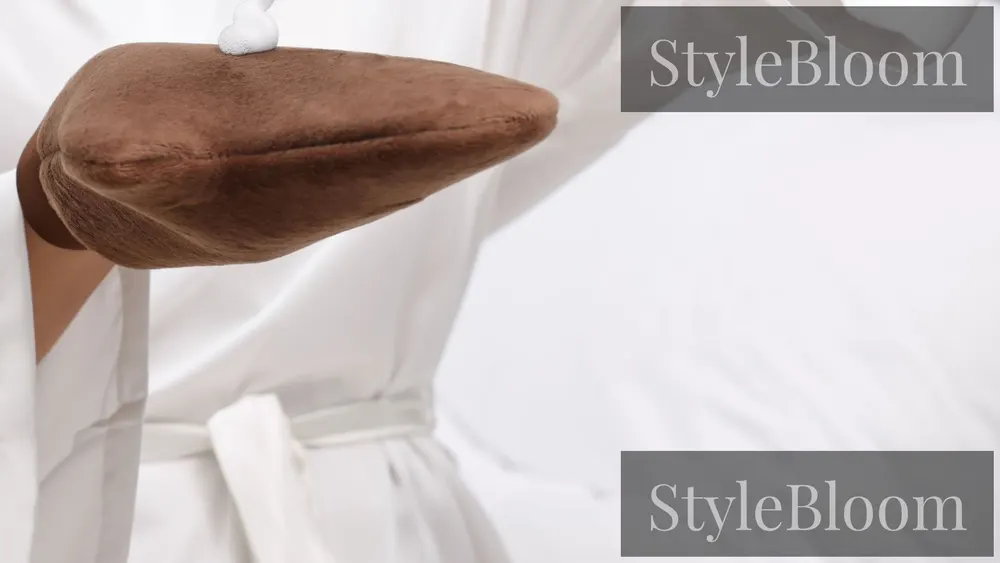
Second, use a mitt. A tanning mitt spreads the product evenly, keeps your palms from turning orange, and is the single tool that separates an even result from a patchy one. This is also the answer to the question the search data keeps asking — whether a sock works as an applicator. Honestly: a sock is a hack, and a messy one. It absorbs unevenly, it leaves lint and texture in the product, and it gives you less control than a mitt that costs less than the tanner itself. If the gift includes a mitt, the recipient's first application is already better; if it does not, add one. Shopping anchor for the tool itself: a self tanner mitt on Amazon — the application lane only, not a tanning product.
Third, apply in sections, in thin layers, and do hands and feet last with whatever product is left on the mitt rather than a fresh pump. Hands and feet have thinner skin and more creases, so a fresh pump there goes dark and settles into lines. Work in long strokes, not circles, and check the backs of legs and the lower back in a mirror before you finish — those are the two places streaks hide until daylight finds them. Then wait before dressing: the product needs to dry, and tight clothing on damp tanner is how transfer and patchiness happen.
Fourth, respect the develop time instead of fighting it. Do not shower, swim, or sweat heavily while the color develops, and do not apply a second coat the same evening to "fix" a light result — a second coat on developing color goes uneven far more often than it goes deeper. If the result is lighter than wanted, the fix is a second application on a later day, after the first has fully developed and you can see what you actually have. Patience is not glamorous advice, but it is the advice that prevents the orange, streaky results people blame on the brand.
How long it takes to develop — and how long it lasts
Development is measured in hours, not minutes, and this guide deliberately prints no fixed hour count. The brand's and retailers' language is "develops over several hours," and the honest version of that is: apply in the evening and judge the result the next morning, not an hour later under bathroom light. Judging early is how people over-apply: the color is still forming, it looks light, they add more, and by morning they have two uneven layers instead of one even one. If the recipient needs color for a specific event, the safe plan is to apply two evenings before, not the night before, so there is a full day to see the real result and correct it if needed.
How long it lasts is measured in days, not weeks, and it fades rather than disappearing. Because DHA color lives on dead skin, it leaves as that skin sheds — faster on hands (washed often), faster where clothing rubs, slower on legs. Moisturizing daily after development slows the fade, because hydrated skin sheds more evenly; hot showers, exfoliating, and swimming speed it up. Anyone promising an exact number of days for a self-tan is inventing precision the biology does not support, so this guide gives the range honestly: several days of good color with daily moisturizing, then a gradual fade, not a sudden stop.
The practical consequence for gifting is timing. A self-tanner given at Christmas is not a Christmas-morning result; it is a between-Christmas-and-New-Year result, and that is fine — the gift is the routine, not a single-day reveal. If the recipient has an event with a hard date, buy early enough for a trial application first. A trial run before the event is the single best insurance against a disappointing result, and it costs nothing but a few days.
Is it safe / is it bad for skin
The honest answer to "is self-tanner safe" has two parts, and they should not be merged. The first part is about DHA itself: DHA has been used in sunless tanners for decades, it reacts only with the outermost dead skin layer, and it is not absorbed into living skin in the way a drug is. That history is reassuring, but it is not a personal guarantee — "widely used" and "safe for you" are different claims, and this guide will not pretend otherwise. The second part is about everything else in the bottle: moisturizers, botanicals, and preservatives that any individual skin can react to, regardless of how "natural" the ingredient list sounds. Natural is not a synonym for non-reactive; poison ivy is natural too.
The practical safety routine is therefore boring and specific: patch test first. Apply a small amount to the inner forearm, once, and wait a full day before a full application. If there is redness, itching, or irritation, do not proceed — and do not try to push through a reaction because the product was expensive. For sensitive skin, or skin with eczema, psoriasis, or any ongoing condition, the right move is to ask a clinician before using any self-tanner, not to take a guide's word for it. This guide is not medical advice, and skin conditions belong with a clinician, full stop.
The "is it bad for skin" question usually hides a different worry: does self-tanning damage skin the way sun tanning does? On that, the comparison is clear and honest. Sun tanning damages living skin with UV radiation; DHA colors dead skin without UV. That does not make self-tanner "good for skin" — it makes it a surface cosmetic, not a treatment — but it does mean the specific harms of UV tanning do not apply here. The real risks of self-tanner are mundane and avoidable: allergic reaction (patch test), uneven results (preparation), and the sunburn trap (no sunscreen inside — see the DHA section). Handle those three, and the product is what it claims to be: color, not care.
Will it look orange or fake
Orange has three usual causes, and all three are fixable before they happen. The first is wrong depth: a Medium-Dark shade on naturally fair skin does not look "more tanned," it looks orange, because the DHA color overshoots what that skin tone would ever produce naturally. The fix is shade honesty — Fair-Medium for fair to light-medium skin, Medium-Dark only for skin that already tans easily and deeply. When in doubt, go lighter: a light result can be deepened with a second application on another day, but an orange result has to be waited out.
The second cause is dry skin grabbing color. Elbows, knees, ankles, and knuckles are rougher and drier than the surrounding skin, so they take up more DHA and go darker and oranger. The fix is the light moisturizer brake from the application section: a thin layer on those areas before applying, and less product there, not more. The third cause is impatience — judging early, adding a second coat the same evening, and ending up with two uneven layers. The fix is the develop-last discipline: one application, judged the next morning, corrected on a later day if needed.
"Fake" is a different complaint from orange, and it usually means a mismatch, not a color. A tanned body with a pale neck and white hands looks fake because the boundaries are visible: color stops abruptly at the jawline, at the wrists, at the ankles. The fix is blending — carry a light layer slightly past each boundary (jawline into the neck, wrists onto the hands with mitt residue only, ankles onto the feet lightly) so there is no hard line where the tan ends. A tan that fades gradually at its edges reads as plausible; a tan with a sharp edge reads as applied, because it was.
Gifting: who to give it to
The Lotion Ultimate Bundle is the gift for the beginner and the dry-skinned recipient: someone new to self-tanning, or someone whose skin runs dry, gets the most forgiving format plus the bundle's extras in one box, and the lotion's slower spread forgives the uneven first application. The Mousse Basics Bundle is the gift for the experienced self-tanner: someone who already tans, wants a deeper result, and will not be slowed down by a fast-drying formula. Giving mousse to a first-timer is a common gifting mistake — it looks like the "better" gift because it is faster and darker, but for a beginner it is the harder tool, not the better one.
The Lotion + Drops Duo ("Glow Your Way") is the gift for the face-conscious recipient: someone who already has a moisturizer routine and wants a buildable glow for the face without committing their whole body to a new product. It is also the best "small gift" of the three bundles — a duo rather than a full routine — which makes it the right pick for a friend, a coworker, or a stocking-adjacent gift where a full bundle would be too much. For Christmas specifically, bundles win over singles because they arrive as a complete gift: no extra mitt to buy, no format to guess, one box to wrap.
Who should not get a self-tanner as a gift? Three people. Someone who will not do the preparation — no exfoliation, no mitt, no develop time — will get a streaky result and blame the gift. Someone who wants instant color for tonight will be disappointed by a product that develops over hours. And someone who treats a tan as sun protection must not be given a self-tanner without the sunscreen conversation, because this product contains no sunscreen at all. For those three recipients, a different gift is kinder than a self-tanner with a warning attached.
Shopping anchor for the gifting lane: a self tanner gift set on Amazon — check the listing shows the bundle you intend (lotion, mousse, or duo) and the shade, since bundles and singles sit together in search results.
What to check before you buy
First, the shade. Fair-Medium versus Medium-Dark is the single decision that matters most, and the rule is simple: match the recipient's natural, untanned skin tone, not the tone they wish they had. Fair to light-medium skin takes Fair-Medium; skin that tans easily and rarely burns takes Medium-Dark. If you genuinely do not know the recipient's skin tone — a common problem with gifts — buy Fair-Medium. A lighter result disappoints mildly and can be deepened; an orange result disappoints for days and cannot be undone.
Second, the format, decided by the recipient, not by you. Dry skin or beginner: lotion. Experienced, wants depth and speed: mousse. Face glow or precise control: drops. If you cannot decide between lotion and mousse, the lotion is the safer gift — its slower application forgives more, and a forgiving gift beats a fast one that streaks. Third, recheck the sunscreen point before you buy: this product does not protect against sunburn, and if the recipient spends time outdoors, a real sunscreen must go with it, bought separately and used separately.
Fourth, bundle versus single, decided by use. A bundle wins when the recipient will use everything in it; a single wins when they will use one thing well. A lotion bundle for a mousse lover is clutter, and a single mousse for someone who also wants a face glow is incomplete — the duo exists for exactly that person. Finally, check the listing itself before ordering: format (lotion, mousse, or drops), size, and shade, because listings for the three formats sit side by side and the wrong format in the cart is the easiest mistake in this whole guide to make.
Lotion vs mousse vs drops vs the rivals
The table below compares the three Beauty by Earth formats against the two rival types a buyer will actually meet in search: a well-known mousse and the generic gift box. It is qualitative on purpose — no prices, because prices change and this guide does not print numbers it cannot keep current. The rival rows are comparisons only, not recommendations of those products over the hero; the point is to show where each format wins and where it loses, so the buyer can match a format to a person rather than a brand to a habit.
| Option | Best for | Hydration | Speed | Control | Gifting note |
|---|---|---|---|---|---|
| Beauty by Earth lotion | Dry skin, beginners | Highest (shea, coconut oil, aloe) | Slowest to absorb | Good (slow spread forgives) | Ultimate Bundle = best beginner gift |
| Beauty by Earth mousse | Experienced, deeper result | Lower (no coconut oil, aloe, shea) | Fastest, quick-drying | Lower (sets fast) | Basics Bundle = best experienced gift |
| Beauty by Earth drops | Face glow, precise depth | Depends on your moisturizer | Buildable over days | Highest (drop by drop) | Duo = best small / face gift |
| St. Tropez Classic Bronzing Mousse | Buyers who want the well-known mousse | Mid (mousse format) | Fast | Mid | Comparison only — not the hero |
| Generic gift box | Buyers who want a box, any box | Varies, often unstated | Varies | Low (formats unclear) | Comparison only — check what is inside |
Two rival notes from the wider field, stated fairly. Review guides put the St. Tropez Classic Bronzing Mousse as a best-for-most mousse and the Loving Tan 2 HR Express as a fast option — both are legitimate comparisons for a buyer who wants a mousse, and neither changes the hero's case, which is ingredient transparency plus three formats plus bundles, not a single famous bottle. The generic gift boxes (the cloud of unbranded sets in search results) compete on box appeal, not on stated ingredients or format logic, and a buyer who cannot tell what is inside the box from the listing should treat that as information, not as a bargain. Coco & Eve's mousse kit and the St. Tropez Purity set sit in the same comparison lane: fine products, different stories, and none of them offers the lotion-mousse-drops choice inside one brand that this guide is built around.
Frequently asked questions
- What is Beauty by Earth self-tanner?
- A DHA-based sunless tanner sold as a lotion, a mousse, and drops, plus bundles of those formats. The lotion is the hydrating core product, the mousse is faster and a bit darker with fewer hydrating ingredients, and the drops mix into your own moisturizer for a buildable glow.
- Lotion or mousse — which should I pick?
- Dry skin or beginner: lotion, because it spreads slowly and forgives uneven application. Experienced and wanting depth and speed: mousse, because it absorbs faster and tans a bit darker. When in doubt, lotion is the safer gift.
- What are self-tanner drops?
- A concentrated tanning liquid you mix, a few drops at a time, into your own moisturizer. More drops mean a deeper glow, so you control the depth. They suit the face best, where you already have a moisturizer your skin tolerates.
- How does DHA tanning work?
- DHA reacts with amino acids in the top layer of dead skin cells, producing a brown color. No sun and no melanin are involved. The color fades as that dead skin sheds, which is why a self-tan lasts days, not weeks.
- Does self-tanner protect me from the sun?
- No. This product contains no sunscreen and does not protect against sunburn in any way. Tanned-looking skin with no sunscreen is unprotected skin. Use a real sunscreen separately whenever you are outdoors.
- How long does it take to develop?
- Hours, not minutes. Apply in the evening and judge the result the next morning. Judging early leads to over-application and uneven layers. For an event, apply two evenings before, not the night before.
- How long does a self-tan last?
- Several days of good color with daily moisturizing, then a gradual fade — not a sudden stop. Hands fade fastest because they are washed most. Hot showers, exfoliating, and swimming speed the fade.
- Will it look orange?
- Usually only when the shade is too deep for the skin tone, dry areas grab extra color, or a second coat is added too soon. Pick the lighter shade when unsure, moisturize dry areas lightly first, and apply once, judged the next morning.
- Is self-tanner safe for skin?
- DHA has been used in sunless tanners for decades and reacts only with dead surface skin, but "widely used" is not a personal guarantee. Patch test first, and treat any reaction as a stop signal. This guide is not medical advice.
- Can I use it on sensitive skin?
- Patch test first on the inner forearm and wait a full day. If you have eczema, psoriasis, or any ongoing skin condition, ask a clinician before using any self-tanner rather than taking a guide's word for it.
- How do I apply it without streaks?
- Exfoliate the day before, moisturize dry areas lightly, use a mitt, apply in thin layers section by section, do hands and feet last with mitt residue only, and let it dry before dressing. Do not add a second coat the same evening.
- Can I use a sock to apply self-tanner?
- You can, but you should not. A sock absorbs unevenly, leaves texture in the product, and gives less control than a mitt. A mitt costs less than the tanner and is the single tool that most improves the result.
- Can I use it on my face?
- Yes, with the drops: mix a few into your own facial moisturizer for a buildable glow, and patch test first. Do not apply body lotion or mousse to the face in a full coat — facial skin is pickier, and a familiar moisturizer plus drops is the safer route.
- Is it a good Christmas gift?
- Yes, as a bundle: the Lotion Ultimate Bundle for beginners, the Mousse Basics Bundle for experienced tanners, and the Lotion + Drops Duo as a smaller gift. Buy early enough for a trial application before any event.
- Where can I buy it?
- On Amazon via the search links in this guide (lotion, mousse, gift set, and mitt lanes), and from the brand's own site. Check the listing shows the format, size, and shade you want before ordering, and remember prices change, so check the listing.