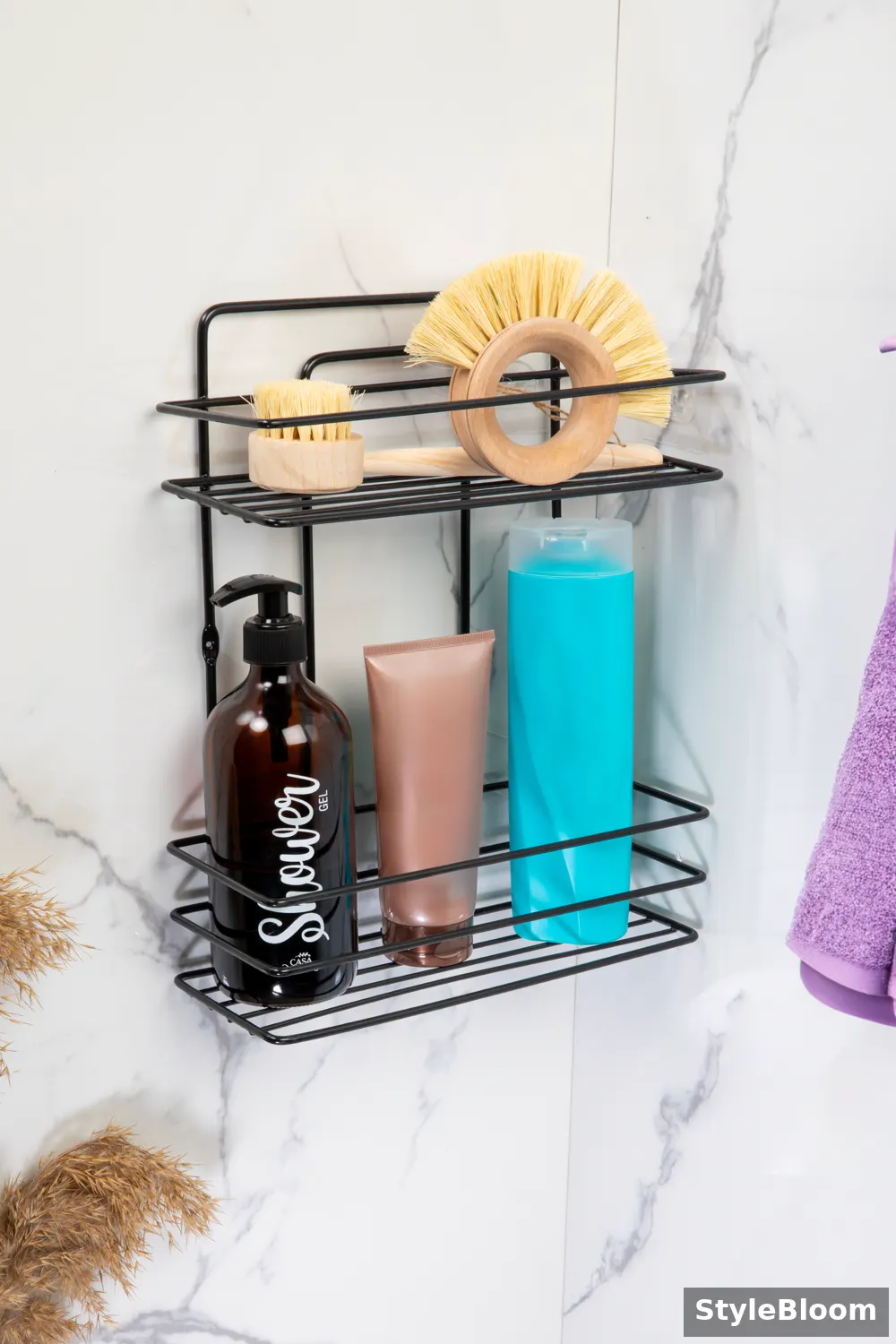
Published: October 28, 2026 · Last updated: October 29, 2026
As an Amazon Associate, StyleBloom earns from qualifying purchases made through links on this page, at no extra cost to you. That support keeps guides like this free. Every Amazon link below is a search link, not a recommendation of one specific listing: use them to compare types side by side, then check the listing's stated size, fit, and material before you buy.
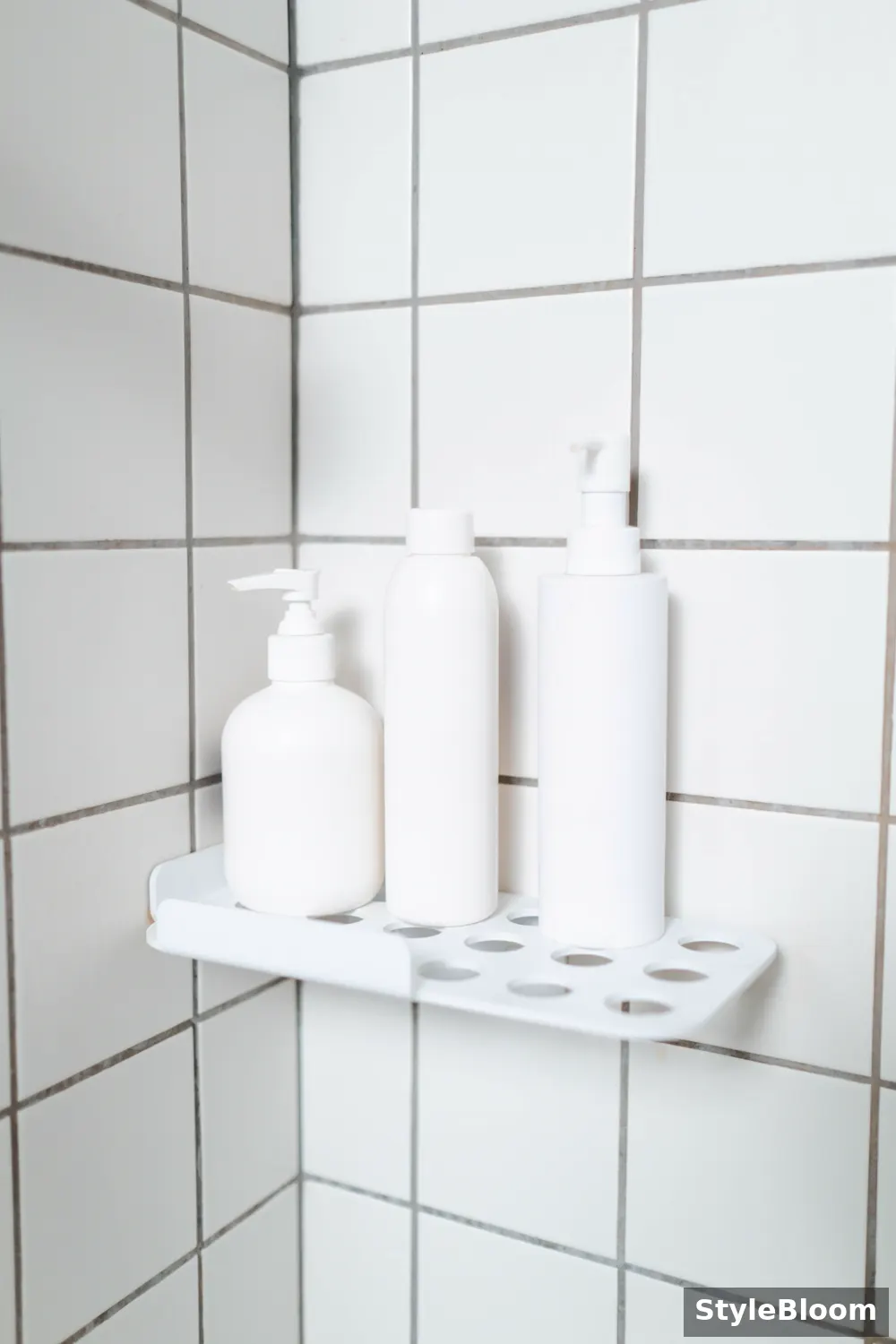
The best shower caddy organizer for most people is an adhesive stainless-steel corner caddy, mounted on a flat, smooth tile wall, loaded with only the bottles one person actually uses every day. That is the direct answer, and it holds for the most common American shower: a tiled corner, a renter or an owner who does not want to drill, and a kit of shampoo, conditioner, body wash, and one or two extras. Adhesive beats suction here because it does not depend on a vacuum seal that a steamy shower keeps breaking, and a corner caddy beats a hanging caddy because it does not swing, crowd the showerhead, or put all of its weight on one small arm.
That verdict changes in three situations, and those three situations are the whole point of this guide. If your shower has no usable corner, or your corners are curved rather than square, a tension pole caddy is the better buy, because it uses the floor and the ceiling instead of the wall. If you rent and your lease forbids anything stuck to the tile, a hanging caddy over the showerhead or a freestanding corner stand is the honest answer, because no adhesive is truly damage-free on every surface. And if your shower is shared by a dorm floor, a gym bag, or rotating guests, a portable mesh caddy beats every fixed caddy, because the right organizer there is the one that leaves the shower with you.
Everything else in this guide exists to stop the two returns I see again and again in this category. The first is a mount on the wrong surface: suction cups on textured tile, adhesive on grout lines, a corner caddy in a curved corner, a hanging caddy on a shower arm it cannot grip. The second is a size mistake: a caddy bought for bottles taller than its shelves, or a two-shelf caddy bought for a five-person household.
I am not going to pretend I tested every caddy on the market in my own shower. What I did is read the listings and the guides the way a careful buyer should: checking what each type claims, where those claims break down, and what real buyers complain about when the caddy falls at two in the morning. Get those three right and almost any well-reviewed caddy in that type will serve you; get any one of them wrong and the best-reviewed caddy in the world will still end up on the shower floor.
There are six types worth knowing, and every shower caddy you will meet is one of them or a combination of two. The table below compares them on the things that decide whether you will still be happy with the purchase in three months: how it mounts, what surface it needs, what it does badly, and who it suits.
| Type | Mount | Surface it needs | Biggest weakness | Best for |
|---|---|---|---|---|
| Adhesive corner caddy | Stick-on pads or strips | Flat, smooth, clean tile or glass | Removal can mark paint or weak grout; fails on texture | Renters and owners with tiled corners |
| Suction cup caddy | Suction cups | Smooth, flat, non-porous tile or glass | Seal breaks in steam and temperature swings | Smooth-tile showers, light kits |
| Tension pole caddy | Spring pole, floor to ceiling | A corner with floor and ceiling to brace against | Needs the right ceiling height; shelves can slide | No usable wall, big households, corner stalls |
| Hanging caddy | Hook over showerhead arm or door | A showerhead arm or door it can grip | Swings, crowds the spray, limited weight | Small kits, no-drill rentals, temporary setups |
| Freestanding stand | Stands on the shower floor | Floor space in a corner | Eats floor space; feet can trap water | Walk-in showers, no-wall situations |
| Portable mesh caddy | Carried by hand, hung on a hook | None, it leaves with you | Not a fixed organizer; holds less | Dorms, gyms, guests, shared bathrooms |
Two patterns in that table are worth sitting with. First, every fixed type trades one freedom for another: adhesive buys strength and loses easy removal, suction buys easy removal and loses strength, tension buys capacity and loses placement flexibility, hanging buys zero installation and loses stability. There is no type that wins on every row, which is why guides that crown a single best overall without asking about your shower are doing you a disservice.
It depends, then, on three answers you already know: what your walls are made of, whether your corner is square, and how many people shower here.
Most shower caddy returns are not quality failures; they are measurement failures, discovered after the box is open. Four measurements, taken with a phone or a tape measure in under five minutes, prevent nearly all of them. Do them in this order, because each one can change the type you should buy.
First, the corner angle. Press a hardcover book or a square object into the corner where the caddy would go. If it sits flush on both walls, you have a square corner, and a corner caddy will fit. If it rocks or gaps on one side, your corner is curved or out of square, and a corner caddy will never sit right no matter how good its adhesive is. This is the single most skipped check in the category, and it is the reason corner caddies get returned by people whose showers look perfectly normal.
Second, the tallest bottle. Stand your tallest bottle, usually a pump shampoo or a family-size conditioner, next to a ruler, and note its height with the pump up. Then compare that height to the shelf spacing on the listing, not to the total height of the caddy. A caddy can be tall overall and still useless if its shelves are spaced for travel-size bottles. If your tallest bottle is taller than a shelf gap, you need adjustable shelves, a tension pole with sliding shelves, or a hanging caddy with an open top, and you need to know that before you buy, not after the pump cap scrapes the shelf above it.
Third, the flat wall area. Find the patch of wall where the caddy would mount and check it the way the mount will experience it: run your hand over it. If you feel texture, grout lines, stone grain, or a curve, suction and adhesive are both compromised there, and you should look for a flatter patch, a different wall, or a different mount. Adhesive pads need a flat area at least as large as the pad itself, fully on tile or glass, not straddling a grout line. A pad half on tile and half on grout is a pad that will peel, slowly, and then all at once.
Fourth, for hanging caddies only, the showerhead arm. Measure the diameter of the arm and check whether it is round, and whether the hook or clamp of the caddy is made for that shape. Square arms, very thick rain-shower arms, and arms that sit close to the wall all defeat hooks designed for a standard round arm. If your showerhead is a fixed overhead rain head with no arm at all, a hanging caddy is not an option, full stop.
Write these four numbers down before you open a single listing. That is the difference between a caddy you keep and a caddy you return.
Adhesive is the mount I recommend most, and it is also the mount most often misused. Good adhesive caddies use pads or strips that bond to smooth tile or glass, and they hold real weight once they have had their stated cure time. That cure time is the part people skip: the instructions will say to wait a day before loading the caddy, and the buyer who loads it ten minutes after sticking it up is the buyer who writes the review about it falling. Clean the wall first, let it dry completely, press firmly for the time stated, and then wait. If you rent, read the removal instructions before you mount, not after, and test the removal method on a hidden spot if you can.
Suction is the mount with the best marketing and the weakest real-world record in a steamy shower. Suction works beautifully on a smooth, flat, non-porous surface in a cool room, and then the shower runs hot, the tile warms, the cup flexes, and the seal creeps. The caddies that do best with suction are light ones, on glass shower doors or polished porcelain, holding a small kit, with cups re-pressed regularly. Suction also fails on textured tile, matte stone, grout lines, and any curved surface, and no amount of wetting the cup changes the physics.
Tension pole caddies are the capacity kings, and they are the right answer when the walls will not cooperate. A spring pole braces between the shower floor and the ceiling, and its shelves slide up and down so you can space them around your actual bottles. That adjustability is the feature that matters most, more than the number of shelves, because it solves the tall-bottle problem that fixed caddies cannot. The checks here are different: measure your floor-to-ceiling height against the stated range of the pole, and be honest about your ceiling. A pole needs a flat, solid ceiling to press against; a sloped ceiling, a ceiling panel, or an enclosure top that flexes will all defeat it. Also check that the shelves lock, not just slide, because a shelf that slides under load will migrate downward over weeks.
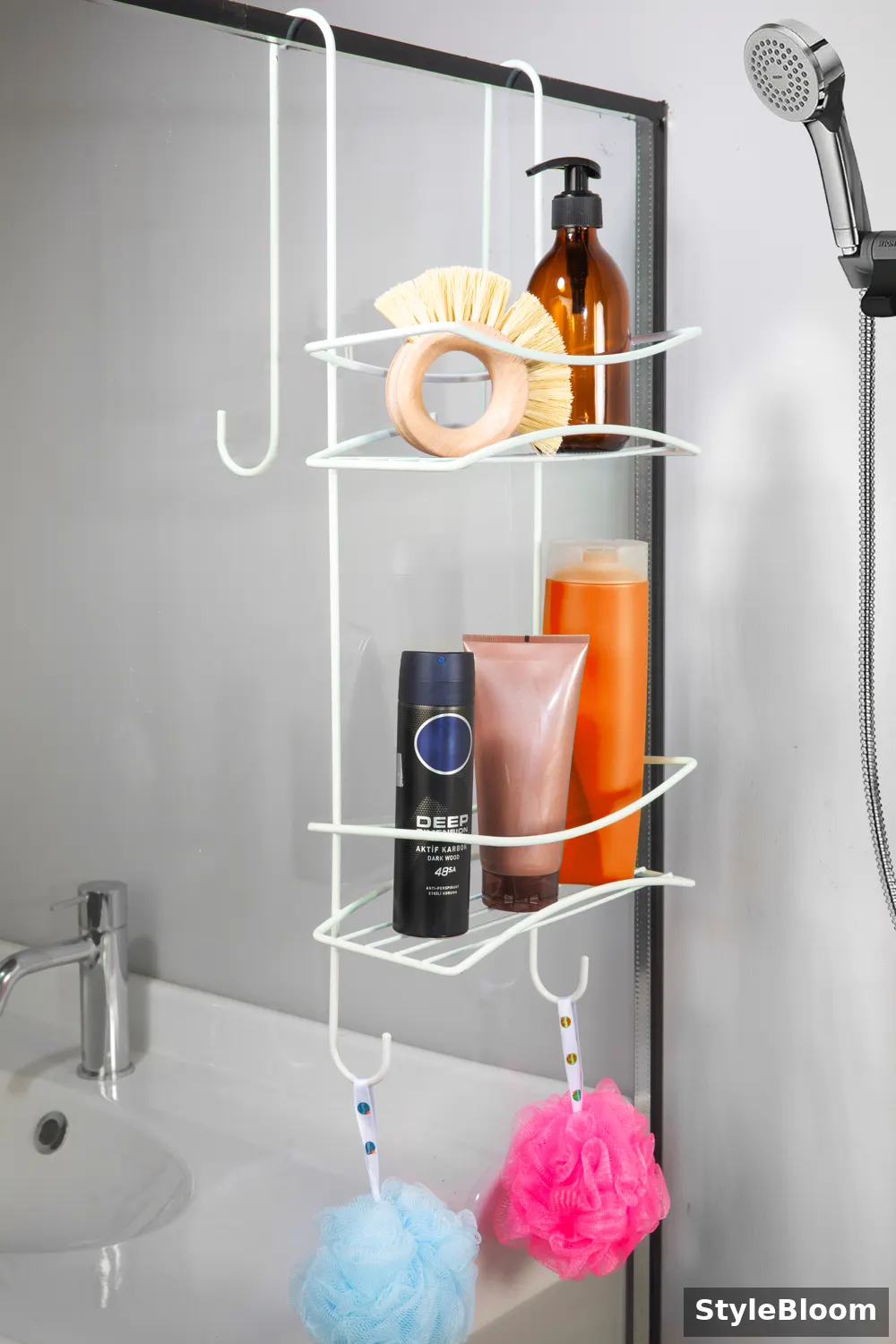
Hanging caddies are the zero-installation answer, and their limits are the price of that freedom. A caddy hooked over the showerhead arm swings when you reach for a bottle, puts its weight on one arm, and sits in or near the spray path, so its contents get wet whether you want them to or not. That matters less for a small kit of two or three bottles and more for a large kit, and most for households where someone yanks rather than lifts. If your shower has a curtain rather than a door, over-the-door is not available to you. Buy hanging when you need something today, with no tools and no landlord conversation, and accept the swing as the trade.
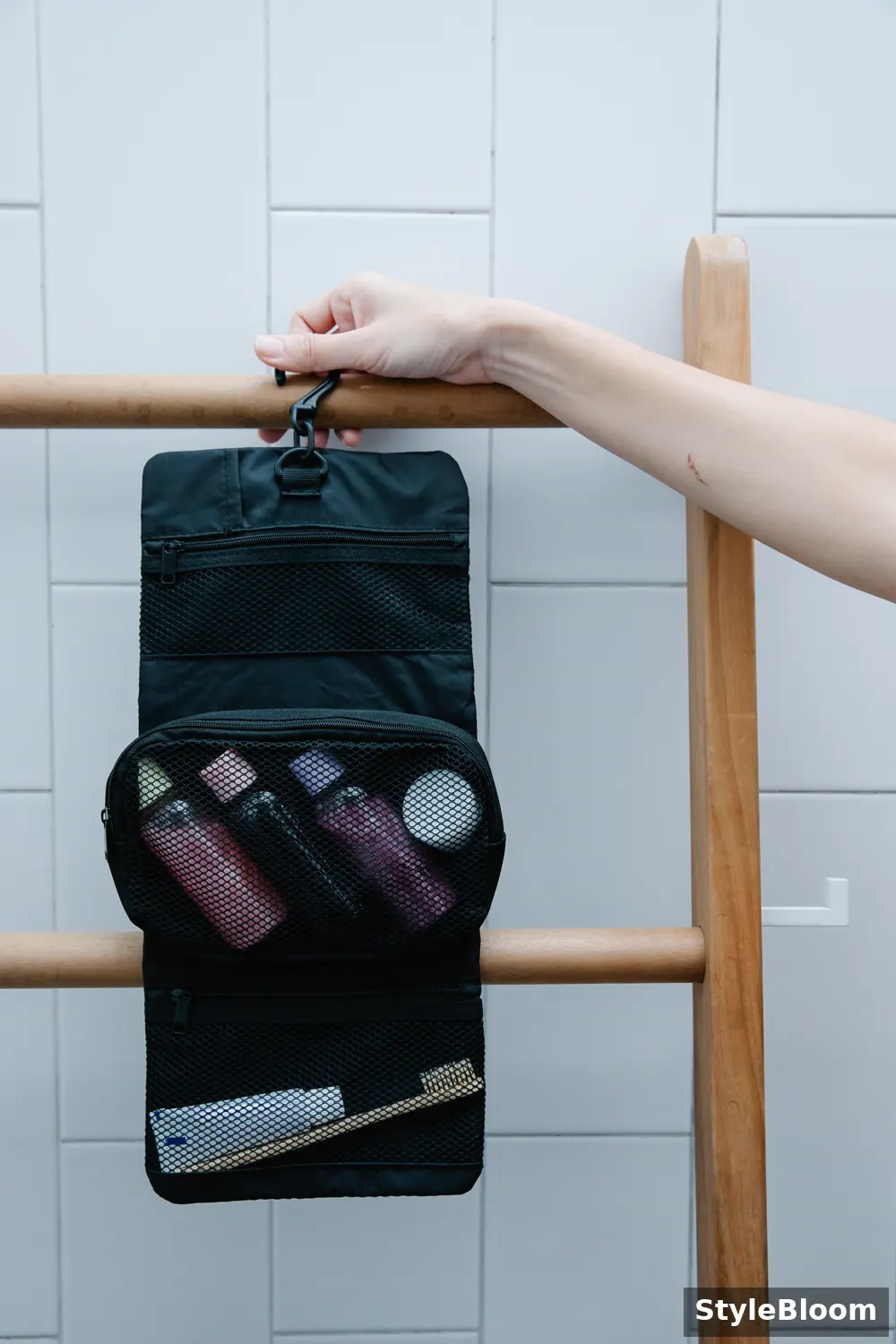
Freestanding stands and portable mesh caddies are the nothing-at-all options, and they deserve more respect than they get. A freestanding corner stand needs floor space, which small tub-shower combos do not have, but in a walk-in shower it is the only type that requires no wall, no ceiling, and no arm, and it moves when you remodel. A portable mesh caddy, meanwhile, is the right organizer for anyone whose shower is not theirs alone: dorm residents, gym users, guests, and families with a shared bathroom where each kit lives in its own room. Its mesh drains, it dries fast, and it hangs on a hook. It will never hold as much as a tension pole, and it is not supposed to.
Stainless steel is the material most guides recommend, and the recommendation needs a qualifier. Stainless steel resists rust far better than plain steel, but no stainless caddy in a permanently wet shower is rust-proof by name alone. What matters is the grade and finish the listing actually states, and how you maintain it: rinse it, let it drain, wipe it when you clean the shower. A stainless caddy that sits in pooled water will spot and stain, and one with a scratched coating will corrode at the scratch.
Plastic is the honest budget material, and its honesty is its virtue. Plastic will not rust, it is light, it is easy to clean, and it costs less. It will stain over time, especially white plastic in hard water, and cheap plastic can flex under a heavy kit or crack if it falls. For a kids bathroom, a dorm, or a second shower, plastic is often the smarter buy than stainless, because the caddy that gets replaced without regret is better than the expensive caddy that gets resented.
Silicone, bamboo, and wood sit at the edges, and each has a real use and a real limit. Silicone baskets are soft, quiet, and kind to tile, and they suit renters who fear scratches, but they hold less rigidly and can sag under tall bottles. Bamboo and wood look warm and spa-like in photos, and they are the worst choice for a permanently wet shower unless the listing clearly states a waterproof treatment and you are willing to dry the caddy regularly. Wood in a shower is a maintenance commitment, not a purchase, and most buyers who love the photo do not love the commitment. Mesh is the material of portability: it drains instantly, dries fast, and holds soft goods well, but it will not support heavy pump bottles rigidly, and its pockets stretch over time.
A note on finishes, because black caddies dominate search results and deserve a straight answer. A black finish, usually a coating over steel, looks sharp against white tile and hides water spots better than chrome. It also shows scratches more, and once the coating is scratched through to steel, that spot can corrode. If you buy black, buy it for the look and accept the maintenance: avoid abrasive cleaners, dry it after heavy use, and replace it when the coating fails rather than living with a rusting spot. A finish is a coating, not a property of the metal, and coatings wear.
Corner caddies exist because the corner is dead space in most showers, and using dead space is smart. But a corner caddy only works in a corner that is actually square, and many showers, especially fiberglass and acrylic surrounds, have corners that curve gently rather than meeting at a right angle. The book test from the measurements section is the whole diagnostic: if a square object rocks in your corner, a rigid corner caddy will rock too, and its adhesive will hold on one side while the other side floats, until it does not hold at all. Curved-corner buyers have three honest options: a tension pole, which does not care about the corner angle; a flat-wall adhesive caddy mounted on one wall rather than across the corner; or a hanging caddy. What they do not have is a corner caddy that will defy geometry.
Three-tier corner caddies deserve a specific warning, because they are the most searched corner type and the most often mis-bought. Three tiers sound like more storage, and they are, but they are also more height, more weight, and more leverage on the mount. A three-tier caddy loaded with full bottles is heavy, and its top shelf is often too high to reach comfortably or too close to the showerhead. Before buying three tiers, count your kit honestly: most single users need two tiers, most couples need two tiers with a soap dish and hooks, and three tiers earn their keep in households of three or more, or where one person has a long routine with many steps.
Hooks and holders are the small features that decide daily happiness, and they are worth checking on the listing rather than discovering later. A soap dish that drains, a razor hook that holds a razor without it sliding off, a hook for a washcloth or a loofah, and a holder that keeps a tall bottle from tipping: these are the features that separate a caddy you use from a caddy you fight. A bottle holder ring, the kind that grips a pump bottle by the neck, is genuinely useful for upside-down storage, but only if your bottle necks fit the ring, so check that diameter the same way you check the tall bottle.
The kit you buy for is the kit that decides the caddy, and most guides skip this question entirely. A single user with shampoo, conditioner, and body wash needs one shelf and a soap dish, and almost any type will do, which means the single user should buy on mount and material, not on capacity. A couple adds a second routine, and the honest answer is usually separate shelves or a two-tier caddy with a clear division, because sharing one shelf means one person's bottles migrate and the other person's get buried. Families with kids add small bottles, bath toys, and a washcloth population that multiplies, and they need hooks and a lower shelf the kids can reach, plus a caddy that tolerates being bumped.
Two groups deserve their own paragraphs because their needs are routinely ignored. The first is dorm and shared-bathroom users, whose problem is not storage but ownership: their kit must be identifiable, portable, and able to hang on a hook in a room, not just in a shower. For them, a mesh caddy with pockets, plus a small fixed hook in the shower for hanging it during use, beats any fixed caddy, and the organizer they need most is a routine: pack it, carry it, hang it, dry it, unpack it. The second is older adults and people with limited grip or reach, whose problem is access: bottles must be at a reachable height, easy to grip, and not require lifting a heavy caddy or reaching overhead. For them, a tension pole with shelves set at waist to chest height, or a freestanding stand with a low shelf, is safer than a high corner caddy, and pump bottles beat squeeze bottles for the same reason. A caddy that requires a stretch is a caddy that could cause a fall, and no storage gain is worth that.
Guests and gym users round out the picture. A guest bathroom needs a caddy that looks intentional but holds a small, generic kit: travel sizes, a spare razor, a washcloth, and nothing personal. A gym bag needs a mesh caddy that drains into a wet pocket and dries before the next visit, not a fixed caddy at all. Match the permanence of the caddy to the permanence of the user, and the purchase will feel right for as long as it lasts.
If you have read this far and still feel torn, use this table as the decision step. Find your situation, read across, and buy that type.
| Your situation | Buy this type | Why it wins here |
|---|---|---|
| Renter, smooth tiled corner | Adhesive stainless corner caddy | No drilling, strong hold, clean look |
| Renter, textured tile or stone | Hanging caddy or freestanding stand | Adhesive and suction both fail on texture |
| Owner, tiled corner, long-term | Adhesive or drilled stainless corner caddy | Strength and longevity matter most |
| Curved or fiberglass corner | Tension pole caddy | Ignores corner angle entirely |
| Household of three or more | Tension pole caddy | Only common type with a shelf per person |
| Single user, small kit | Adhesive single shelf or suction shelf | Capacity is not the constraint; mount is |
| Dorm or shared bathroom | Portable mesh caddy | Kit travels; nothing is left behind |
| Gym bag or guest bathroom | Portable mesh caddy | Temporary problem, temporary solution |
| Walk-in shower, no usable wall | Freestanding corner stand | Needs no wall, ceiling, or arm |
| Limited grip or reach | Tension pole at waist height or low stand | No overhead reaching, no heavy lifting |
It depends, always, on your shower, and that is not a dodge; it is the answer. Two buyers with the same budget and the same taste should buy different caddies if one has smooth tile and the other has textured stone, and a guide that ignores that difference is selling a product, not solving a problem.
Every shower caddy lives in the wettest room in the house, and every caddy that cannot drain will grow mold, mildew, or pink slime in its low spots. The listings call this easy to clean, which is true in the narrow sense that you can wipe it, and misleading in the sense that matters: a caddy that pools water will need wiping constantly, and a caddy that drains will need it rarely. When you compare listings, look at the bottom of every shelf. Open grids, drilled holes, and slatted bases drain; solid trays pool, and solid trays with a raised lip pool worse, because the lip that keeps bottles from sliding also keeps water from leaving.
The routine that prevents this is short, and it is the real cost of owning a shower caddy. Once a week, when you clean the shower, lift the contents of the caddy, rinse the shelves, and wipe the wall behind them, because the wall behind a caddy is the spot nobody cleans and where mold starts. Once a month, check the mounts: re-press suction cups, check adhesive edges for peeling, check tension pole shelves for sliding, and check hanging hooks for bending. Every few months, take the caddy down entirely and clean it properly, including the undersides and the wall behind it, and let both dry before remounting.
Two mold facts are worth stating plainly because listings never do. First, no material is mold-proof in a shower; stainless resists rust, not mold, and plastic resists rust, not mold, and mold grows on soap residue and skin oils, not on the caddy itself, so the caddy that never gets cleaned will grow mold whatever it is made of. If your caddy keeps going pink or black despite weekly cleaning, the problem is usually pooled water or poor ventilation in the bathroom, and the fix is drainage and airflow, not a new purchase.
"Adhesive will ruin my tile." It can damage weak grout, paint, or poorly bonded tile, and it can leave residue, but on glazed tile installed properly, quality adhesive pads remove cleanly with the method the instructions give, usually slow peeling, heat, or floss behind the pad. If your tile is already cracked, your grout is already crumbling, or your landlord has forbidden adhesives in writing, do not buy adhesive; buy hanging or freestanding, and skip the argument with physics and with your lease.
"Suction cups always fall." Not always, but often enough that you should plan for it. Suction falls when the surface is wrong, the cup is dirty, the kit is heavy, or hot shower steam lets the seal creep. If you buy suction, buy it for a light kit on glass or polished porcelain, keep the cups and the wall clean, re-press them weekly, and accept that re-pressing is part of owning the product.
"Tension poles damage ceilings." A pole presses, and pressing can mark a soft ceiling or a painted surface, especially if the pole is over-tightened or the ceiling is a panel rather than solid. Use the rubber feet the pole comes with, do not over-tighten past the point where the pole is firm, and check the ceiling monthly for marks. The pole is only as solid as what it presses against, and a flexing ceiling is a pole that will eventually slip.
"A caddy is a waste of money; I can use the tub edge." You can, and many people do, and the tub edge works until it does not: bottles fall in, the edge gets crowded, someone knocks a bottle into the tub, and the bottles that live on the edge stay wet underneath, which is where mold starts. A caddy is not a luxury; it is the difference between bottles with a home and bottles with a ledge. If your edge holds eight bottles and two of them fell this week, the caddy has already paid for itself in avoided breakage and avoided mildew.
"All the good ones are expensive." The price spread in this category is wide, and the expensive end buys finish, brand, and sometimes better steel, not a different kind of storage. A mid-range adhesive stainless caddy holds bottles exactly as well as a premium one, and the premium advantage is usually looks and longevity, not capacity. It holds shampoo. It should hold shampoo well, and then get out of the way.
Skip adhesive if your wall is textured, your grout is crumbling, your landlord forbids it, or you plan to move within months and cannot risk a mark. Skip suction if your tile is textured, your kit is heavy, or you will not re-press cups weekly. Skip a corner caddy if your corner is curved, if the book test rocks, or if your shower has no corner at all. Skip a tension pole if your ceiling is sloped, paneled, or flexible, or if your floor-to-ceiling height falls outside the pole's stated range. Skip a hanging caddy if your showerhead is a fixed overhead rain head with no arm, if your arm is square or oversized, or if your kit is heavy enough to swing dangerously. Skip three tiers if you are a single user with three bottles.
Skip any listing that promises it fits all showers, holds any weight, never rusts, or never falls. Those are not specifications; they are wishes, printed in bold. The honest listings are the ones with numbers and limits, because limits are what let you check fit before you buy.
The first week decides whether the caddy becomes part of the shower or part of the return pile, and the difference is installation patience. Day one is mounting day, and mounting day has one rule: follow the cure time. Clean the wall, dry it, mount the caddy, and leave it empty for the time the instructions state, usually a day for adhesive. The temptation to load it immediately is the single biggest cause of early failure, and resisting it is free. While it cures, decide what lives in it, and be ruthless: the daily kit only, not the aspirational kit, not the bottles you might use someday, not the free samples. A caddy loaded with the daily kit feels generous; a caddy loaded with everything feels crowded, and crowded caddies get knocked over.
Days two to seven are the settling week. Load the daily kit, heaviest bottles lowest, tallest bottles where the shelf spacing allows, soap in the draining dish, razor on its hook, washcloth on its hook and not draped over a shelf where it blocks drainage. Use the shower normally and notice three things: does anything swing, slide, or crowd the spray; does water pool anywhere; and can everyone who showers here reach what they need without stretching. If something swings, redistribute weight lower. If water pools, check that the shelf drains and that the caddy is level. If someone stretches, move a shelf or move the caddy.
By the end of week one, the win looks like this: every daily bottle has a spot, nothing falls when you reach, the soap dish drains, the wall behind the caddy is still clean, and you no longer think about the caddy at all. A good organizer disappears into the routine, and the week you stop noticing it is the week it has done its job.
After the first week, the caddy needs a routine, and the routine is the same one from the drainage section, kept honestly. Weekly, rinse and wipe, and wipe the wall behind it. Monthly, check mounts and shelf locks. Every few months, take it down, clean it fully, and let wall and caddy dry before remounting. Rotate your products as you do it: move the bottle you are about to finish to the front, move the backup to the back, and throw out the bottle that has lived in the shower for a year and congealed around the cap.
Replacement signs are straightforward, and they are worth knowing so you do not keep a caddy past its useful life out of guilt. Replace it when adhesive pads no longer hold after cleaning and re-pressing, when suction cups are warped or cracked, when a tension pole spring no longer holds firm, when a hanging hook is bent, when stainless has corroded through its coating in several spots, when plastic is cracked or bowed, or when mesh pockets have stretched so far that bottles slide through. Also replace it when your household changes: a new baby, a new roommate, a move to a new shower, or a routine that doubled in size are all reasons to re-measure and re-buy, not reasons to force the old caddy to do a job it was not bought for. A caddy is a small purchase, and replacing it at the right time is cheaper than living with one that falls.
Removal, for renters, deserves its own paragraph, because it is the moment adhesive caddies are judged. Remove slowly, following the instructions: peel at the angle stated, use heat or floss if the instructions say so, and clean residue with the method the instructions recommend, usually warm water or rubbing alcohol, not a scraper. Photograph the wall before you mount and after you remove, so a deposit dispute has evidence rather than argument. Plan for removal at purchase, and removal will not surprise you at move-out.
Use these search links to compare types side by side on Amazon. Each link is a search, not a single product, so you can filter by the mount, material, and shelf spacing your measurements demand, and check the listing's stated size and fit before you buy.
Search results for shower caddies are full of noise, and the noise has patterns worth naming so you can skip it faster. Store names appear constantly: people search for a shower caddy organizer at IKEA or Walmart because they picture the store, not because the store changes the decision. The decision is still mount, material, and measurements, and a store house brand is judged by the same three things as any other caddy.
"Near me" searches deserve the same honesty. A near-me result tells you a store exists near you, not that it stocks the type you need, and calling ahead saves a wasted trip. If you do buy in person, open the box in the store if the store allows it, and check the mount hardware and shelf spacing against your numbers before you leave, because the return trip costs more time than the check. Pinterest idea searches are a different kind of noise: they are useful for layout inspiration, for seeing how other people arrange a small shower, and for discovering types you had not considered, but an inspiration photo is not a specification. A photo cannot tell you the corner angle, the shelf spacing, or the mount, and a caddy that looks perfect in a styled photo can still fail your book test.
As of the guide date, October 28, 2026, this guide states no prices, no ratings, no review counts, and no per-product specifications — no dimensions, capacities, load ratings, or rust-proof guarantees — because those numbers belong to the listing you actually buy from, checked against your own measurements.
For most people with a standard tiled shower, an adhesive stainless-steel corner caddy is the best starting point: it holds well without drilling, does not depend on a suction seal, and does not swing like a hanging caddy. Curved corners call for a tension pole, textured tile calls for hanging or freestanding, and large households call for a tension pole with a shelf per person.
On properly installed glazed tile, quality adhesive pads usually remove cleanly if you follow the instructions and peel slowly, but they can damage weak grout, paint, or poorly bonded tile, and they can leave residue. Read the removal instructions before you mount, and do not use adhesive if your landlord forbids it or your grout is already crumbling.
Suction cups fall when the surface is textured, the cup or wall is dirty, the kit is heavy, or hot shower steam lets the seal creep over time. Suction works best for a light kit on smooth glass or polished porcelain, with cups re-pressed weekly. If your tile is textured or your kit is heavy, adhesive, tension pole, or hanging will hold better.
Usually not. A rigid corner caddy needs a square corner, and fiberglass and acrylic surrounds often curve gently instead. Press a square object into the corner: if it rocks or gaps, your corner is not square, and a corner caddy will hold on one side and float on the other. Use a tension pole, a flat-wall adhesive caddy on one wall, or a hanging caddy instead.
Buy a caddy that drains, with open grids or drilled shelf bottoms and a draining soap dish, and clean it weekly: rinse the shelves, wipe the wall behind the caddy, and let both dry. No material is mold-proof, because mold grows on soap residue and skin oils, not on the caddy itself, so regular cleaning matters more than the material you choose.
Measure your tallest bottle with its pump up and compare that height to the shelf spacing on the listing, not to the total height of the caddy. Count your daily kit honestly: one person usually needs one shelf and a soap dish, a couple needs two tiers, and a household of three or more usually needs a tension pole with adjustable shelves.
No stainless caddy in a permanently wet shower is rust-proof by name alone. Stainless steel resists rust far better than plain steel, but pooled water, scratched coating, and lack of cleaning will still spot and stain it. Check the stated grade and finish, rinse and dry the caddy regularly, and treat any rust-proof claim as marketing, not measurement.
Yes. Adhesive, suction, hanging, tension pole, and freestanding types all install without drilling. The renter's real question is removal: read the adhesive removal instructions before mounting, photograph the wall before and after, and choose hanging or freestanding if your lease forbids anything stuck to the tile.
A portable mesh caddy is the best answer for a dorm or shared bathroom, because the kit travels with you, drains fast, dries fast, and hangs on a hook in your room. Pair it with a small fixed hook in the shower for hanging during use, and keep the routine simple: pack it, carry it, hang it, dry it, unpack it.
It depends on the mount and the stated load limit of the listing, which you should check before buying rather than trusting a general number. Adhesive and tension pole types generally hold more than suction or hanging types, and loading heavy bottles low and keeping the total kit small matters more than chasing the highest stated limit, because stated limits assume a perfect surface.
Most single users do not, and most couples do not either. Three tiers earn their keep in households of three or more, or where one person has a long routine with many steps. Extra tiers add height, weight, and leverage on the mount, so buy the tiers your kit actually needs rather than the tiers that look impressive in a photo.
Once a week, lift the contents, rinse the shelves, wipe the wall behind the caddy, and let both dry. Every few months, take the caddy down entirely, clean the undersides and the wall behind it, and remount only when both are dry. Check mounts monthly: re-press suction cups, check adhesive edges, check tension pole shelf locks, and check hanging hooks for bending.
Black finishes hide water spots better than chrome but show scratches more, and once the coating is scratched through to steel, that spot can corrode. Avoid abrasive cleaners, dry the caddy after heavy use, and replace the finish when the coating fails rather than living with a rusting spot.
Buy wherever you can check the decision honestly. A store brand is judged by the same three things as any online caddy: mount, material, and measurements. Take your four measurements to the store, check shelf spacing and mount type on the box before you buy, and call ahead, because a store listing is not a promise that your store stocks the type you need.
Replace it when adhesive no longer holds after cleaning, suction cups are warped or cracked, a tension pole spring no longer holds firm, a hanging hook is bent, stainless has corroded through its coating in several spots, plastic is cracked or bowed, or mesh pockets have stretched so bottles slide through. Also re-measure and re-buy when your household changes, such as a move, a new roommate, or a routine that doubled in size.
Buy the mount first and the caddy second. If your shower is a standard tiled corner and you rent or simply do not want to drill, buy an adhesive stainless-steel corner caddy, mount it on flat tile after the cure time, and load only the daily kit. If your corner is curved, your tile is textured, or your household is large, buy a tension pole and set its shelves around your actual bottles. If your shower is shared, temporary, or someone else's, buy a portable mesh caddy and let it travel.
A shower caddy is a small purchase, and that is exactly why it deserves a careful one: the wrong small purchase is the one that falls at two in the morning, grows mold in its low spots, and gets bought again. Buy the right type once, rinse it weekly, and let a dry, quiet shower be the review that matters.